Do you need an International Driving Permit to drive in Denmark?
This is a private translation, not a government-issued permit. If Denmark requires the official document for your specific situation, confirm with its motor authority before you order.


Sourced from the 1949 Geneva & 1968 Vienna Conventions and rental-network policies
What the rules require
When do you need an IDP in Denmark?
Denmark drives on the right with daytime headlights required year-round; non-EU visitors should carry an IDP with their licence.
Does renting a car in Denmark require an IDP?
Copenhagen desks ask for an IDP for non-EU licences. Having your permit ready avoids losing your reservation at the counter.
Driving rules in Denmark you should know
- Daytime running lights mandatory.
- Watch for cyclists at junctions.
- 0.05% alcohol limit.
- Warning triangle required.
How long is an IDP valid in Denmark?
Denmark honours both the 1949 Geneva and 1968 Vienna Convention formats. A 1949-format IDP is valid for up to 1 year; a 1968-format IDP can be valid for up to 3 years, or until your national licence expires. If you travel regularly, the validity clock starts on the issue date, not on first use — so order close to your departure to maximise usable time.
Documents checklist for driving in Denmark
- Your original national driving licence — the IDP is a translation and is never valid on its own.
- Your International Driving Permit, prepared in the 1949 Geneva and 1968 Vienna Convention format that Denmark recognises.
- Your passport or accepted national ID for police checks and rental pick-up.
- For rentals: the credit card used for the booking and your rental agreement (it covers the registration and insurance papers).
- Local currency or a card for road costs — Denmark uses the DKK.
Driving in Denmark: the practical detail
Sourced from national road authorities, motoring clubs and rental policies — the things that actually catch foreign drivers out.
Driving on a foreign licence
EU/EEA licences are fully valid; non-EU visitors may drive on a valid home licence for tourist stays and should carry an International Driving Permit where the licence is not in Latin script or English. Minimum driving age is 18, and rental firms usually require age 20-21+.
Tolls & road charges
Denmark has no motorway tolls or vignette; charges apply only at two bridges - the Storebaelt/Great Belt (Funen-Zealand) at about DKK 260 one-way for a car, and the Oresund bridge to Sweden at about DKK 540. Pay by card or automatic plate recognition at the toll plaza; no booking needed.
Parking in the cities
Towns use paid zones via apps (EasyPark, ParkMan) and pay-and-display; a parking disc on the dashboard is required in free time-limited bays - available at petrol stations and kiosks. Copenhagen parking is expensive and restricted, with zones signposted and active enforcement.
Winter & seasonal rules
No mandatory winter-tyre rule currently - a law making winter tyres compulsory 1 Nov-31 Mar was passed in 2025 but takes effect from November 2026. Winter tyres are strongly recommended, and you must clear all snow and ice from the car before driving.
Fuel & filling up
Stations sell 95/98 octane petrol (Blyfri) and diesel and are mostly unmanned self-service with card/contactless payment; some require a chip-and-PIN card. Fuel is expensive, around DKK 14-15 per litre, and rural stations can be far apart.
If you have an accident
Call 112 for emergencies/injury; for minor damage exchange details and complete a European Accident Statement. Do not leave the scene, and report to police where there is injury, dispute, or a parked/unidentified other party.
Driving in the capital
Copenhagen has heavy bicycle traffic with dedicated cycle lanes alongside the road - always check the bike lane before turning right or opening a door, as cyclists have priority and the city centre has limited, costly parking.
Fines & enforcement
Speeding fines are steep and percentage-based on the overage, easily exceeding DKK 2,000, with gross speeding risking vehicle confiscation; the alcohol limit is 0.5 g/l. Speed cameras and police are active, and rental companies forward camera fines to the renter with a handling fee.
A drive worth taking
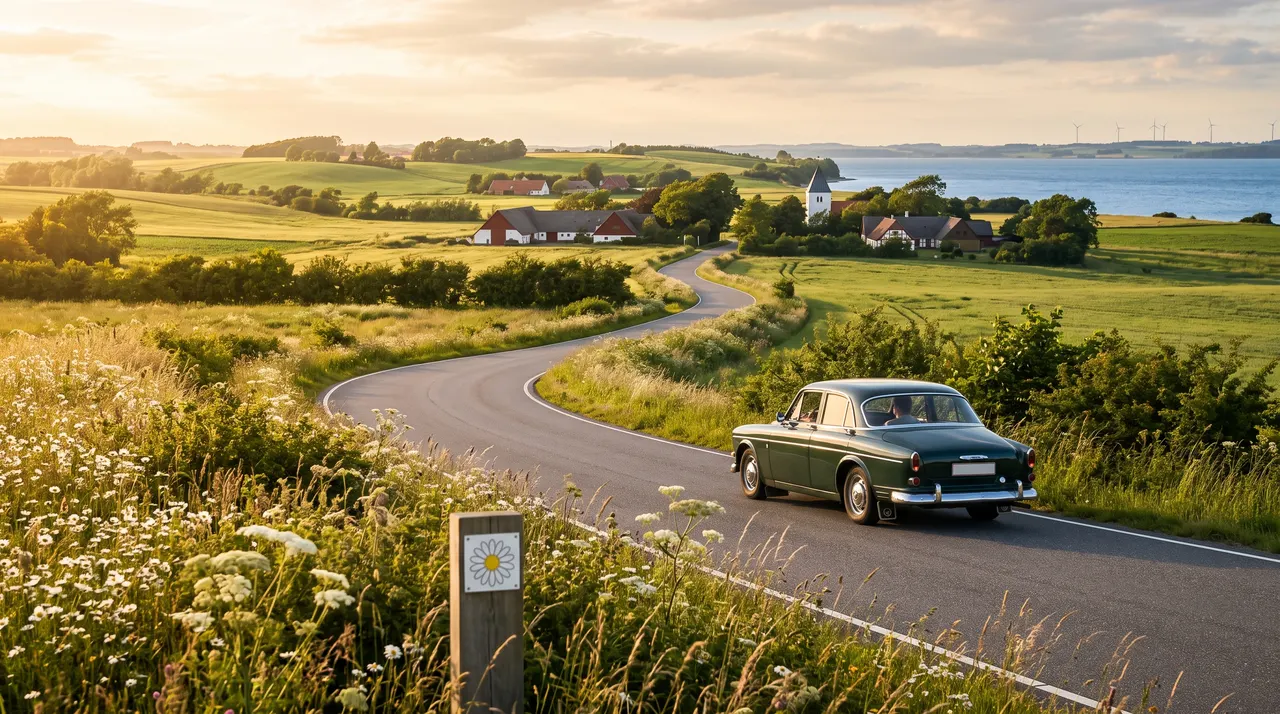
The Marguerite Route (Margueritruten), a network of signed scenic roads winding past castles, coast and countryside across the country, is the classic Danish touring drive.
Sources: rac.co.uk · tollguru.com · tyremap.com · danishnet.com
Denmark · common questions
What rental desks in Denmark ask foreign drivers for
| Rental company | Policy for foreign licences in Denmark |
|---|---|
| Hertz | Asks foreign drivers for a licence translation when the licence is not printed in the Roman alphabet, and often for non-EU renters in much of Europe. |
| Enterprise | Asks for a licence translation alongside your home licence in many countries across Europe, Asia and South America. |
| Alamo | Asks for a licence translation when the licence is in a non-Latin alphabet, and suggests one for all international renters. |
| Budget | Asks for a licence translation when your licence is not in the Roman alphabet. |
| National | Asks for a licence translation for non-Latin-alphabet licences and where local rules call for one. |
| Thrifty | Asks for a licence translation in select countries and for non-Roman-alphabet licences. |
| Sixt | Asks for a licence translation for licences issued outside the EU and not in the Roman alphabet. |
| Avis | Asks for a licence translation where the national licence is not in the Roman alphabet or where local rules call for one. |
Copenhagen desks ask for an IDP for non-EU licences. Minimum rental age in Denmark is typically 18+, with a young-driver surcharge usually applied under 25.