Do you need an International Driving Permit to drive in Sweden?
This is a private translation, not a government-issued permit. If Sweden requires the official document for your specific situation, confirm with its motor authority before you order.


Sourced from the 1949 Geneva & 1968 Vienna Conventions and rental-network policies

What the rules require
When do you need an IDP in Sweden?
Sweden drives on the right with daytime headlights mandatory year-round; non-EU visitors should carry an IDP, and the alcohol limit is among Europe's lowest.
Does renting a car in Sweden require an IDP?
Stockholm desks request an IDP for non-EU licences. Having your permit ready avoids losing your reservation at the counter.
Driving rules in Sweden you should know
- Daytime headlights mandatory at all times.
- 0.02% alcohol limit — near zero.
- Winter tyres mandatory Dec–Mar.
- Congestion tax in Stockholm and Gothenburg.
How long is an IDP valid in Sweden?
Sweden honours both the 1949 Geneva and 1968 Vienna Convention formats. A 1949-format IDP is valid for up to 1 year; a 1968-format IDP can be valid for up to 3 years, or until your national licence expires. If you travel regularly, the validity clock starts on the issue date, not on first use — so order close to your departure to maximise usable time.
Documents checklist for driving in Sweden
- Your original national driving licence — the IDP is a translation and is never valid on its own.
- Your International Driving Permit, prepared in the 1949 Geneva and 1968 Vienna Convention format that Sweden recognises.
- Your passport or accepted national ID for police checks and rental pick-up.
- For rentals: the credit card used for the booking and your rental agreement (it covers the registration and insurance papers).
- Local currency or a card for road costs — Sweden uses the SEK.
Driving in Sweden: the practical detail
Sourced from national road authorities, motoring clubs and rental policies — the things that actually catch foreign drivers out.
Driving on a foreign licence
EU/EEA licences are fully valid; tourists who are not entered in the Swedish population register may drive on any valid foreign licence (with a translation/IDP if not in Latin script) for their whole visit. Non-EEA residents who register fall under a one-year limit.
Tolls & road charges
Stockholm and Gothenburg levy a congestion tax at camera stations on weekdays, plus bridge tolls (Oresund, Sundsvall, Motala); foreign-registered cars are billed via the EPASS24 partner, and rental firms typically pass charges on with a fee.
Parking in the cities
Urban parking is paid and zone-based, usually via apps (EasyPark, Parkster, Mobill) or meters; watch cleaning-day and residential signs, and illegal parking fines reach about SEK 1,400 (~EUR 125).
Winter & seasonal rules
Winter tyres are mandatory from 1 December to 31 March when roads are wintry; studded tyres are allowed 1 October-15 April (and otherwise in winter conditions), with un-studded all-season tyres permitted year-round.
Fuel & filling up
Petrol (95) runs around EUR 1.59/litre and diesel about EUR 1.85/litre; stations are overwhelmingly self-serve and card-operated, with many unmanned pumps that may not accept all foreign cards.
If you have an accident
Call 112 for injuries; exchange details and complete a European Accident Statement for minor crashes, and report to police if there are injuries, disputed fault, or damage to public property or wildlife (a duty to report animal collisions applies).
Driving in the capital
Central Stockholm's congestion-tax cordon is charged on entry and exit on weekdays, and the compact, bridge-linked Gamla Stan old town has heavy pedestrian and one-way restrictions best avoided by car.
Fines & enforcement
Speeding even 1 km/h over is finable, starting around SEK 2,000 and rising by band; holding a phone while driving is prohibited, seatbelts are compulsory, and police issue fixed on-the-spot fines.
A drive worth taking
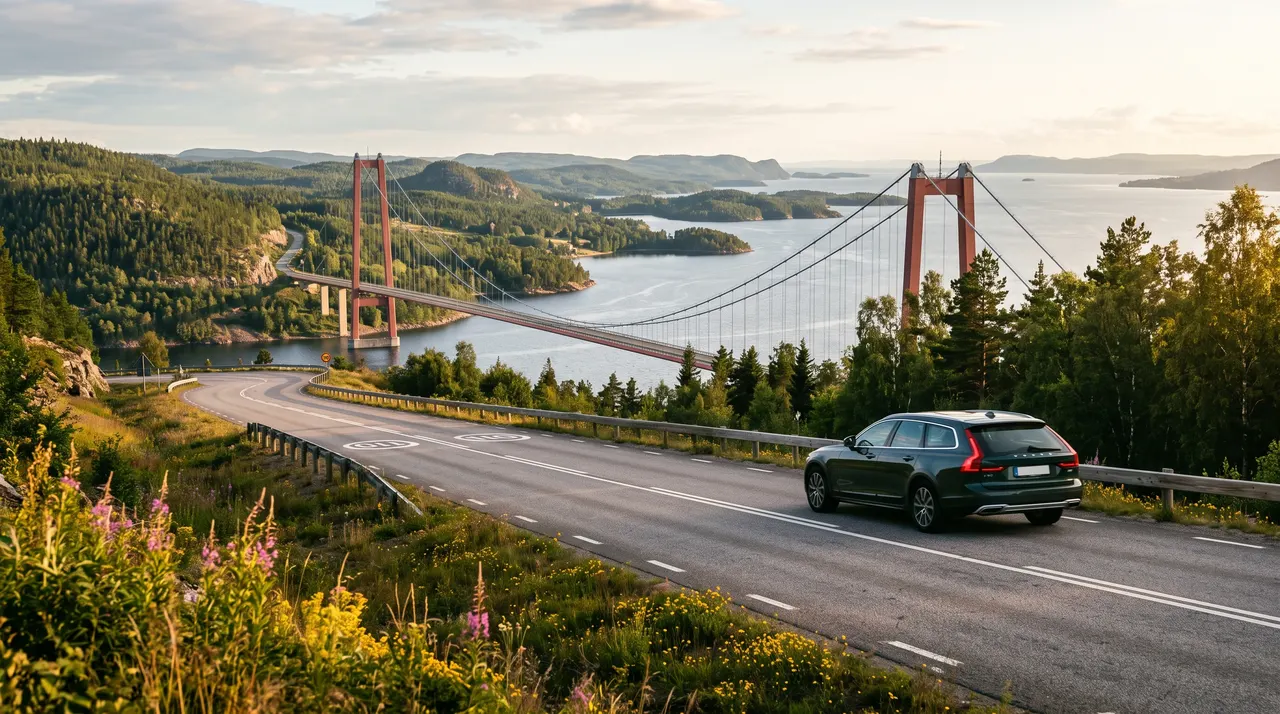
The High Coast (Hoga Kusten) drive along the E4 and Bridge in northern Sweden offers dramatic Gulf-of-Bothnia coastline.
Sources: transportstyrelsen.se · transportstyrelsen.se · polisen.se · fuel-prices.eu
Sweden · common questions
What rental desks in Sweden ask foreign drivers for
| Rental company | Policy for foreign licences in Sweden |
|---|---|
| Hertz | Asks foreign drivers for a licence translation when the licence is not printed in the Roman alphabet, and often for non-EU renters in much of Europe. |
| Enterprise | Asks for a licence translation alongside your home licence in many countries across Europe, Asia and South America. |
| Alamo | Asks for a licence translation when the licence is in a non-Latin alphabet, and suggests one for all international renters. |
| Budget | Asks for a licence translation when your licence is not in the Roman alphabet. |
| National | Asks for a licence translation for non-Latin-alphabet licences and where local rules call for one. |
| Thrifty | Asks for a licence translation in select countries and for non-Roman-alphabet licences. |
| Sixt | Asks for a licence translation for licences issued outside the EU and not in the Roman alphabet. |
| Avis | Asks for a licence translation where the national licence is not in the Roman alphabet or where local rules call for one. |
Stockholm desks request an IDP for non-EU licences. Minimum rental age in Sweden is typically 18+, with a young-driver surcharge usually applied under 25.