 China licence
  Bhutan
Can you drive in Bhutan with a China license?
Short answer: to drive in Bhutan with a China license you need an International Driving Permit in the 1949 Geneva format, carried together with your China license.
Yes — to drive in Bhutan on a China licence you should carry an International Driving Permit together with your China licence. Bhutan expects foreign drivers to hold an IDP.
Mainland China is not party to the IDP conventions, so Chinese drivers typically obtain a temporary local licence in the destination country. Your International Driving Permit is a certified multilingual translation of your existing licence, prepared in the 1949 Geneva format and carried alongside your national licence.


What driving in Bhutan is like
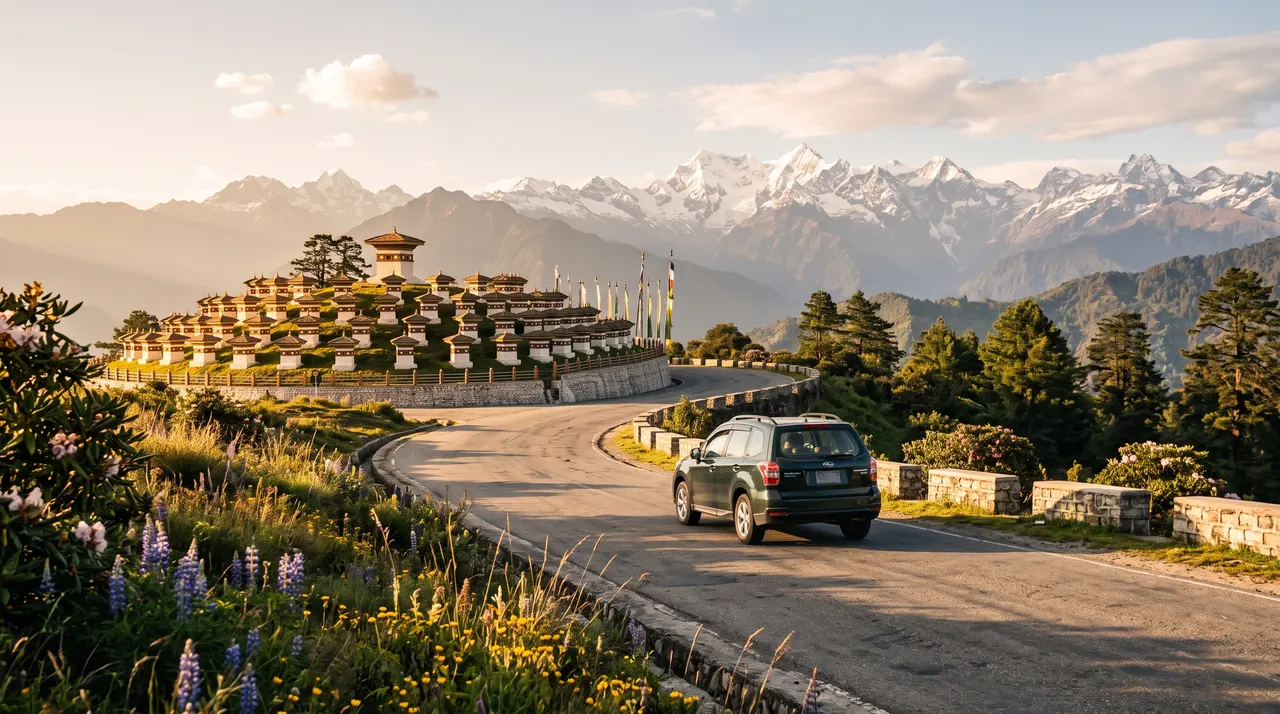
The drive from Thimphu to Punakha over Dochula Pass (3,100 m), lined with 108 chortens and panoramic Himalayan views, is Bhutan's signature road journey. For most visitors the real draw is the freedom to reach places trains and tours don't, on your own schedule, with the open road generally capped around 50 km/h mountain roads (national cap). Getting behind the wheel is the easy part: your International Driving Permit is a certified translation of your China licence, carried alongside it, so rental staff and officials in Bhutan can read your credentials at a glance.
What applies to China licence holders in Bhutan
| China licence in Bhutan | |
|---|---|
| Do you need an IDP? | Yes — carry one alongside your licence |
| IDP format required | 1949 Geneva |
| Your China licence script | Not in the Roman alphabet — an IDP translation is expected |
| China is party to | Neither IDP convention |
| Drives on the | Left-hand side |
| Minimum driving age | 18 |
| Emergency number | 113 (police), 112 (ambulance) |
| Top speed limit | 50 km/h mountain roads (national cap) |
| Currency | BTN |
Driving rules in Bhutan you should know
- Drive on the left on narrow mountain roads.
- Strict speed limits on switchbacks.
- 0.0% alcohol tolerance.
- Carry passport, IDP and permits.
Local driving facts in Bhutan
Emergency number: 113 (police), 112 (ambulance) (112 also connects from most mobiles). Typical maximum for cars on the fastest road class: 50 km/h mountain roads (national cap). Posted limits always take precedence.
Tolls & road charges in Bhutan
Bhutan has no expressway toll or vignette system; road use is free, though tourists pay the government Sustainable Development Fee separately as part of entry, not at any road booth.
Parking in Bhutan
In Thimphu use the marked municipal parking bays near landmarks such as Clock Tower Square, Tashichho Dzong and Buddha Dordenma, where attendants collect a small hourly fee; unauthorised parking is fined by the Thimphu Thromde.
Penalties & enforcement in Bhutan
Police strictly enforce seatbelt, speed and drink-driving laws with on-the-spot fines; urban limit is 50 km/h, rural 80 km/h. Drink-driving and reckless driving on cliff roads draw heavier penalties and possible licence action.
If you have an accident in Bhutan
Dial 113 for police and 112 for ambulance; do not move the vehicles after a serious crash and wait for police, as a police report is required and fault can carry compensation liability.
City driving in Bhutan
Thimphu is famously the only capital with no traffic lights - a white-gloved policeman directs traffic by hand at the main Norzin Lam junction, and roads are narrow with steep gradients.
Winter driving in Bhutan
Mountain passes such as Dochula and Thrumshingla can ice and snow in winter (roughly Dec-Feb); chains or snow tyres may be needed at altitude, while monsoon (Jun-Sep) brings landslides and closures.
Fuel in Bhutan
Stations sell petrol and diesel and are attendant-served; they are sparse outside towns, so refuel in Thimphu, Paro or Wangdue before long mountain stretches and carry cash (ngultrum/Indian rupee).
Sources: travel.state.gov, tyremap.com, drukasia.com, thimphu.gov.bt