 China licence
  Bolivia
Can you drive in Bolivia with a China license?
Short answer: to drive in Bolivia with a China license you need an International Driving Permit in the 1968 Vienna format, carried together with your China license.
Yes — to drive in Bolivia on a China licence you should carry an International Driving Permit together with your China licence. Bolivia expects foreign drivers to hold an IDP.
Mainland China is not party to the IDP conventions, so Chinese drivers typically obtain a temporary local licence in the destination country. Your International Driving Permit is a certified multilingual translation of your existing licence, prepared in the 1968 Vienna format and carried alongside your national licence.


What driving in Bolivia is like
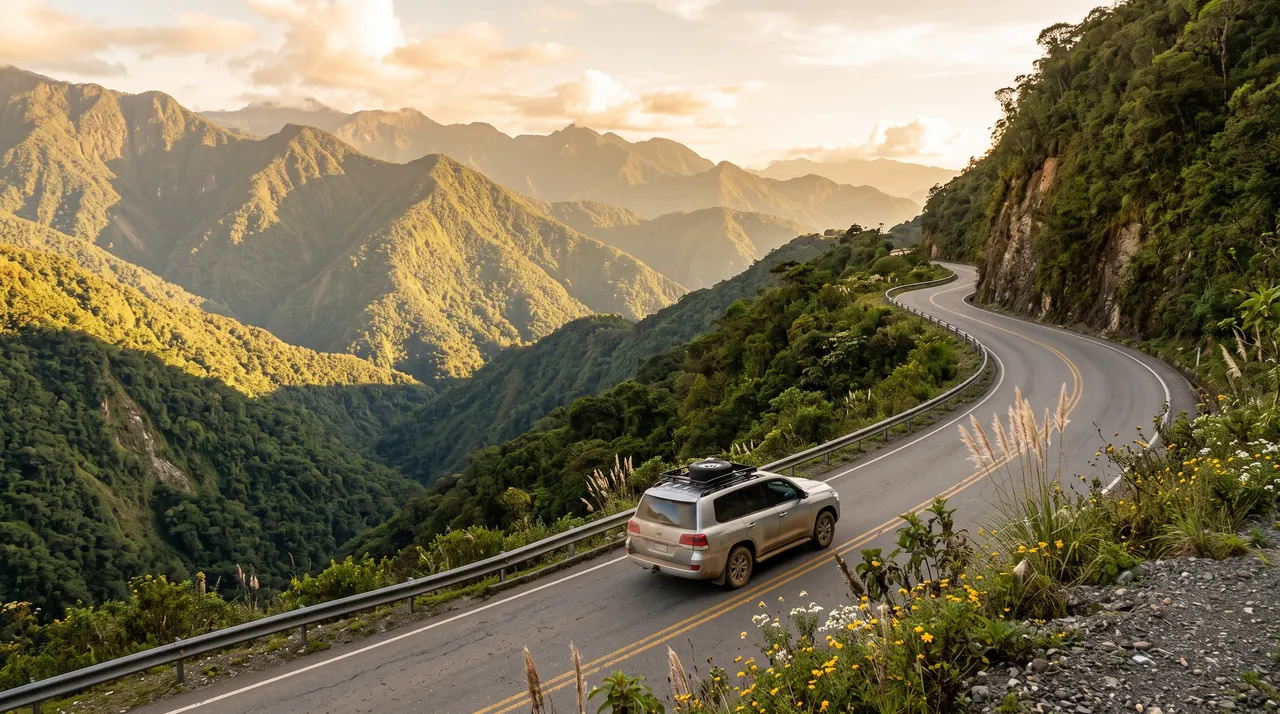
The Yungas Road from La Paz to Coroico, the infamous 'Death Road', is the country's most-searched drive (the old route now mainly used by cyclists, with a safer paved bypass for cars). For most visitors the real draw is the freedom to reach places trains and tours don't, on your own schedule, with the open road generally capped around 80–100 km/h highways. Getting behind the wheel is the easy part: your International Driving Permit is a certified translation of your China licence, carried alongside it, so rental staff and officials in Bolivia can read your credentials at a glance.
What applies to China licence holders in Bolivia
| China licence in Bolivia | |
|---|---|
| Do you need an IDP? | Yes — carry one alongside your licence |
| IDP format required | 1968 Vienna |
| Your China licence script | Not in the Roman alphabet — an IDP translation is expected |
| China is party to | Neither IDP convention |
| Drives on the | Right-hand side |
| Minimum driving age | 18 |
| Emergency number | 110 (police) |
| Top speed limit | 80–100 km/h highways |
| Currency | BOB |
Driving rules in Bolivia you should know
- Drive on the right.
- High altitude affects engine and driver performance.
- 0.07% alcohol limit.
- Carry passport, IDP and home licence.
Local driving facts in Bolivia
Emergency number: 110 (police) (112 also connects from most mobiles). Typical maximum for cars on the fastest road class: 80–100 km/h highways. Posted limits always take precedence.
Tolls & road charges in Bolivia
Most major intercity highways have toll plazas (peajes) operated by ABC and local administrations; charges are modest (a few bolivianos to ~20 Bs) and must be paid in cash, as cards are rarely accepted.
Parking in Bolivia
In central La Paz and Santa Cruz, paid on-street parking is managed by municipal zones and parqueo attendants; illegal or double-parked cars in congested centres can be wheel-clamped or towed, so use guarded lots (playas de estacionamiento).
Penalties & enforcement in Bolivia
Fines for speeding, no seatbelt or using a phone are issued by transit police, often expected on the spot in cash; rental firms pass on any camera or unpaid fines by charging the card on file plus an admin fee.
If you have an accident in Bolivia
Call the Policia Nacional on 110 (or 911 in some cities) and the ambulance on 118; do not move vehicles until the transit police arrive and a report is filed, as the official accident report is required for any insurance or rental claim.
City driving in Bolivia
La Paz traffic is chaotic and steeply graded; many central streets are controlled by 'zebras' (costumed crossing volunteers) rather than signals, and the linked El Alto–La Paz autopista charges a toll.
Winter driving in Bolivia
No winter-tyre rules - tropical/Andean climate, but high-altitude passes (e.g. La Cumbre above La Paz) can get snow, ice and fog, so carry chains only if crossing the Cordillera in winter.
Fuel in Bolivia
State firm YPFB sells Gasolina Especial (~6.96 Bs/L), Gasolina Premium (~11 Bs/L) and Diesel Oil (~9.80 Bs/L); subsidised local prices are low but foreigners are sometimes charged a higher non-subsidised rate, and many rural stations take cash only.
Sources: ypfb.gob.bo, internationaldriversassociation.com, tyremap.com, internationaltravelpermits.com