 Australia licence
  Fiji
FijiCan you drive in Fiji with an Australia license?
Short answer: you can drive in Fiji with an Australia license; an International Driving Permit is recommended and is carried alongside your Australia license.
An International Driving Permit is recommended (not strictly required) for Australia licence holders driving in Fiji. Your Australia licence is in the Roman alphabet, but an IDP removes any doubt at rental desks and roadside checks. Carry both.
Australian drivers should carry an International Driving Permit (1949 Convention) alongside their state licence when driving abroad. Your International Driving Permit is a certified multilingual translation of your existing licence, prepared in the 1949 Geneva format and carried alongside your national licence.


What driving in Fiji is like
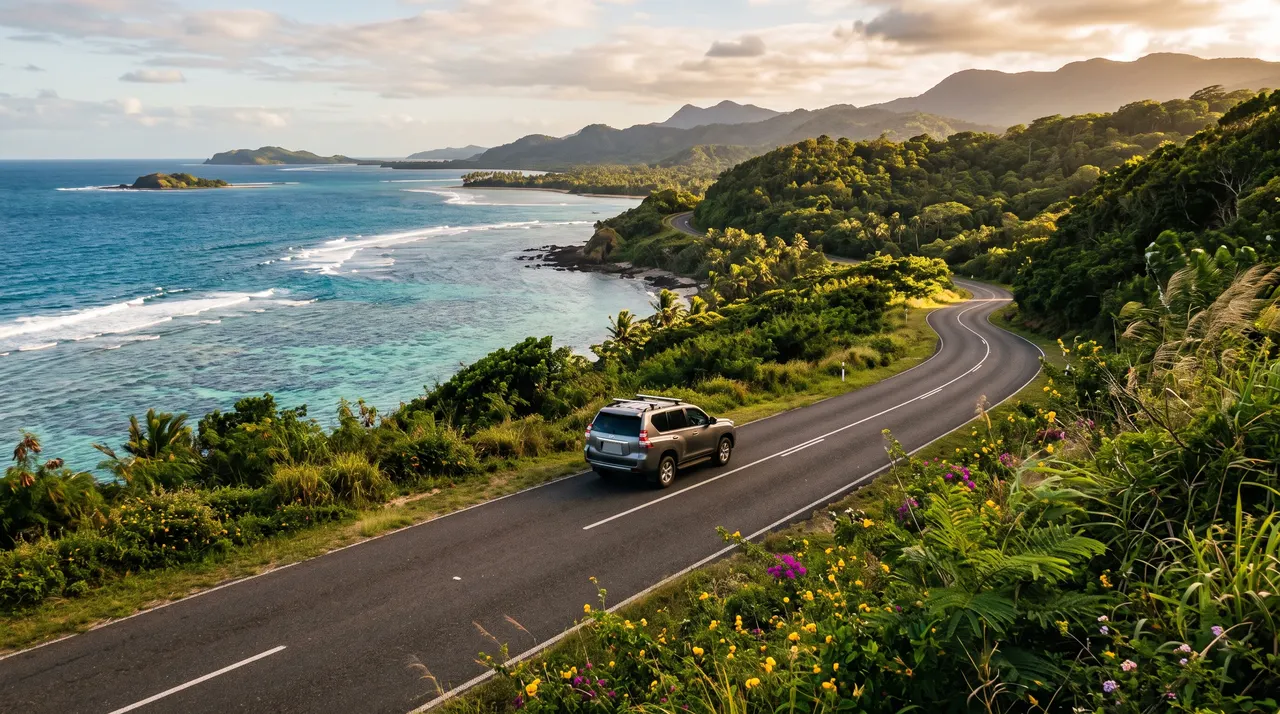
The Coral Coast drive along the Queens Road between Suva and Nadi, hugging Viti Levu's southern reef shoreline, is Fiji's classic road trip. For most visitors the real draw is the freedom to reach places trains and tours don't, on your own schedule, with the open road generally capped around 80 km/h open roads. Getting behind the wheel is the easy part: your International Driving Permit is a certified translation of your Australia licence, carried alongside it, so rental staff and officials in Fiji can read your credentials at a glance.
What applies to Australia licence holders in Fiji
| Australia licence in Fiji | |
|---|---|
| Do you need an IDP? | Recommended, not legally mandatory |
| IDP format required | 1949 Geneva |
| Your Australia licence script | Roman (Latin) alphabet |
| Australia is party to | 1949 Geneva |
| Drives on the | Left-hand side |
| Minimum driving age | 18 |
| Emergency number | 911 or 917 (police) |
| Top speed limit | 80 km/h open roads |
| Currency | FJD |
Driving rules in Fiji you should know
- Drive on the left.
- Watch for pedestrians and animals in villages.
- 0.08% alcohol limit.
- Unsealed roads on smaller islands.
Local driving facts in Fiji
Emergency number: 911 or 917 (police) (112 also connects from most mobiles). Typical maximum for cars on the fastest road class: 80 km/h open roads. Posted limits always take precedence.
Tolls & road charges in Fiji
Fiji has no toll roads, so no vignettes, passes or booths to deal with anywhere on Viti Levu or the other islands.
Parking in Fiji
In Suva and Nadi you must buy and display a ticket from parking meters/wardens where signed; wardens are strict and fines start around FJD 20, so always pay the meter and observe time limits.
Penalties & enforcement in Fiji
Hand-held phone use is banned and seatbelts are mandatory; police enforce speeding with on-the-spot fines, and parking wardens ticket aggressively. Rental firms recover unpaid fines and parking tickets from your card.
If you have an accident in Fiji
Stop and call police on 917 (general emergency 112; fire/ambulance 911), collect witness and driver details, photograph the scene, and ask police for a copy of their report for your insurer and the hire company.
City driving in Fiji
Around Suva expect 50 km/h limits, congestion and aggressive bus traffic; remember Fiji drives on the LEFT, and the biggest hazard outside town is roaming animals, pedestrians and potholes on the Queens and Kings Roads circling Viti Levu.
Winter driving in Fiji
No winter-tyre rules - tropical climate; the wet season instead brings flash flooding and washed-out rural roads.
Fuel in Fiji
Stations sell petrol and diesel at roughly FJD 2-3 per litre (about USD 1.18 petrol / 1.15 diesel); they are plentiful around Nadi-Suva but sparse on the back roads and outer islands, so refuel before remote drives. Cards are accepted at main stations.
Sources: tyremap.com, fijipocketguide.com, autoeurope.co.uk, taf.org.fj