 India licence
  Greece
Can you drive in Greece with an India license?
Short answer: to drive in Greece with an India license you need an International Driving Permit in the 1949 Geneva or 1968 Vienna format, carried together with your India license.
Yes — to drive in Greece on an India licence you should carry an International Driving Permit together with your India licence. Greece expects foreign drivers to hold an IDP.
Indian drivers need an International Driving Permit to drive or rent a car in most countries abroad. Your International Driving Permit is a certified multilingual translation of your existing licence, prepared in the 1949 Geneva & 1968 Vienna format and carried alongside your national licence.


What driving in Greece is like
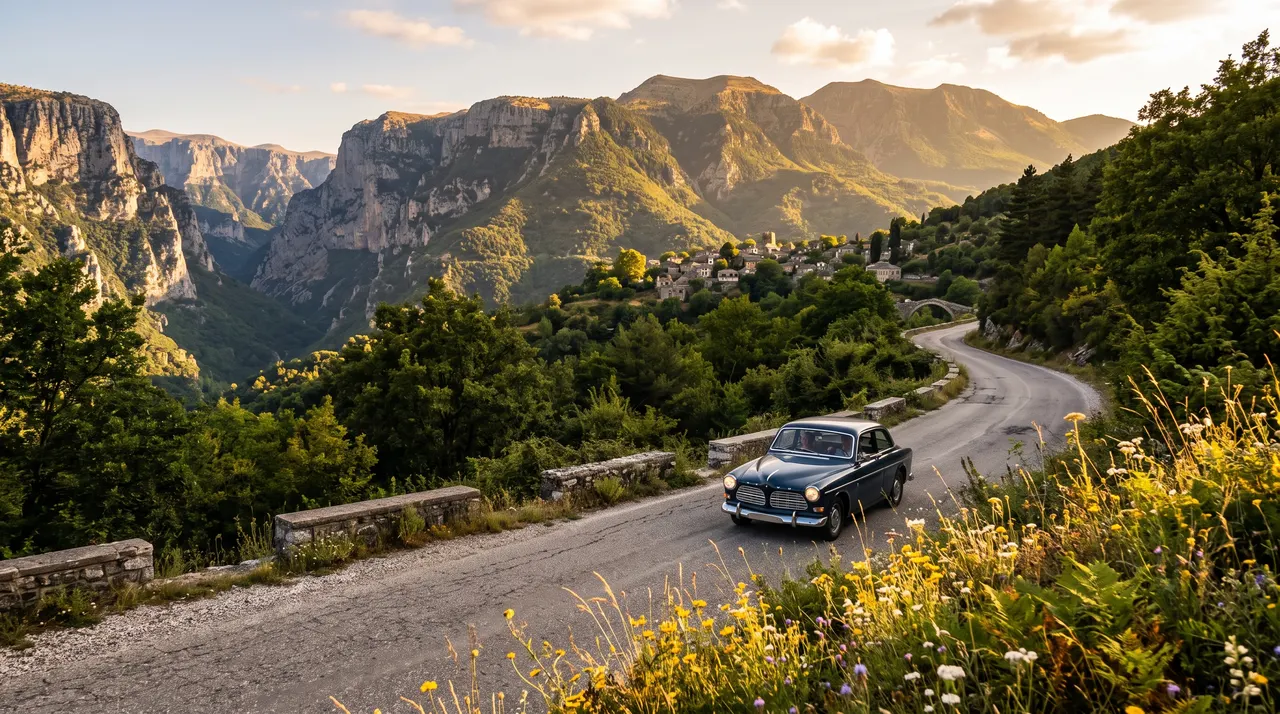
The drive through the Vikos Gorge and Zagori stone-bridge villages in the Pindus mountains of Epirus is among the most spectacular in the country. For most visitors the real draw is the freedom to reach places trains and tours don't, on your own schedule, with the open road generally capped around 130 km/h motorways. Getting behind the wheel is the easy part: your International Driving Permit is a certified translation of your India licence, carried alongside it, so rental staff and officials in Greece can read your credentials at a glance.
What applies to India licence holders in Greece
| India licence in Greece | |
|---|---|
| Do you need an IDP? | Yes — carry one alongside your licence |
| IDP format required | 1949 Geneva or 1968 Vienna |
| Your India licence script | Roman (Latin) alphabet |
| India is party to | 1949 Geneva |
| Drives on the | Right-hand side |
| Minimum driving age | 18 |
| Emergency number | 112 |
| Top speed limit | 130 km/h motorways |
| Currency | EUR |
Driving rules in Greece you should know
- Carry a first-aid kit, fire extinguisher and warning triangle.
- Seatbelts and motorcycle helmets are mandatory.
- 0.05% alcohol limit.
- Tolls on national highways (Attiki Odos, etc.).
Local driving facts in Greece
Emergency number: 112 (112 also connects from most mobiles). Typical maximum for cars on the fastest road class: 130 km/h motorways. Posted limits always take precedence.
Tolls & road charges in Greece
Major motorways (Attiki Odos, the A1, the Olympia Odos and others) use staffed cash/card toll plazas charging fixed per-section amounts of roughly EUR 1.50-3; there is no national vignette, and Crete has no toll roads at all. An optional e-pass transponder exists but tourists normally just pay at the booth.
Parking in Greece
City-centre parking in Athens and Thessaloniki is controlled-zone paid parking (white/blue marked bays) paid via app or kiosk ticket, and is genuinely scarce. White-and-yellow kerbs and resident-only zones are off-limits and towing/clamping is common, so a guarded public garage is the safer choice.
Penalties & enforcement in Greece
Under the September 2025 Traffic Code fines are steep and digital: exceeding the limit by even up to 20 km/h is EUR 150, and handheld phone use and no-seatbelt each draw large fines with possible licence-point penalties. Camera and digital violations are increasingly forwarded to rental firms and billed to your card.
If you have an accident in Greece
Call 112 for emergencies; for any injury or dispute you must wait for and obtain a police report, which insurers and rental firms require. Vehicles should not be moved until documented if there is injury, and both driver and rental company can each be fined EUR 1,000 if the driver lacked a required IDP.
City driving in Greece
Athens runs a long-standing central-ring 'daktylios' restriction that bars private cars by odd/even number plate on alternating days within the inner ring during weekday hours; foreign-plated and many rental vehicles can be affected, so check before entering the centre.
Winter driving in Greece
Anti-skid chains (or equivalent) are obligatory to carry from 1 October to 30 April and must be fitted when authorities signal snow/ice conditions; non-compliance carries an EUR 80 fine. With chains fitted the speed limit is 50 km/h.
Fuel in Greece
Stations sell amolivdi (unleaded 95/100) and diesel (petreleo kinisis); almost all are full-service with an attendant, and cards are widely accepted though small rural stations may be cash-only. Petrol runs around EUR 1.85-2.00 per litre in 2026.
Sources: acerentacar.gr, keeptalkinggreece.com, autoeurope.com, keeptalkinggreece.com