 US licence
  Italy
ItalyCan you drive in Italy with a US license?
Short answer: to drive in Italy with a US license you need an International Driving Permit in the 1949 Geneva or 1968 Vienna format, carried together with your US license.
Yes — to drive in Italy on a US licence you should carry an International Driving Permit together with your US licence. Italy expects foreign drivers to hold an IDP.
U.S. drivers should carry an International Driving Permit alongside their state licence when driving or renting a car abroad. Your International Driving Permit is a certified multilingual translation of your existing licence, prepared in the 1949 Geneva & 1968 Vienna format and carried alongside your national licence.


What driving in Italy is like
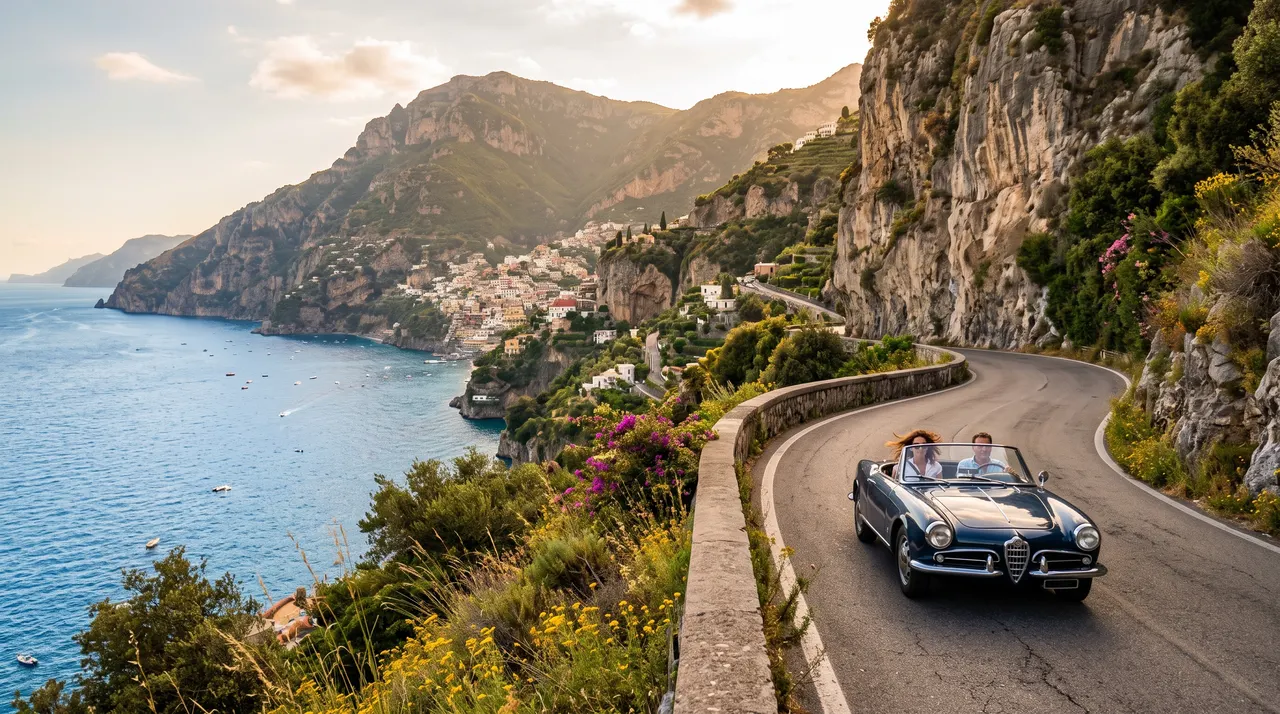
The Amalfi Coast road (SS163 Amalfitana) hugging the cliffs from Sorrento to Salerno is one of the world's most famous coastal drives. For most visitors the real draw is the freedom to reach places trains and tours don't, on your own schedule, with the open road generally capped around 130 km/h autostrade. Getting behind the wheel is the easy part: your International Driving Permit is a certified translation of your US licence, carried alongside it, so rental staff and officials in Italy can read your credentials at a glance.
What applies to US licence holders in Italy
| US licence in Italy | |
|---|---|
| Do you need an IDP? | Yes — carry one alongside your licence |
| IDP format required | 1949 Geneva or 1968 Vienna |
| Your US licence script | Roman (Latin) alphabet |
| United States is party to | 1949 Geneva |
| Drives on the | Right-hand side |
| Minimum driving age | 18 |
| Emergency number | 112 |
| Top speed limit | 130 km/h autostrade |
| Currency | EUR |
Driving rules in Italy you should know
- ZTL (limited-traffic) zones in city centres are camera-enforced — heavy fines.
- Headlights required on motorways at all times.
- Carry a reflective jacket and warning triangle.
- 0.05% alcohol limit; zero for drivers under 21.
Local driving facts in Italy
Emergency number: 112 (112 also connects from most mobiles). Typical maximum for cars on the fastest road class: 130 km/h autostrade. Posted limits always take precedence.
Tolls & road charges in Italy
Most autostrade are tolled by distance: take a ticket at the white-signed entry and pay on exit by cash or card (Carte/blue lanes) or via a Telepass transponder in yellow lanes. Use Telepass lanes only if your rental includes the device; a Milan-Rome run costs roughly EUR 40-45.
Parking in Italy
Kerb lines signal the rule: blue lines are paid (meter or app, often EUR 1-3/hour), white lines are free, and yellow lines are reserved (residents/disabled). Pay at the parcometro or via apps like EasyPark; illegal parking risks fines and removal (rimozione forzata) by carro attrezzi.
Penalties & enforcement in Italy
Urban speeding fines start around EUR 45 and rise steeply on highways; handheld phone use is roughly EUR 165+ and can mean a licence suspension. Camera and ZTL fines arrive at the rental firm and are billed to you months later with an admin fee; a ~30% discount applies if paid within 5 days.
If you have an accident in Italy
Call 112 for emergencies; police must be alerted if anyone is injured. For minor damage complete the CID/constatazione amichevole (European Accident Statement) signed by both drivers, photograph the scene, do not move vehicles if there are injuries, and report it to the rental company promptly.
City driving in Italy
Rome, Florence, Milan, Bologna, Naples and Turin enforce camera-controlled Zona a Traffico Limitato (ZTL) zones in historic centres during set hours; entering without a permit auto-generates a fine from about EUR 80-100+. Confirm any hotel-arranged ZTL permit before driving in, as cameras catch you instantly.
Winter driving in Italy
From 15 November to 15 April winter tyres or onboard snow chains are compulsory on many roads and motorway stretches under prefecture/ordinance signage (segnale obbligo catene o pneumatici invernali). Rules are signposted route-by-route rather than nationwide.
Fuel in Italy
Stations sell benzina (petrol, unleaded) and gasolio (diesel); pumps offer servito (attended, pricier) or fai-da-te/self self-service. Pay by card or cash, with many autostrada and rural stations going card-only automated overnight; petrol is around EUR 1.80-1.95/litre.
Sources: finalrentals.com, adagioumbro.it, cover4rentals.ie, europa.eu