 Philippines licence
  United Kingdom
Can you drive in United Kingdom with a Philippines license?
Short answer: you can drive in United Kingdom with a Philippines license; an International Driving Permit is recommended and is carried alongside your Philippines license.
An International Driving Permit is recommended (not strictly required) for Philippines licence holders driving in United Kingdom. Your Philippines licence is in the Roman alphabet, but carrying one alongside it can help at rental desks and roadside checks. Carry both.
Philippine drivers need an International Driving Permit to drive or rent a car in most countries abroad. Your International Driving Permit is a certified multilingual translation of your existing licence, prepared in the 1949 Geneva and 1968 Vienna Convention format that United Kingdom recognises and carried alongside your national licence.


What driving in United Kingdom is like
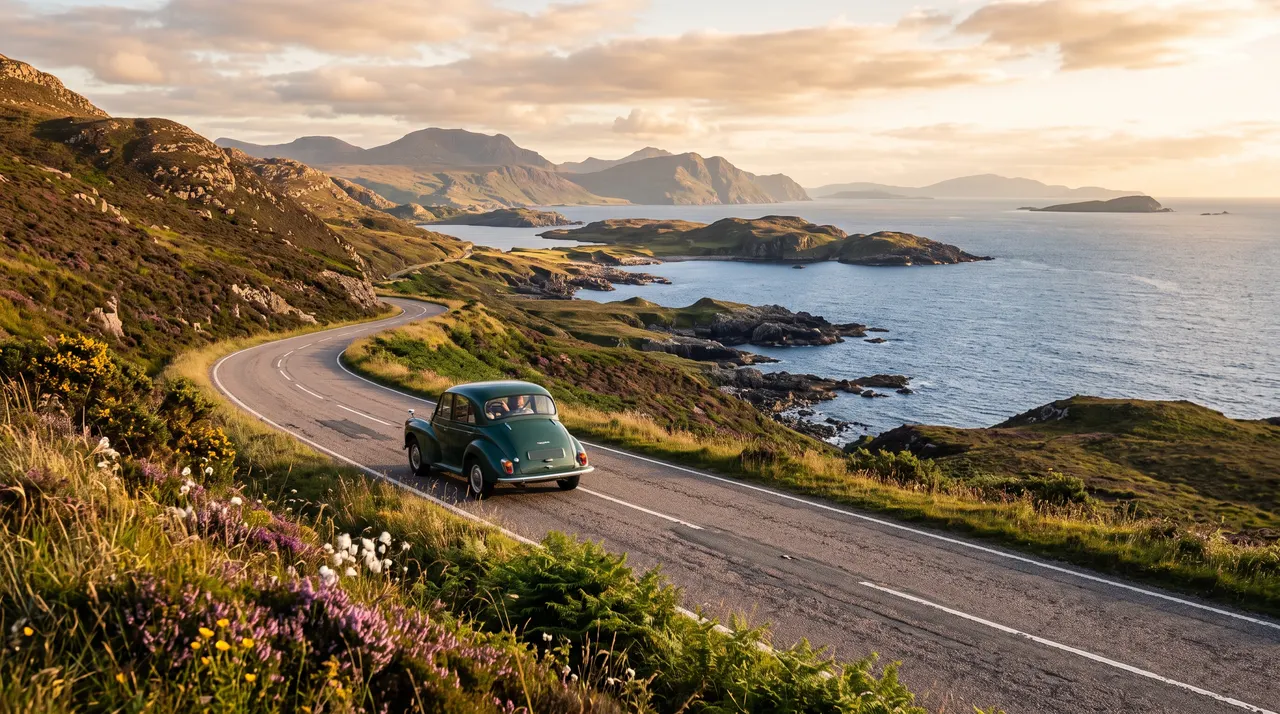
The North Coast 500, a roughly 830km loop around the northern Scottish Highlands from Inverness, is the country's signature scenic drive. For most visitors the real draw is the freedom to reach places trains and tours don't, on your own schedule, with the open road generally capped around 70 mph (113 km/h) motorways. Getting behind the wheel is the easy part: your International Driving Permit is a certified translation of your Philippines licence, carried alongside it, so rental staff and officials in United Kingdom can read your credentials at a glance.
What applies to Philippines licence holders in United Kingdom
| Philippines licence in United Kingdom | |
|---|---|
| Do you need an IDP? | Recommended, not legally mandatory |
| IDP format required | 1949 Geneva or 1968 Vienna |
| Your Philippines licence script | Roman (Latin) alphabet |
| Philippines is party to | 1968 Vienna |
| Drives on the | Left-hand side |
| Minimum driving age | 17 |
| Emergency number | 999 or 112 |
| Top speed limit | 70 mph (113 km/h) motorways |
| Currency | GBP |
Driving rules in United Kingdom you should know
- Drive on the left.
- Seatbelts mandatory for all occupants.
- Mobile-phone use while driving is heavily penalised.
- 0.08% alcohol limit in England/Wales; lower in Scotland.
Local driving facts in United Kingdom
Emergency number: 999 or 112 (112 also connects from most mobiles). Typical maximum for cars on the fastest road class: 70 mph (113 km/h) motorways. Posted limits always take precedence.
Tolls & road charges in United Kingdom
The UK has almost no toll motorways - the main exceptions are the M6 Toll near Birmingham and a handful of estuary crossings (Dartford Crossing/Dart Charge, Mersey tunnels, Tyne Tunnel), most of which are now barrier-free and must be paid online by midnight the next day. The Dartford Crossing costs about GBP 2.50 per car.
Parking in United Kingdom
Urban kerbside parking is controlled by pay-and-display machines or apps (RingGo, PayByPhone); single yellow lines mean restricted hours and double yellow lines mean no parking at any time. Cars left illegally risk a Penalty Charge Notice (typically GBP 70-130) and possible clamping or removal.
Penalties & enforcement in United Kingdom
A standard speeding fine is a fixed penalty of GBP 100 plus 3 points (worse for higher speeds), and handheld phone use is GBP 200 plus 6 points; seatbelt failure is GBP 100. Police do not generally take roadside cash, and camera fines are forwarded by the hire firm to your home address with an admin fee.
If you have an accident in United Kingdom
Call 999 (or 112) for injuries; police attendance is only required where someone is hurt, the road is blocked, or a driver fails to stop or give details. You must stop, exchange names, addresses and insurance details, and report to police within 24 hours if details could not be exchanged at the scene.
City driving in United Kingdom
Central London has a daily Congestion Charge (GBP 18 as of January 2026, payable online by the day after travel) overlapping the 24-hour ULEZ, which adds GBP 12.50 a day for non-compliant vehicles across all of Greater London. Confirm any hire car is ULEZ-compliant to avoid daily charges.
Winter driving in United Kingdom
No mandatory winter-tyre or snow-chain law; tyres simply must meet the 1.6mm minimum tread. Snow is occasional, so carrying chains is only advisable for remote upland routes in Scotland or the Pennines in deep winter.
Fuel in United Kingdom
Stations sell unleaded petrol (95 E10 standard, 97/99 super) and diesel, all self-service and paid at the kiosk or pay-at-pump card terminal; LPG is rare. Prices in mid-2026 run roughly GBP 1.35-1.45 per litre, with motorway services markedly dearer.
Sources: gov.uk, visitlondon.com, autoeurope.com, carwow.co.uk