France Germany
 France
  Germany
Last reviewed July 2026
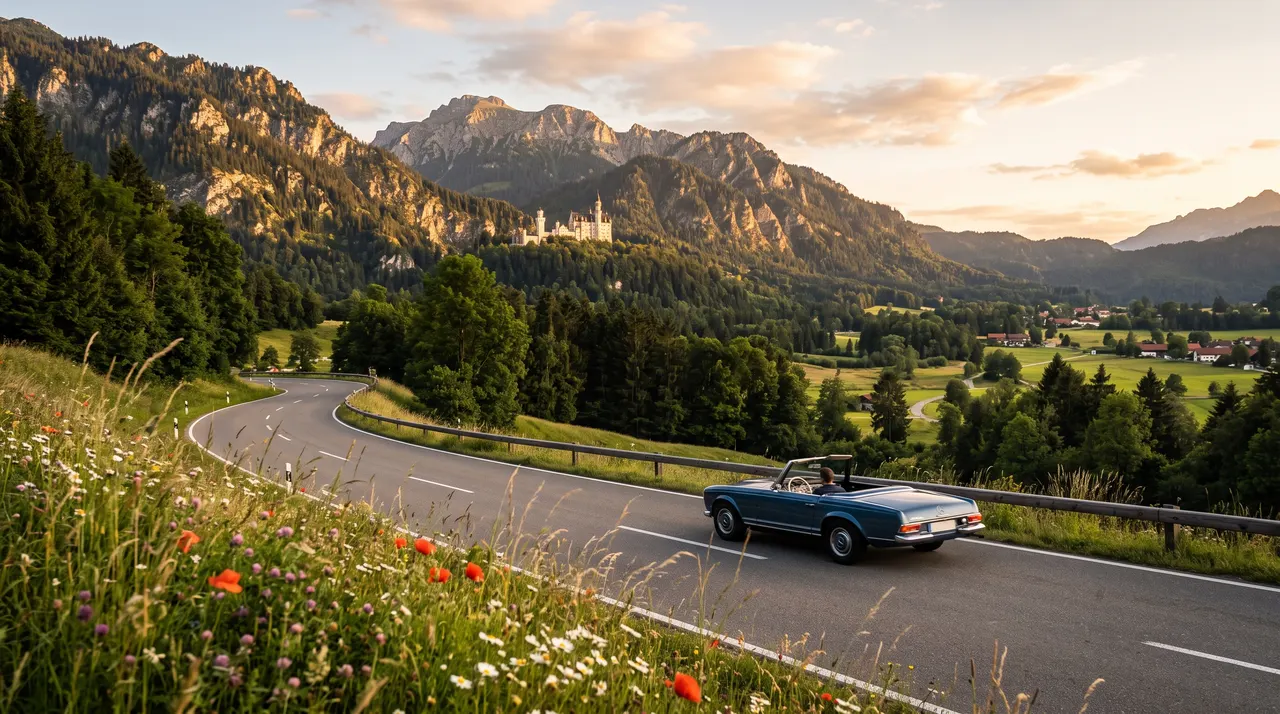
Crossing the border
The A4/A5 corridor crosses near Strasbourg and Kehl over the Rhine.
Driving rules in Germany
- Autobahn: keep right except to overtake; some sections have no speed limit.
- Winter tyres mandatory in wintry conditions.
- Environmental (Umweltplakette) sticker required for low-emission city zones.
- 0.05% alcohol limit; zero for drivers under 21.
What to see when you arrive in Germany
- Neuschwanstein Castle
- the Brandenburg Gate in Berlin
- Cologne Cathedral
- the Black Forest
- Munich's Oktoberfest and Marienplatz
Once you're driving in Germany
Destination-specific detail sourced from national road authorities, motoring clubs and rental policies — the things that catch cross-border drivers out.
Driving on a foreign licence
EU/EEA licences are valid, and a non-EU licence in Latin script can be used by tourists for up to six months alongside the original. An International Driving Permit (or certified German translation) is required if the licence is not in the Roman alphabet; major rental firms otherwise rarely insist on one.
Tolls & road charges
Germany has no car tolls on the Autobahn (only trucks pay), so passenger cars drive the motorway network free. Budget instead for tolls on neighbouring countries' roads if crossing borders, and note Germany has no passenger-car vignette.
Parking in the cities
City centres use paid Parkschein meters or apps (often EUR 1-4/hour) and blue-signed Bewohnerparken bays reserved for permit-holding residents. A blue parking disc (Parkscheibe) is needed in free time-limited zones, and illegally parked cars are clamped or towed (abgeschleppt) at the driver's cost.
Fines & camera enforcement
Speeding fines scale with the amount over (built-up area: ~EUR 30 for 10 km/h up to hundreds plus points/bans for large excesses), handheld phone use is EUR 100+ and a point, no seatbelt EUR 30. Camera fines route to the rental firm and on to you with an admin fee, and from 2025 these are enforceable cross-border within the EU.
If you have an accident
Call 112 (ambulance/fire) or 110 (police); police must be called if anyone is injured or damage is significant. Complete the European Accident Statement (Europaischer Unfallbericht) with the other driver, secure the scene with warning triangle and hi-vis vest, do not move injured persons or vehicles needlessly, and report to the rental company.
Driving in the capital
Most large cities (Berlin, Munich, Cologne, Stuttgart, Frankfurt) enforce an Umweltzone low-emission zone that since 2025 only admits cars with a green Umweltplakette windscreen sticker; entering without it is a EUR 100 fine. Rental cars are almost always already stickered, but verify the green badge before entering.
Sources: rac.co.uk · evz.de · iamexpat.de · europa.eu