Paraguay Bolivia
 Paraguay
  Bolivia
Last reviewed July 2026
Crossing the border
Paraguay and Bolivia share a land border you can cross by car. Keep your passport, national driving licence and International Driving Permit together, and check opening hours and any toll or vignette requirements before you travel.
Driving rules in Bolivia
- Drive on the right.
- High altitude affects engine and driver performance.
- 0.07% alcohol limit.
- Carry passport, IDP and home licence.
What to see when you arrive in Bolivia
- the Uyuni salt flats
- Lake Titicaca and the Isla del Sol
- the colonial city of Sucre
- the silver mines of Potosí
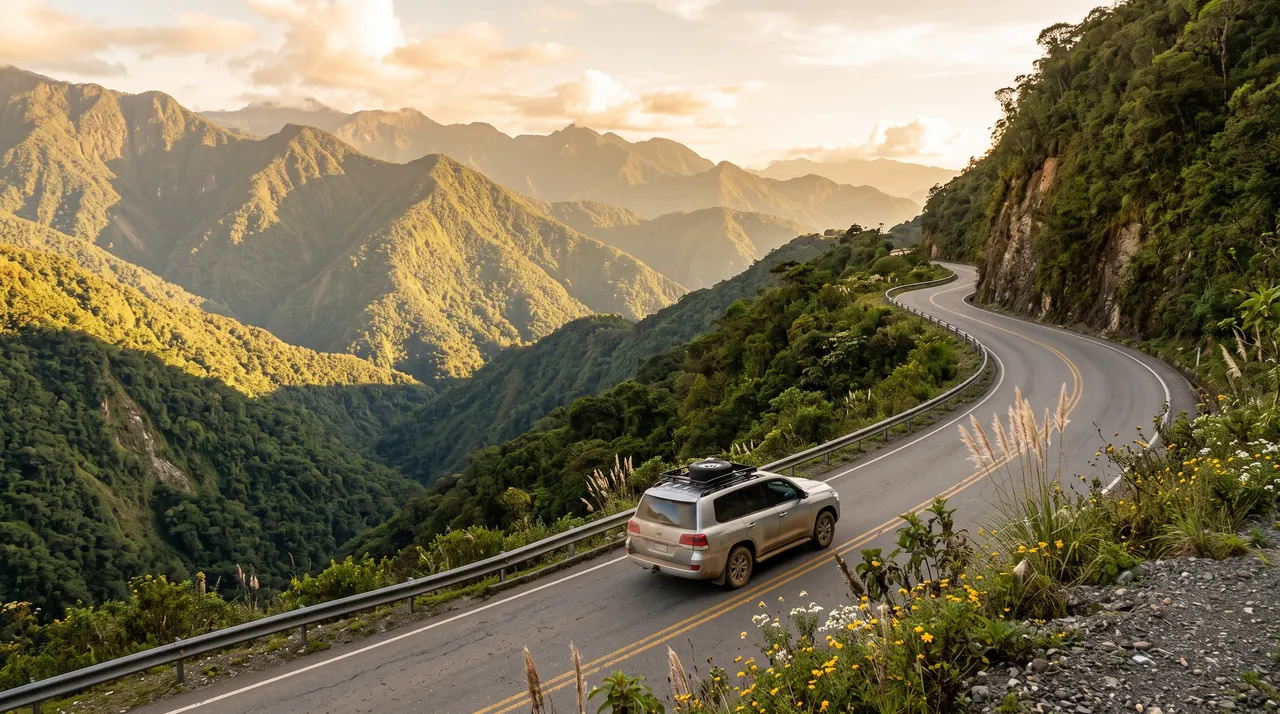
- the Death Road near La Paz
Once you're driving in Bolivia
Destination-specific detail sourced from national road authorities, motoring clubs and rental policies — the things that catch cross-border drivers out.
Driving on a foreign licence
A tourist may drive on a valid home licence for the duration of a legal stay; an IDP (Bolivia accepts the 1949 Geneva permit) is strongly recommended and is effectively required by rental agencies and at police checkpoints to translate a non-Spanish licence.
Tolls & road charges
Most major intercity highways have toll plazas (peajes) operated by ABC and local administrations; charges are modest (a few bolivianos to ~20 Bs) and must be paid in cash, as cards are rarely accepted.
Parking in the cities
In central La Paz and Santa Cruz, paid on-street parking is managed by municipal zones and parqueo attendants; illegal or double-parked cars in congested centres can be wheel-clamped or towed, so use guarded lots (playas de estacionamiento).
Fines & camera enforcement
Fines for speeding, no seatbelt or using a phone are issued by transit police, often expected on the spot in cash; rental firms pass on any camera or unpaid fines by charging the card on file plus an admin fee.
If you have an accident
Call the Policia Nacional on 110 (or 911 in some cities) and the ambulance on 118; do not move vehicles until the transit police arrive and a report is filed, as the official accident report is required for any insurance or rental claim.
Driving in the capital
La Paz traffic is chaotic and steeply graded; many central streets are controlled by 'zebras' (costumed crossing volunteers) rather than signals, and the linked El Alto–La Paz autopista charges a toll.
Sources: ypfb.gob.bo · internationaldriversassociation.com · tyremap.com · internationaltravelpermits.com