Do you need an International Driving Permit to drive in Burundi?
This is a private translation, not a government-issued permit. If Burundi requires the official document for your specific situation, confirm with its motor authority before you order.


Sourced from the 1949 Geneva & 1968 Vienna Conventions and rental-network policies

What the rules require
When do you need an IDP in Burundi?
Burundi drives on the right; an IDP is recommended with your home licence for its hilly roads and busy capital.
Does renting a car in Burundi require an IDP?
Bujumbura desks request an IDP for non-French licences. Having your permit ready avoids losing your reservation at the counter.
Driving rules in Burundi you should know
- Drive on the right.
- Hilly, winding rural roads.
- 0.08% alcohol limit.
- Carry passport, IDP and home licence.
How long is an IDP valid in Burundi?
Burundi uses the 1949 Geneva Convention format, under which an IDP is valid for up to 1 year from its issue date. If you travel regularly, the validity clock starts on the issue date, not on first use — so order close to your departure to maximise usable time.
Documents checklist for driving in Burundi
- Your original national driving licence — the IDP is a translation and is never valid on its own.
- Your International Driving Permit, prepared in the 1949 Geneva Convention format that Burundi recognises.
- Your passport or accepted national ID for police checks and rental pick-up.
- For rentals: the credit card used for the booking and your rental agreement (it covers the registration and insurance papers).
- Local currency or a card for road costs — Burundi uses the BIF.
Driving in Burundi: the practical detail
Sourced from national road authorities, motoring clubs and rental policies — the things that actually catch foreign drivers out.
Driving on a foreign licence
Burundi follows the 1949 Geneva Convention, so a 1949-format IDP carried with the home licence is the safest choice and is preferred by rental firms; short-stay visitors from the US, UK, EU, Canada or Australia may drive on their home licence but an IDP avoids checkpoint disputes. Both documents must be carried together.
Tolls & road charges
Burundi has no toll-road network or electronic tags; there are no formal tolls for tourists, though police and military checkpoints where documents are inspected are common on intercity routes.
Parking in the cities
Bujumbura has no organised paid-zone or metered system; parking is informal kerbside or in guarded lots where an attendant expects a small Burundian-franc tip. Use hotel or compound parking, as roadways are unmarked and street security is a concern.
Winter & seasonal rules
No winter-tyre rules - tropical climate; the real seasonal hazard is the rainy season turning unpaved roads to mud.
Fuel & filling up
Fuel supply is unreliable and periodic shortages with long queues occur, especially outside Bujumbura, so fill up whenever possible and carry spare fuel for remote travel. Pay in Burundian francs cash; card acceptance at pumps is minimal.
If you have an accident
Drive on the right; after a crash stop, do not move the vehicles, and report to the police (emergency lines around 117/112) and obtain a report for insurance, which is compulsory third-party. Stay alert at the scene, as crowds can form and tensions rise quickly.
Driving in the capital
Bujumbura's defining quirk is that traffic signals are largely non-functional and roads are unmarked, while many local drivers are untrained, so junctions work on improvisation - drive slowly and defensively. A 4x4 is advisable once you leave the paved city corridors.
Fines & enforcement
Enforcement is via roadside police checks where licence, IDP, registration and insurance are demanded and fines settled in cash francs; the legal blood-alcohol limit is low (around 0.1%/0.08%). Keep all documents on hand to avoid prolonged stops.
A drive worth taking
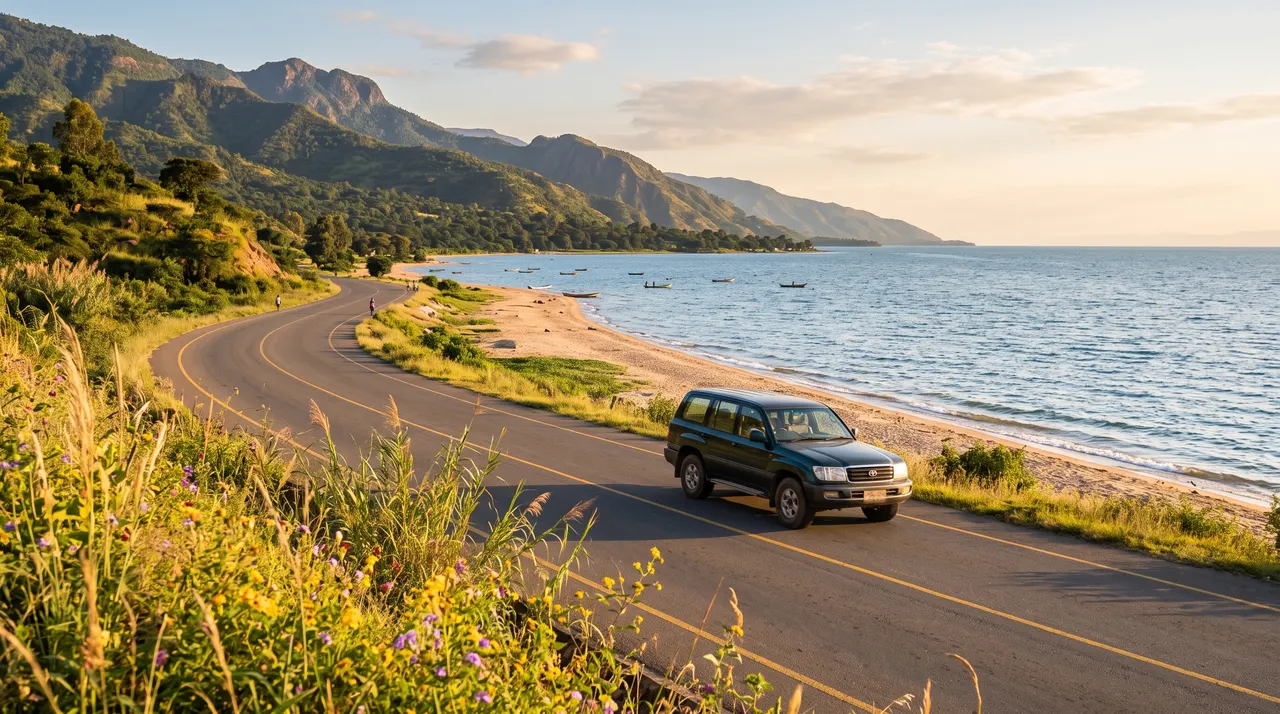
The lakeshore road south of Bujumbura along Lake Tanganyika toward Rumonge, past the Rusizi hippos and sandy beaches, is the country's standout drive.
Sources: internationaldriversassociation.com · adcidl.com · curiousexpeditions.org · internationaltravelpermits.com
Burundi · common questions
What rental desks in Burundi ask foreign drivers for
| Rental company | Policy for foreign licences in Burundi |
|---|---|
| Hertz | Asks foreign drivers for a licence translation when the licence is not printed in the Roman alphabet, and often for non-EU renters in much of Europe. |
| Enterprise | Asks for a licence translation alongside your home licence in many countries across Europe, Asia and South America. |
| Alamo | Asks for a licence translation when the licence is in a non-Latin alphabet, and suggests one for all international renters. |
| Budget | Asks for a licence translation when your licence is not in the Roman alphabet. |
| National | Asks for a licence translation for non-Latin-alphabet licences and where local rules call for one. |
| Thrifty | Asks for a licence translation in select countries and for non-Roman-alphabet licences. |
| Sixt | Asks for a licence translation for licences issued outside the EU and not in the Roman alphabet. |
| Avis | Asks for a licence translation where the national licence is not in the Roman alphabet or where local rules call for one. |
Bujumbura desks request an IDP for non-French licences. Minimum rental age in Burundi is typically 18+, with a young-driver surcharge usually applied under 25.