Do you need an International Driving Permit to drive in Morocco?


Sourced from the 1949 Geneva & 1968 Vienna Conventions and rental-network policies
What the rules require
When do you need an IDP in Morocco?
An IDP is recommended and frequently requested to rent a car in Morocco.
Does renting a car in Morocco require an IDP?
Requested at airport and city desks. Having your permit ready avoids losing your reservation at the counter.
Driving rules in Morocco you should know
- Toll motorways link major cities.
- Speed traps frequent on rural roads.
- 0.00% alcohol tolerance for driving.
- Carry passport, licence and IDP.
How long is an IDP valid in Morocco?
Morocco uses the 1968 Vienna Convention format, under which an IDP can be valid for up to 3 years — or until your national licence expires, whichever comes first. If you travel regularly, the validity clock starts on the issue date, not on first use — so order close to your departure to maximise usable time.
Documents checklist for driving in Morocco
- Your original national driving licence — the IDP is a translation and is never valid on its own.
- Your International Driving Permit, in the 1968 Vienna Convention format Morocco uses.
- Your passport or accepted national ID for police checks and rental pick-up.
- For rentals: the credit card used for the booking and your rental agreement (it covers the registration and insurance papers).
- Local currency or a card for road costs — Morocco uses the MAD.
Driving in Morocco: the practical detail
Sourced from national road authorities, motoring clubs and rental policies — the things that actually catch foreign drivers out.
Driving on a foreign licence
Tourists may drive on a valid national licence for up to one year; if it is not in Arabic, French or English you should carry an International Driving Permit alongside it, and rental firms and Gendarmerie checkpoints commonly expect one.
Tolls & road charges
The autoroute network uses a ticket system - take a card from the machine at entry and pay cash (or card at larger plazas) at the manned exit booth; fares are modest, e.g. Casablanca-Marrakech is roughly 70-90 MAD one way.
Parking in the cities
City streets have paid bays and meters (1-2 hour limits) plus garages in Marrakech, Casablanca and other cities; informal gardiens in vests also watch parked cars for a few-dirham tip.
Winter & seasonal rules
Generally mild, but High Atlas passes such as Tizi n'Tichka can get snow and ice from roughly December to March - carry chains and check conditions before crossing, as passes occasionally close.
Fuel & filling up
Stations are attended; fuel is sold by the litre as gasoil (diesel, the most common) and sans-plomb (unleaded petrol), priced around 14-15 MAD/litre, with cards accepted in towns but cash safer in rural areas - refuel before remote stretches.
If you have an accident
Call the police (19) in cities or the Gendarmerie Royale (177) on rural roads; for any injury or dispute wait for police and obtain the official report (constat) and its number, as your insurer and rental firm will require it.
Driving in the capital
Casablanca has Morocco's most chaotic traffic, with aggressive lane use, scooters weaving everywhere and busy roundabouts where right-of-way is loosely observed; stay defensive and expect frequent Gendarmerie checkpoints on exits.
Fines & enforcement
Speeding fines start at about 300 MAD, rising to 500 MAD (over 20 km/h) and 700 MAD (over 30 km/h), and seatbelt or phone offences are around 300 MAD; Gendarmerie issue these on the spot and usually expect immediate cash payment, so keep small notes and ask for a receipt.
A drive worth taking
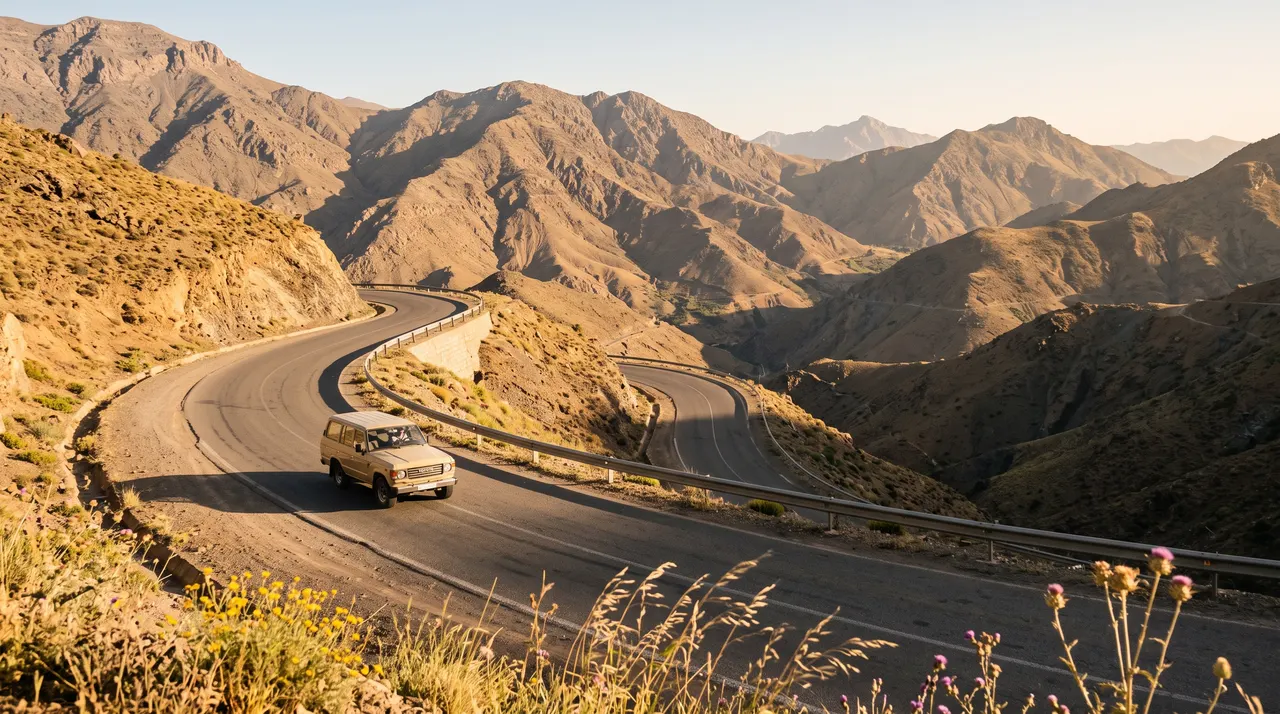
The Tizi n'Tichka pass (N9) over the High Atlas, climbing to about 2,260 m between Marrakech and Ouarzazate, is Morocco's signature mountain drive.
Sources: autoeurope.com · localrent.com · globalpetrolprices.com · dangerousroads.org
Morocco · common questions
What rental desks in Morocco ask foreign drivers for
| Rental company | Policy for foreign licences in Morocco |
|---|---|
| Hertz | Asks foreign drivers for a licence translation when the licence is not printed in the Roman alphabet, and often for non-EU renters in much of Europe. |
| Enterprise | Asks for a licence translation alongside your home licence in many countries across Europe, Asia and South America. |
| Alamo | Asks for a licence translation when the licence is in a non-Latin alphabet, and suggests one for all international renters. |
| Budget | Asks for a licence translation when your licence is not in the Roman alphabet. |
| National | Asks for a licence translation for non-Latin-alphabet licences and where local rules call for one. |
| Thrifty | Asks for a licence translation in select countries and for non-Roman-alphabet licences. |
| Sixt | Asks for a licence translation for licences issued outside the EU and not in the Roman alphabet. |
| Avis | Asks for a licence translation where the national licence is not in the Roman alphabet or where local rules call for one. |
Requested at airport and city desks. Minimum rental age in Morocco is typically 18+, with a young-driver surcharge usually applied under 25.