Driving in CroatiaWhat the rules require
When do you need an IDP in Croatia?
Croatia drives on the right and accepts both conventions; non-EU drivers should hold an IDP, useful on the toll motorways linking the coast.
Does renting a car in Croatia require an IDP?
Split and Dubrovnik desks request an IDP for non-EU licences. Having your permit ready avoids losing your reservation at the counter.
Driving rules in Croatia you should know
- Headlights on in winter and in poor visibility.
- Reflective vest and triangle required.
- 0.05% alcohol limit; zero for drivers under 24.
- Toll motorways along the Adriatic.
How long is an IDP valid in Croatia?
Croatia honours both the 1949 Geneva and 1968 Vienna Convention formats. A 1949-format IDP is valid for up to 1 year; a 1968-format IDP can be valid for up to 3 years, or until your national licence expires. If you travel regularly, the validity clock starts on the issue date, not on first use — so order close to your departure to maximise usable time.
Documents checklist for driving in Croatia
- Your original national driving licence — the IDP is a translation and is never valid on its own.
- Your International Driving Permit, in the 1949 Geneva and 1968 Vienna Convention format Croatia uses.
- Your passport or accepted national ID for police checks and rental pick-up.
- For rentals: the credit card used for the booking and your rental agreement (it covers the registration and insurance papers).
- Local currency or a card for road costs — Croatia uses the EUR.
Driving in Croatia: the practical detail
Sourced from national road authorities, motoring clubs and rental policies — the things that actually catch foreign drivers out.
Driving on a foreign licence
EU/EEA licences are valid as-is; non-EU visitors may drive on their home licence for short tourist stays but should carry an International Driving Permit alongside it (mandatory if the licence is not in Latin script). Rental firms require the licence held at least one year and usually a minimum age of 21.
Tolls & road charges
Croatia still uses a ticket-based toll system on most motorways (A1/A3/A5/A6 etc.), not a vignette: take a ticket on entry and pay on exit by cash (euros) or card; an ENC electronic tag gives a discount. Costs vary by distance, e.g. roughly EUR 30+ for Zagreb to Split.
Parking in the cities
Cities use colour-coded paid zones controlled mainly by SMS/app: in Zagreb Zone 1 is about EUR 1.60/hr (max 2 hrs), Zone 2 about EUR 0.70/hr (max 3 hrs), with cheaper outer zones. Coastal towns get extremely congested in summer; illegal parking risks towing.
Winter & seasonal rules
Winter equipment is mandatory on designated winter road sections from 15 November to 15 April regardless of actual snow: winter (M+S or 3PMSF) tyres on all wheels, or summer tyres with at least 4 mm tread plus chains carried. Driving without it risks an on-the-spot fine around EUR 130.
Fuel & filling up
Stations sell Eurosuper 95/100 petrol and Eurodizel diesel, mostly attended (self-serve growing); cards are widely accepted. Prices run roughly EUR 1.40-1.55 per litre, with rural and island stations sparser, so refuel before long stretches.
If you have an accident
Call 112 (or police 192) and report any accident involving injury or significant damage; for minor damage-only crashes, move vehicles clear and complete a European Accident Statement form. Leaving the scene of an injury accident is a serious offence.
Driving in the capital
Zagreb's compact Upper Town (Gornji Grad) and the area around Ban Jelacic square have narrow one-way streets, trams sharing the carriageway, and tight paid parking zones - most visitors park in a garage and walk.
Fines & enforcement
Foreign drivers face on-the-spot fines from about EUR 70 for moderate speeding up to roughly EUR 2,000 for extreme speeding; the alcohol limit is 0.5 g/l (0.0 for drivers under 25). Speed cameras typically tolerate only about 10 km/h over, and rental firms pass camera fines to the renter with an admin fee.
A drive worth taking
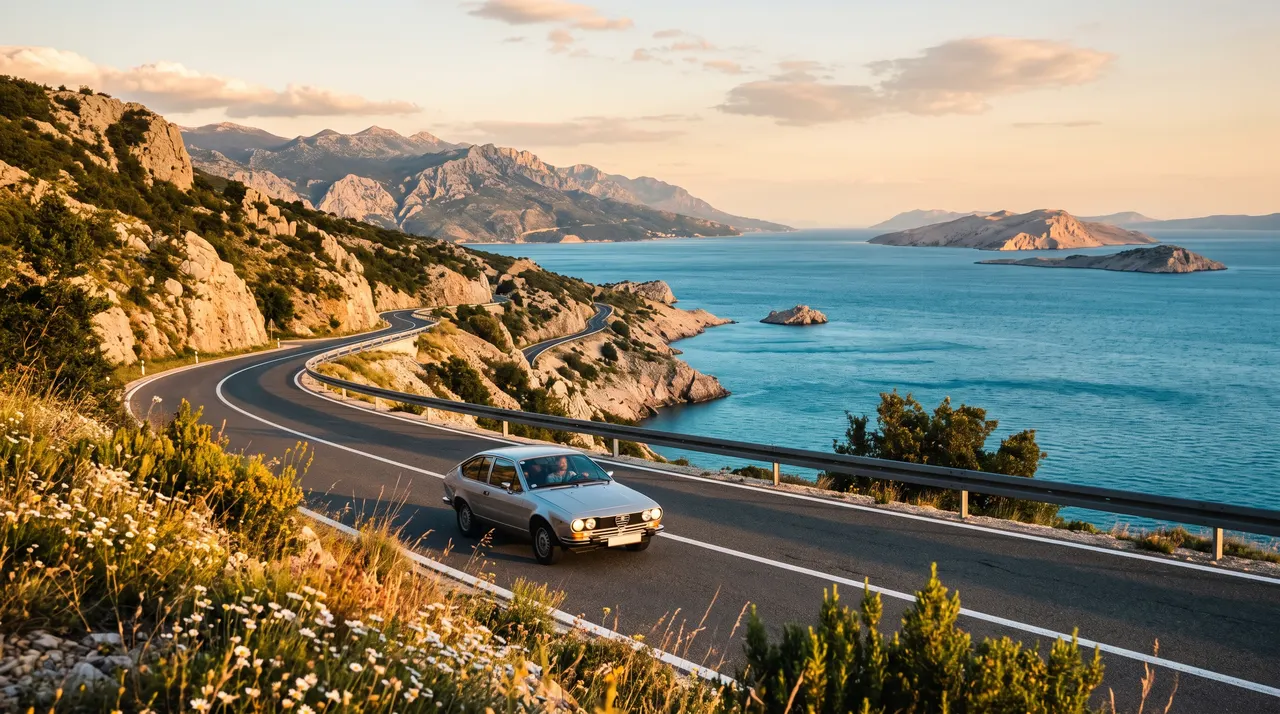
The Adriatic Highway (Jadranska magistrala, D8) hugging the coastline from Rijeka south toward Dubrovnik is the classic Croatian drive.
Sources: rac.co.uk · croatiaweek.com · zagrebparking.hr · tyremap.com
Croatia · common questions
01Do I need an International Driving Permit to drive in Croatia?
Yes — an International Driving Permit is commonly required for foreign drivers in Croatia, and it is especially expected when your national licence is not printed in the Roman alphabet. Carry it alongside your valid national licence, which most rental agreements and traffic checkpoints ask to see. Croatia drives on the right and accepts both conventions; non-EU drivers should hold an IDP, useful on the toll motorways linking the coast. Your IDP is prepared in the 1949 Geneva and 1968 Vienna Convention format that Croatia recognises. Without one you risk being denied car rental, facing fines, or having your rental insurance invalidated.
02Which IDP format does Croatia accept, and how long is it valid?
Croatia honours both the 1949 Geneva and 1968 Vienna Convention formats. A 1949-format IDP is valid for up to 1 year; a 1968-format IDP can be valid for up to 3 years, or until your national licence expires. The format matters because some countries are signatories to only one convention, meaning an IDP in the wrong format may not be recognized. International Driver Licence prepares your permit in the exact booklet format that Croatia requires, eliminating any ambiguity at rental desks or police checks. Remember that the validity period begins on the issue date, not when you first arrive in the country — this is critical for trip planning, especially if you're traveling across multiple countries over several weeks. Plan your order timing carefully to ensure your permit remains valid throughout your intended driving period in Croatia.
03Do I need an IDP to rent a car in Croatia?
Yes, an IDP is highly recommended when renting a car in Croatia. Split and Dubrovnik desks request an IDP for non-EU licences. Most major rental chains — including Hertz, Enterprise, Budget, Avis, Sixt and Alamo — list a valid International Driving Permit as a standard counter requirement for foreign licences, especially those not printed in English. The minimum rental age in Croatia is typically 18+, and most agencies apply a young-driver surcharge for drivers under 25. Arriving without your IDP can result in a refused booking, a held security deposit, or being forced to pay inflated rates for a last-minute local driver upgrade. Always bring your IDP, your original national licence, your passport and the credit card used for the booking — having all documents ready significantly reduces friction at pick-up.
04Which side of the road does Croatia drive on?
Croatia drives on the right-hand side of the road. Headlights on in winter and in poor visibility. This is one of the most crucial adjustments for international drivers — muscle memory from your home country can lead to serious errors if you're suddenly on the opposite side. Pay special attention when turning left or right, overtaking, and using roundabouts, as these manoeuvres feel unintuitive when reversed. Rental companies often include brief driving-side orientation tips in their contract, but it's worth spending the first 10–15 minutes on quiet roads to acclimatize. Many foreign drivers who cause accidents in Croatia do so within the first few hours due to this disorientation, so allow extra time and heightened alertness until the adjustment becomes automatic.
05What is the drink-driving limit in Croatia?
0.05% alcohol limit; zero for drivers under 24. Penalties for exceeding the limit as a foreign driver in Croatia are severe and enforced rigorously. On-the-spot fines commonly reach several hundred euros or the local equivalent, and vehicle impoundment can occur immediately — your rental insurance is often invalidated if you test positive, leaving you personally liable for tow and storage costs. Some countries impose driving bans that extend into subsequent years, complicating future visits. Police in Croatia conduct random breath tests at checkpoints and after minor incidents, so even a single drink significantly raises your risk. The safest rule is simple: do not drive after consuming any alcohol. Use taxis, ride-shares, or designated-driver services instead; the cost is trivial compared to fines, insurance claims and legal troubles.
06What is the speed limit in Croatia?
The maximum for cars on the fastest road class in Croatia is 130 km/h motorways. However, limits drop significantly in built-up areas, residential zones and on secondary roads — always observe posted signs as they take absolute precedence over general limits. Speed enforcement in Croatia relies on fixed cameras, mobile radar units and plainclothes patrols that target foreign drivers, and fines are often steep. Critically, fines charged to foreign drivers typically arrive weeks later through your rental company as an administrative fee, sometimes inflated with handling charges, so you may not realize you were caught speeding until after your trip ends. Modern rental cars often display speed limits automatically on the dashboard — reference this feature continuously. Exceeding the limit by just 10–20 km/h can trigger automatic fines, so maintain consistent compliance and allow extra time for your journey.
07What is the emergency number in Croatia?
Dial 112 in Croatia for police, fire or medical emergencies. From any GSM mobile phone, 112 also connects to local emergency services in most countries even without a local SIM card or active service plan. After an accident, remain at the scene and secure it immediately — place your warning triangle at least 50 metres behind your vehicle (30 metres on motorways). Turn on hazard lights and move yourself and passengers to a safe location away from traffic. Notify your rental company without delay before attempting any repairs; most rental agreements require this, and proceeding otherwise may void insurance coverage. Exchange contact and insurance details with other parties involved, take photos of the damage, and request a police report if injuries occurred or if the accident is disputed. Do not admit liability or sign documents you don't understand; let your rental company's local legal team handle communications.
08What documents should I carry while driving in Croatia?
Always carry your original national driving licence, your International Driving Permit in the 1949 Geneva and 1968 Vienna Convention format, and your passport or national ID card (police may request ID during routine checks). For rental vehicles, bring the rental agreement itself, as it functions as proof of insurance and authorization — keep it easily accessible. Croatia uses the EUR, so carry local currency or a credit card; many rural petrol stations and toll booths still accept cash only. Some drivers also carry a second colour photocopy of their licence and IDP, stored separately from the originals in case of loss. Do not be tempted to drive without these documents — police in Croatia conduct random document checks, especially at borders and motorway rest areas, and fines for missing documentation can be substantial. Present your original licence together with the IDP — showing only the IDP will result in a citation. Keep all documents in a small travel organizer within arm's reach, not in the boot.
09Is an IDP the same as a driver's licence in Croatia?
No — an IDP is fundamentally different from a driver's licence. It is a certified multilingual translation of your existing national licence prepared in the United Nations convention format (either 1949 Geneva or 1968 Vienna). An IDP does not grant any driving privileges by itself and holds no legal validity unless presented together with your original, valid national licence. Think of it as a document that helps local authorities, police, and rental staff understand your credentials when your home licence is difficult to verify. Some countries, including the United States, issue official government IDPs only through authorized bodies such as AAA and AATA. International Driver Licence is a reputable certified service provider, but its translation is not a substitute for a government-issued IDP where one is legally required in your home country. If you're unsure whether a government IDP is mandatory before departure, check your national motor authority's website before ordering a translation service IDP.
10How long does it take to get an IDP for Croatia?
With International Driver Licence, you receive your digital IDP by email in as fast as 8 minutes after your application is approved — this makes it possible to order even while you're at the airport or at the rental counter. Your permit arrives as a printable 16-page convention-format PDF booklet in the exact format that Croatia recognizes, plus a wallet-sized card that includes a QR code for instant online verification by authorities or rental staff. This digital-first approach eliminates the delays of traditional postal mail and gives you instant access to your documents on your smartphone, making it practical for last-minute trips or as a backup if you misplace a printed copy. Print the PDF on standard white paper — no special materials are required. The entire permit package fits standard wallets, and having a digital backup on your phone ensures you're never caught without proof of your credentials, even if your documents are lost or damaged during travel.
What rental desks in Croatia ask foreign drivers for
Car-rental IDP policy · Croatia| Rental company | Policy for foreign licences in Croatia |
|---|
| Hertz | Asks foreign drivers for a licence translation when the licence is not printed in the Roman alphabet, and often for non-EU renters in much of Europe. |
|---|
| Enterprise | Asks for a licence translation alongside your home licence in many countries across Europe, Asia and South America. |
|---|
| Alamo | Asks for a licence translation when the licence is in a non-Latin alphabet, and suggests one for all international renters. |
|---|
| Budget | Asks for a licence translation when your licence is not in the Roman alphabet. |
|---|
| National | Asks for a licence translation for non-Latin-alphabet licences and where local rules call for one. |
|---|
| Thrifty | Asks for a licence translation in select countries and for non-Roman-alphabet licences. |
|---|
| Sixt | Asks for a licence translation for licences issued outside the EU and not in the Roman alphabet. |
|---|
| Avis | Asks for a licence translation where the national licence is not in the Roman alphabet or where local rules call for one. |
|---|
Split and Dubrovnik desks request an IDP for non-EU licences. Minimum rental age in Croatia is typically 18+, with a young-driver surcharge usually applied under 25.
Ask AI about International Driver Licence
Opens an AI assistant with the Croatia question already written, so you can read up on it somewhere other than our own website.
Driving from Croatia to neighbouring countries
Driving in Croatia on a foreign licence