Do you need an International Driving Permit to drive in Ireland?
This is a private translation, not a government-issued permit. If Ireland requires the official document for your specific situation, confirm with its motor authority before you order.


Sourced from the 1949 Geneva & 1968 Vienna Conventions and rental-network policies

What the rules require
When do you need an IDP in Ireland?
Visitors may drive in Ireland on a valid foreign licence; an IDP is advised for non-English, non-EU licences.
Does renting a car in Ireland require an IDP?
Recommended for non-EU licences and requested for some non-Latin scripts. Having your permit ready avoids losing your reservation at the counter.
Driving rules in Ireland you should know
- Drive on the left.
- Speed limits posted in km/h.
- Seatbelts mandatory.
- 0.05% alcohol limit; 0.02% for learner/novice drivers.
How long is an IDP valid in Ireland?
Ireland honours both the 1949 Geneva and 1968 Vienna Convention formats. A 1949-format IDP is valid for up to 1 year; a 1968-format IDP can be valid for up to 3 years, or until your national licence expires. If you travel regularly, the validity clock starts on the issue date, not on first use — so order close to your departure to maximise usable time.
Documents checklist for driving in Ireland
- Your original national driving licence — the IDP is a translation and is never valid on its own.
- Your International Driving Permit, prepared in the 1949 Geneva and 1968 Vienna Convention format that Ireland recognises.
- Your passport or accepted national ID for police checks and rental pick-up.
- For rentals: the credit card used for the booking and your rental agreement (it covers the registration and insurance papers).
- Local currency or a card for road costs — Ireland uses the EUR.
Driving in Ireland: the practical detail
Sourced from national road authorities, motoring clubs and rental policies — the things that actually catch foreign drivers out.
Driving on a foreign licence
EU/EEA licences are valid until expiry. Non-EU/EEA visitors may drive on a valid home licence for up to 12 months; an International Driving Permit is recommended where the licence is not in English. Remember Ireland drives on the left.
Tolls & road charges
Most toll roads use cash/card plazas, but the M50 around Dublin is fully barrier-free (eFlow): cameras read your plate and the toll must be paid by 8pm the next day, online, by app or at Payzone outlets. Rental firms either include M50 tolls or bill them with an admin fee, so confirm at pickup; per-toll plaza charges are around EUR 2-3.
Parking in the cities
Dublin and larger towns use pay-and-display (ticket machines or the apps), while smaller towns use a free or cheap cardboard parking disc bought in local shops and marked with your arrival time. Double yellow lines mean no parking, and clamping/release fees in Dublin are steep.
Winter & seasonal rules
No mandatory winter-tyre or chain law; tyres need only the 1.6mm minimum tread. Snow and ice are infrequent and usually short-lived, so chains are rarely needed.
Fuel & filling up
Stations sell unleaded petrol and diesel (LPG is uncommon), self-service and paid at the kiosk or pay-at-pump; note diesel and petrol pumps are colour-coded differently than in some countries, so check before fuelling. Prices in 2026 sit around EUR 1.75-1.90 per litre.
If you have an accident
Call 112 or 999 for Garda, ambulance or fire if anyone is injured or the road is blocked. Stop, exchange names, addresses, insurance and registration details, and report to the Gardai; do not admit liability and photograph the scene for your rental and insurance claim.
Driving in the capital
The M50 is Dublin's busy orbital motorway and its barrier-free toll catches many visitors who do not realise they must pay online by 8pm the next day. Central Dublin also has extensive bus lanes and one-way systems that are heavily camera-enforced.
Fines & enforcement
Speeding carries a fixed charge of EUR 160 (rising if unpaid) plus penalty points, handheld phone use is EUR 120-plus and points, and not wearing a seatbelt is EUR 120. Gardai do not take roadside cash; fixed-charge notices and camera fines are passed via the rental firm to the driver.
A drive worth taking
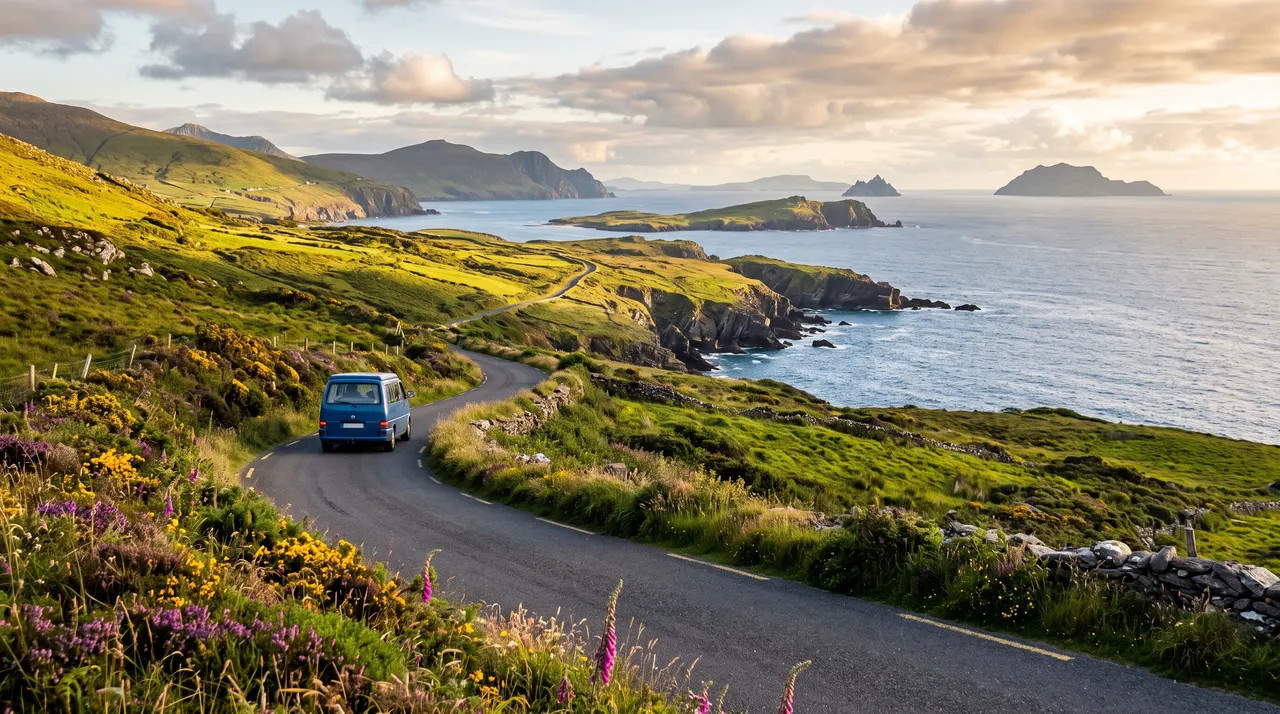
The Ring of Kerry, a roughly 180km loop around the Iveragh Peninsula on the Wild Atlantic Way, is Ireland's most celebrated scenic drive.
Sources: eflow.ie · ireland.com · blackcircles.com · tollguru.com
Ireland · common questions
What rental desks in Ireland ask foreign drivers for
| Rental company | Policy for foreign licences in Ireland |
|---|---|
| Hertz | Asks foreign drivers for a licence translation when the licence is not printed in the Roman alphabet, and often for non-EU renters in much of Europe. |
| Enterprise | Asks for a licence translation alongside your home licence in many countries across Europe, Asia and South America. |
| Alamo | Asks for a licence translation when the licence is in a non-Latin alphabet, and suggests one for all international renters. |
| Budget | Asks for a licence translation when your licence is not in the Roman alphabet. |
| National | Asks for a licence translation for non-Latin-alphabet licences and where local rules call for one. |
| Thrifty | Asks for a licence translation in select countries and for non-Roman-alphabet licences. |
| Sixt | Asks for a licence translation for licences issued outside the EU and not in the Roman alphabet. |
| Avis | Asks for a licence translation where the national licence is not in the Roman alphabet or where local rules call for one. |
Recommended for non-EU licences and requested for some non-Latin scripts. Minimum rental age in Ireland is typically 17+, with a young-driver surcharge usually applied under 25.