 Canada licence
  Ireland
Can you drive in Ireland with a Canada license?
Short answer: you can drive in Ireland with a Canada license; an International Driving Permit is recommended and is carried alongside your Canada license.
An International Driving Permit is recommended (not strictly required) for Canada licence holders driving in Ireland. Your Canada licence is in the Roman alphabet, but carrying one alongside it can help at rental desks and roadside checks. Carry both.
Canadian drivers should carry an International Driving Permit alongside their provincial licence when driving abroad. Your International Driving Permit is a certified multilingual translation of your existing licence, prepared in the 1949 Geneva and 1968 Vienna Convention format that Ireland recognises and carried alongside your national licence.


What driving in Ireland is like
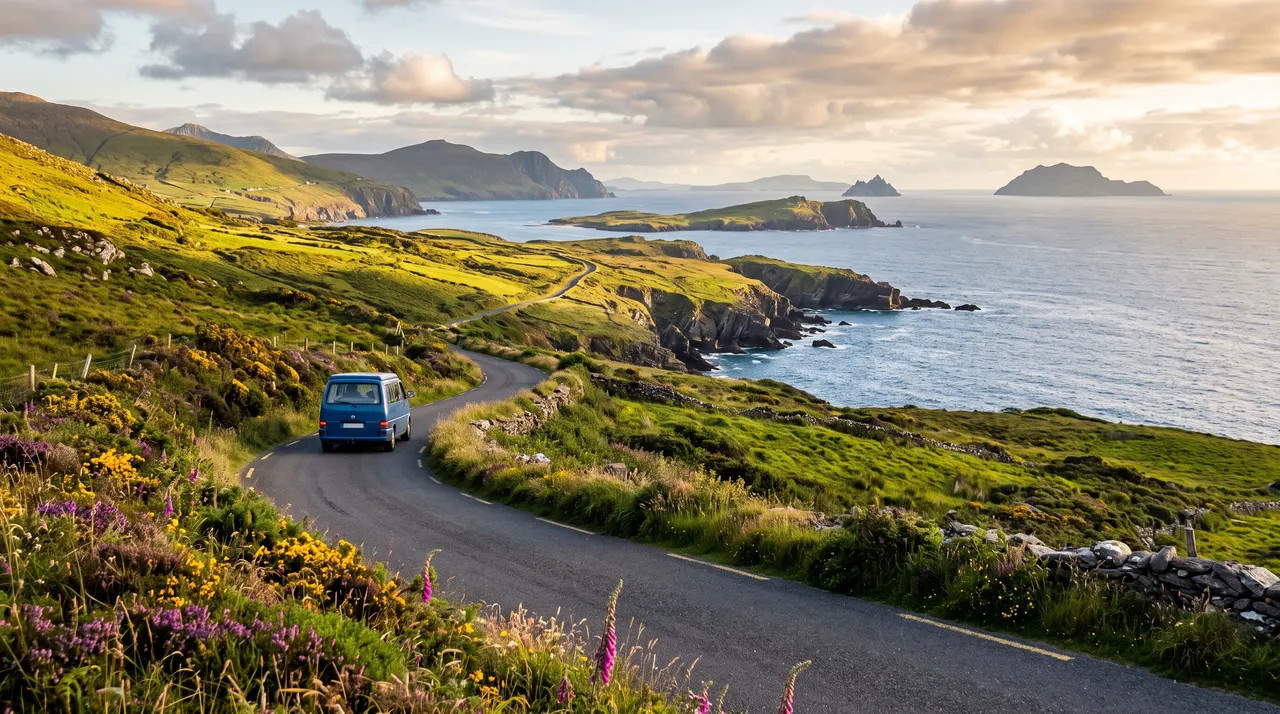
The Ring of Kerry, a roughly 180km loop around the Iveragh Peninsula on the Wild Atlantic Way, is Ireland's most celebrated scenic drive. For most visitors the real draw is the freedom to reach places trains and tours don't, on your own schedule, with the open road generally capped around 120 km/h motorways. Getting behind the wheel is the easy part: your International Driving Permit is a certified translation of your Canada licence, carried alongside it, so rental staff and officials in Ireland can read your credentials at a glance.
What applies to Canada licence holders in Ireland
| Canada licence in Ireland | |
|---|---|
| Do you need an IDP? | Recommended, not legally mandatory |
| IDP format required | 1949 Geneva or 1968 Vienna |
| Your Canada licence script | Roman (Latin) alphabet |
| Canada is party to | 1949 Geneva |
| Drives on the | Left-hand side |
| Minimum driving age | 17 |
| Emergency number | 112 or 999 |
| Top speed limit | 120 km/h motorways |
| Currency | EUR |
Driving rules in Ireland you should know
- Drive on the left.
- Speed limits posted in km/h.
- Seatbelts mandatory.
- 0.05% alcohol limit; 0.02% for learner/novice drivers.
Local driving facts in Ireland
Emergency number: 112 or 999 (112 also connects from most mobiles). Typical maximum for cars on the fastest road class: 120 km/h motorways. Posted limits always take precedence.
Tolls & road charges in Ireland
Most toll roads use cash/card plazas, but the M50 around Dublin is fully barrier-free (eFlow): cameras read your plate and the toll must be paid by 8pm the next day, online, by app or at Payzone outlets. Rental firms either include M50 tolls or bill them with an admin fee, so confirm at pickup; per-toll plaza charges are around EUR 2-3.
Parking in Ireland
Dublin and larger towns use pay-and-display (ticket machines or the apps), while smaller towns use a free or cheap cardboard parking disc bought in local shops and marked with your arrival time. Double yellow lines mean no parking, and clamping/release fees in Dublin are steep.
Penalties & enforcement in Ireland
Speeding carries a fixed charge of EUR 160 (rising if unpaid) plus penalty points, handheld phone use is EUR 120-plus and points, and not wearing a seatbelt is EUR 120. Gardai do not take roadside cash; fixed-charge notices and camera fines are passed via the rental firm to the driver.
If you have an accident in Ireland
Call 112 or 999 for Garda, ambulance or fire if anyone is injured or the road is blocked. Stop, exchange names, addresses, insurance and registration details, and report to the Gardai; do not admit liability and photograph the scene for your rental and insurance claim.
City driving in Ireland
The M50 is Dublin's busy orbital motorway and its barrier-free toll catches many visitors who do not realise they must pay online by 8pm the next day. Central Dublin also has extensive bus lanes and one-way systems that are heavily camera-enforced.
Winter driving in Ireland
No mandatory winter-tyre or chain law; tyres need only the 1.6mm minimum tread. Snow and ice are infrequent and usually short-lived, so chains are rarely needed.
Fuel in Ireland
Stations sell unleaded petrol and diesel (LPG is uncommon), self-service and paid at the kiosk or pay-at-pump; note diesel and petrol pumps are colour-coded differently than in some countries, so check before fuelling. Prices in 2026 sit around EUR 1.75-1.90 per litre.
Sources: eflow.ie, ireland.com, blackcircles.com, tollguru.com