 Canada licence
  France
Can you drive in France with a Canada license?
Short answer: to drive in France with a Canada license you need an International Driving Permit in the 1949 Geneva or 1968 Vienna format, carried together with your Canada license.
Yes — to drive in France on a Canada licence you should carry an International Driving Permit together with your Canada licence. France expects foreign drivers to hold an IDP.
Canadian drivers should carry an International Driving Permit alongside their provincial licence when driving abroad. Your International Driving Permit is a certified multilingual translation of your existing licence, prepared in the 1949 Geneva and 1968 Vienna Convention format that France recognises and carried alongside your national licence.


What driving in France is like
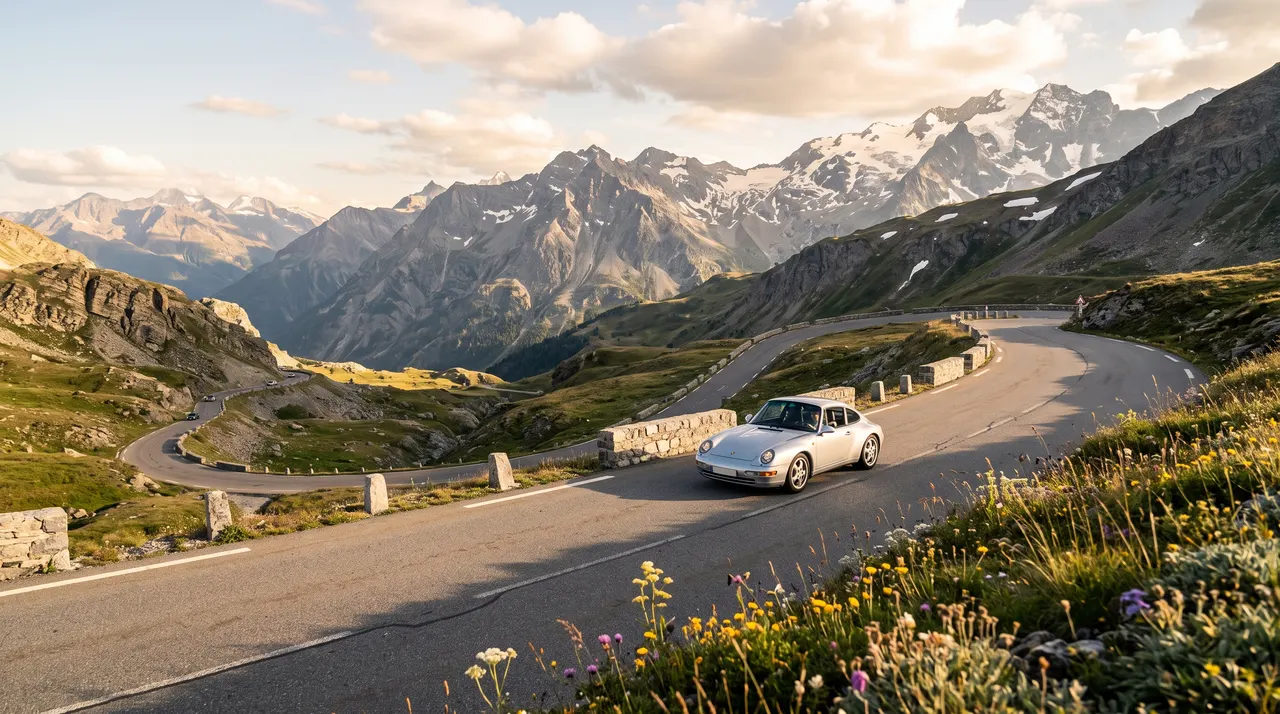
The Route des Grandes Alpes, a roughly 700 km alpine drive from Lake Geneva to the Mediterranean over high passes like the Col de l'Iseran, is a bucket-list route. For most visitors the real draw is the freedom to reach places trains and tours don't, on your own schedule, with the open road generally capped around 130 km/h motorways (110 in rain). Getting behind the wheel is the easy part: your International Driving Permit is a certified translation of your Canada licence, carried alongside it, so rental staff and officials in France can read your credentials at a glance.
What applies to Canada licence holders in France
| Canada licence in France | |
|---|---|
| Do you need an IDP? | Yes — carry one alongside your licence |
| IDP format required | 1949 Geneva or 1968 Vienna |
| Your Canada licence script | Roman (Latin) alphabet |
| Canada is party to | 1949 Geneva |
| Drives on the | Right-hand side |
| Minimum driving age | 18 |
| Emergency number | 112 |
| Top speed limit | 130 km/h motorways (110 in rain) |
| Currency | EUR |
Driving rules in France you should know
- Drive on the right; overtake on the left.
- Carry a reflective vest and warning triangle in the vehicle.
- Priority to the right (priorité à droite) applies at unmarked junctions.
- Strict 0.05% blood-alcohol limit (0.02% for new drivers).
Local driving facts in France
Emergency number: 112 (112 also connects from most mobiles). Typical maximum for cars on the fastest road class: 130 km/h motorways (110 in rain). Posted limits always take precedence.
Tolls & road charges in France
Most autoroutes are tolled (peage), paid at booths by cash, card or contactless, or via a Liber-T electronic tag; long-distance trips can run EUR 30-60+. Take a ticket on entry and pay by distance on exit; green-arrow lanes are for tag holders only.
Parking in France
Paid on-street parking (stationnement payant) is bought from horodateur meters or apps like PayByPhone/Flowbird, often EUR 2-6/hour in cities; many central spaces are resident-only (zone residentielle). Overstaying triggers a forfait post-stationnement fine and persistent offenders risk towing (mise en fourriere).
Penalties & enforcement in France
On-the-spot fines are common for foreign drivers: speeding starts around EUR 68-135 (more for higher bands), handheld phone use EUR 135, no seatbelt EUR 135; police may demand immediate payment or a deposit. Radar/speed-camera fines are forwarded to the rental company, which passes them to you with an admin fee, and radar detectors are illegal.
If you have an accident in France
Call 112 (or 15 SAMU / 17 police); police attendance is required if anyone is injured. For damage-only crashes complete and both-sign the constat amiable (European Accident Statement), do not move vehicles if there are injuries, and send the form to the insurer/rental firm within 5 days.
City driving in France
Paris runs a permanent low-emission zone (ZFE) requiring a Crit'Air windscreen sticker; cars rated Crit'Air 4-5 are banned and driving without a valid sticker risks a EUR 68-135 fine. Order the sticker in advance at certificat-air.gouv.fr as postal delivery takes 1-2 weeks.
Winter driving in France
Since the Loi Montagne, from 1 November to 31 March vehicles in 34 designated mountain departements (Alps, Pyrenees, Massif Central, Vosges, Jura, Corsica) must have winter tyres or snow chains. Outside these zones there is no national winter-tyre mandate.
Fuel in France
Stations sell unleaded petrol (SP95, SP95-E10, SP98) and diesel (gazole/B7); most are self-service (libre-service) and many are 24h automated card-only. Foreign chip-and-PIN cards usually work, but some unmanned pumps reject non-French cards, so keep cash as backup; petrol runs roughly EUR 1.75-1.95/litre.
Sources: service-public.gouv.fr, france.fr, eta.co.uk, europa.eu