Do you need an International Driving Permit to drive in Portugal?


Sourced from the 1949 Geneva & 1968 Vienna Conventions and rental-network policies

What the rules require
When do you need an IDP in Portugal?
Non-EU visitors should carry an IDP to drive and rent in Portugal.
Does renting a car in Portugal require an IDP?
Requested for licences issued outside the EU/EEA. Having your permit ready avoids losing your reservation at the counter.
Driving rules in Portugal you should know
- Electronic tolls (Via Verde) — arrange with your rental car.
- Reflective vest and triangle required.
- 0.05% alcohol limit; 0.02% for new drivers.
- Dipped headlights in tunnels.
How long is an IDP valid in Portugal?
Portugal honours both the 1949 Geneva and 1968 Vienna Convention formats. A 1949-format IDP is valid for up to 1 year; a 1968-format IDP can be valid for up to 3 years, or until your national licence expires. If you travel regularly, the validity clock starts on the issue date, not on first use — so order close to your departure to maximise usable time.
Documents checklist for driving in Portugal
- Your original national driving licence — the IDP is a translation and is never valid on its own.
- Your International Driving Permit, in the 1949 Geneva and 1968 Vienna Convention format Portugal uses.
- Your passport or accepted national ID for police checks and rental pick-up.
- For rentals: the credit card used for the booking and your rental agreement (it covers the registration and insurance papers).
- Local currency or a card for road costs — Portugal uses the EUR.
Driving in Portugal: the practical detail
Sourced from national road authorities, motoring clubs and rental policies — the things that actually catch foreign drivers out.
Driving on a foreign licence
EU/EEA licences are valid for the licence's lifetime. Non-EU visitors may drive on a valid home licence (with an IDP recommended, and required if the licence is not in a Roman alphabet) for the duration of a tourist stay; an IDP is strongly advised to avoid rental and police complications.
Tolls & road charges
Portugal mixes staffed toll plazas with fully electronic 'ex-SCUT' motorways that have no booths and read your plate via Via Verde. Rental cars carry a Via Verde transponder (about EUR 1-2/day plus tolls billed to your card); independent drivers can use EASYToll, registering a card to the plate at a border/airport kiosk for EUR 1 setup plus per-transit charges.
Parking in the cities
In Lisbon paid zones are run by EMEL (pay by machine or app), and Porto and other cities have similar metered zones; bays are scarce and illegal-parking fines reach about EUR 300. Peripheral park-and-ride plus public transport into the centre is the practical option.
Winter & seasonal rules
Winter tyres and chains are not mandatory; tyres only need the 1.6mm legal minimum tread. Snow is confined to the Serra da Estrela highlands, where chains may occasionally be needed in winter.
Fuel & filling up
Stations sell gasolina (unleaded 95/98) and gasoleo (diesel), mostly self-service paid at the till, with cards widely accepted; main chains are Galp, Repsol, BP and Cepsa. In 2026 petrol averages around EUR 1.65 and diesel around EUR 1.55 per litre, dearer on motorways.
If you have an accident
Call 112 for emergencies (the GNR or PSP handle road policing). For a minor crash, complete the European Accident Statement (Declaracao Amigavel) jointly with the other driver; call police if there is injury, a dispute, or a driver without documents, and do not move vehicles before documenting an injury crash.
Driving in the capital
Lisbon's steep, narrow tram-lined streets and the Baixa/Chiado area are heavily restricted and hard to drive; the city also operates a low-emission ZER zone in the historic centre limiting older vehicles. Trams always have priority and many lanes are tram/bus only.
Fines & enforcement
Speeding fines start around EUR 60 and rise sharply, and police can demand on-the-spot payment from non-residents (a deposit) for offences such as speeding, phone use or no seatbelt before allowing you to continue. Camera fines to foreign drivers are passed on by rental firms with an admin fee.
A drive worth taking
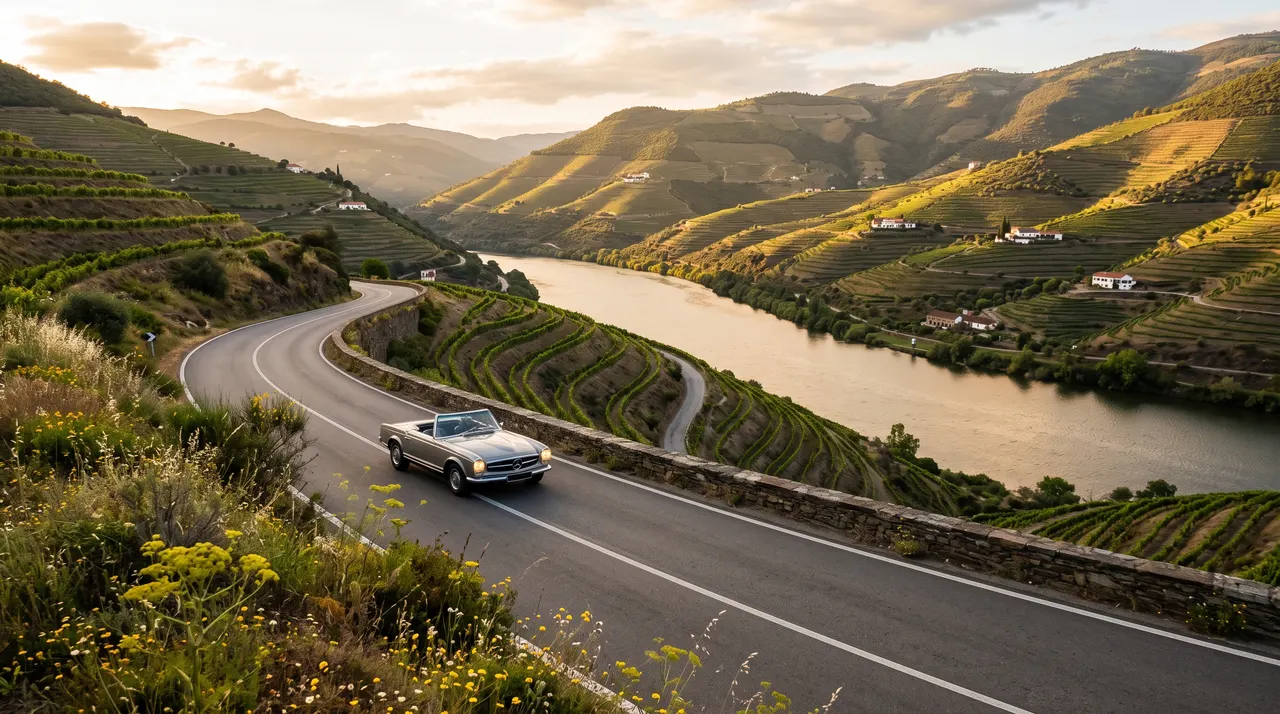
The N222 along the Douro valley from Peso da Regua to Pinhao, repeatedly rated one of the world's best driving roads, winds through terraced vineyards above the river.
Sources: hertz.pt · carjet.com · estatefy.com · guerin.pt
Portugal · common questions
What rental desks in Portugal ask foreign drivers for
| Rental company | Policy for foreign licences in Portugal |
|---|---|
| Hertz | Asks foreign drivers for a licence translation when the licence is not printed in the Roman alphabet, and often for non-EU renters in much of Europe. |
| Enterprise | Asks for a licence translation alongside your home licence in many countries across Europe, Asia and South America. |
| Alamo | Asks for a licence translation when the licence is in a non-Latin alphabet, and suggests one for all international renters. |
| Budget | Asks for a licence translation when your licence is not in the Roman alphabet. |
| National | Asks for a licence translation for non-Latin-alphabet licences and where local rules call for one. |
| Thrifty | Asks for a licence translation in select countries and for non-Roman-alphabet licences. |
| Sixt | Asks for a licence translation for licences issued outside the EU and not in the Roman alphabet. |
| Avis | Asks for a licence translation where the national licence is not in the Roman alphabet or where local rules call for one. |
Requested for licences issued outside the EU/EEA. Minimum rental age in Portugal is typically 18+, with a young-driver surcharge usually applied under 25.