Do you need an International Driving Permit to drive in Russia?
This is a private translation, not a government-issued permit. If Russia requires the official document for your specific situation, confirm with its motor authority before you order.


Sourced from the 1949 Geneva & 1968 Vienna Conventions and rental-network policies
What the rules require
When do you need an IDP in Russia?
Russia drives on the right under the 1968 Vienna Convention and uses Cyrillic, so an IDP helps translate non-Cyrillic licences for desks and police.
Does renting a car in Russia require an IDP?
Desks ask for an IDP for any non-Cyrillic licence. Having your permit ready avoids losing your reservation at the counter.
Driving rules in Russia you should know
- Drive on the right.
- Zero-tolerance alcohol limit (0.0%).
- Headlights on at all times.
- Carry passport, IDP and home licence.
How long is an IDP valid in Russia?
Russia uses the 1968 Vienna Convention format, under which an IDP can be valid for up to 3 years — or until your national licence expires, whichever comes first. If you travel regularly, the validity clock starts on the issue date, not on first use — so order close to your departure to maximise usable time.
Documents checklist for driving in Russia
- Your original national driving licence — the IDP is a translation and is never valid on its own.
- Your International Driving Permit, prepared in the 1968 Vienna Convention format that Russia recognises.
- Your passport or accepted national ID for police checks and rental pick-up.
- For rentals: the credit card used for the booking and your rental agreement (it covers the registration and insurance papers).
- Local currency or a card for road costs — Russia uses the RUB.
Driving in Russia: the practical detail
Sourced from national road authorities, motoring clubs and rental policies — the things that actually catch foreign drivers out.
Driving on a foreign licence
A foreign tourist may drive on a valid national licence for up to 60 days after arrival; if the licence is not in Russian/Cyrillic an International Driving Permit (1949 or 1968 Convention) is required, and rental firms generally insist on an IDP plus passport and credit card.
Tolls & road charges
Most roads are free, but several modern highways (e.g. the M11 Neva Moscow-St Petersburg and M4 Don sections) are tolled; pay cash or card at toll plazas, or use a T-pass/Transponder transponder for the barrier lanes.
Parking in the cities
Central Moscow and St Petersburg have paid zones marked by blue signs, paid via the Moscow Parking app, parkomat machines or SMS; unpaid or wrongly parked cars are ticketed by camera and frequently towed to an impound lot.
Winter & seasonal rules
Winter tyres marked M+S or 3PMSF are legally mandatory in December, January and February; studded or winter tyres are widely fitted from roughly October to April given severe ice and snow.
Fuel & filling up
Petrol is sold as AI-92, AI-95 and AI-98, with diesel (DT/ДТ) common; most stations are full self-serve where you prepay the cashier first, and cards are accepted, with petrol cheap by Western standards.
If you have an accident
Dial 112 (general emergency) or 102 for police; you must call the traffic police (GIBDD, formerly GAI) and obtain their report, and you must not move the vehicles until they document the scene unless a minor crash qualifies for the Europrotokol self-report form.
Driving in the capital
Moscow's MKAD ring road is a fast, heavily trafficked beltway, and the historic centre inside the Garden Ring (Sadovoye Koltso) is congested with strict camera-enforced paid parking.
Fines & enforcement
Foreign drivers face common fines such as roughly 500 RUB for no seatbelt, 1,500 RUB for handheld phone use and 500-5,000 RUB for speeding bands; many are camera-issued, and rental firms deduct camera penalties plus an admin fee from your card.
A drive worth taking
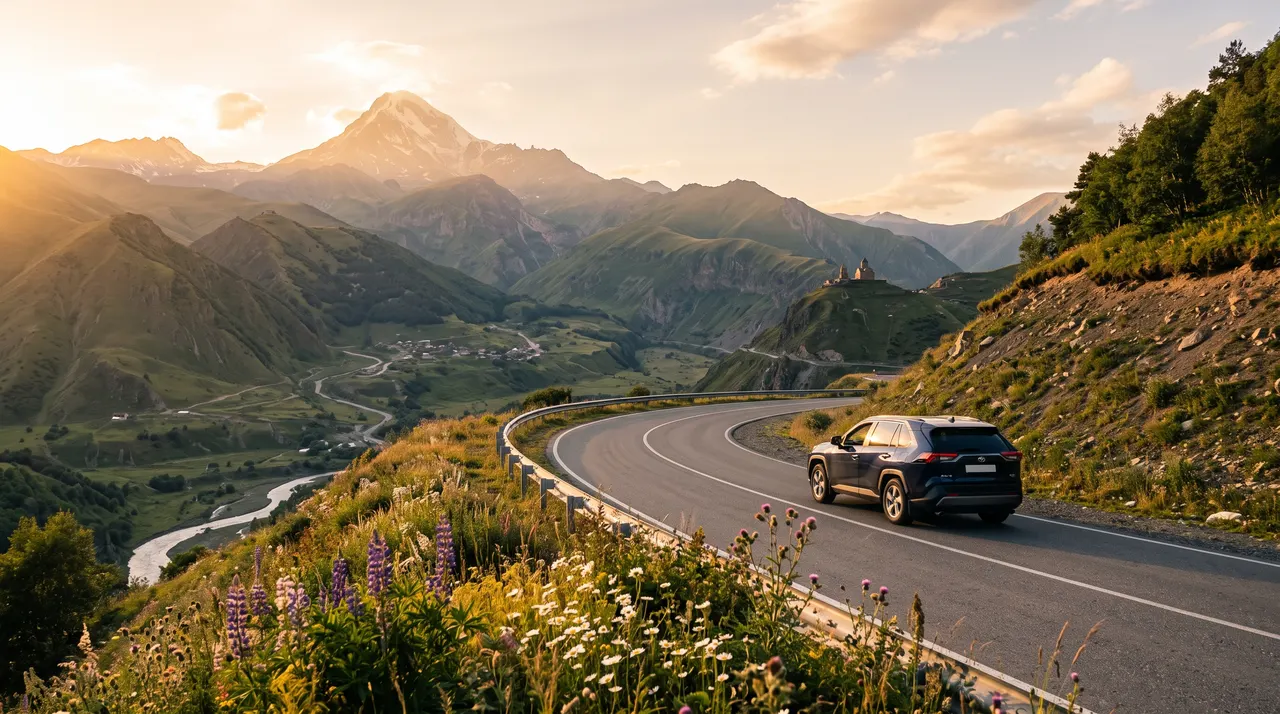
The Georgian Military Road and the Black Sea coastal route around Sochi are the classic scenic drives travellers seek out.
Sources: en.wikivoyage.org · en.wikipedia.org · remitly.com
Russia · common questions
What rental desks in Russia ask foreign drivers for
| Rental company | Policy for foreign licences in Russia |
|---|---|
| Hertz | Asks foreign drivers for a licence translation when the licence is not printed in the Roman alphabet, and often for non-EU renters in much of Europe. |
| Enterprise | Asks for a licence translation alongside your home licence in many countries across Europe, Asia and South America. |
| Alamo | Asks for a licence translation when the licence is in a non-Latin alphabet, and suggests one for all international renters. |
| Budget | Asks for a licence translation when your licence is not in the Roman alphabet. |
| National | Asks for a licence translation for non-Latin-alphabet licences and where local rules call for one. |
| Thrifty | Asks for a licence translation in select countries and for non-Roman-alphabet licences. |
| Sixt | Asks for a licence translation for licences issued outside the EU and not in the Roman alphabet. |
| Avis | Asks for a licence translation where the national licence is not in the Roman alphabet or where local rules call for one. |
Desks ask for an IDP for any non-Cyrillic licence. Minimum rental age in Russia is typically 18+, with a young-driver surcharge usually applied under 25.