 UK licence
  Israel
Can you drive in Israel with a UK license?
Short answer: you can drive in Israel with a UK license; an International Driving Permit is recommended and is carried alongside your UK license.
An International Driving Permit is recommended (not strictly required) for UK licence holders driving in Israel. Your UK licence is in the Roman alphabet, but carrying one alongside it can help at rental desks and roadside checks. Carry both.
UK drivers should carry an International Driving Permit with their licence; some countries recognise the 1949 version and others the 1968 version. Your International Driving Permit is a certified multilingual translation of your existing licence, prepared in the 1949 Geneva Convention format that Israel recognises and carried alongside your national licence.


What driving in Israel is like
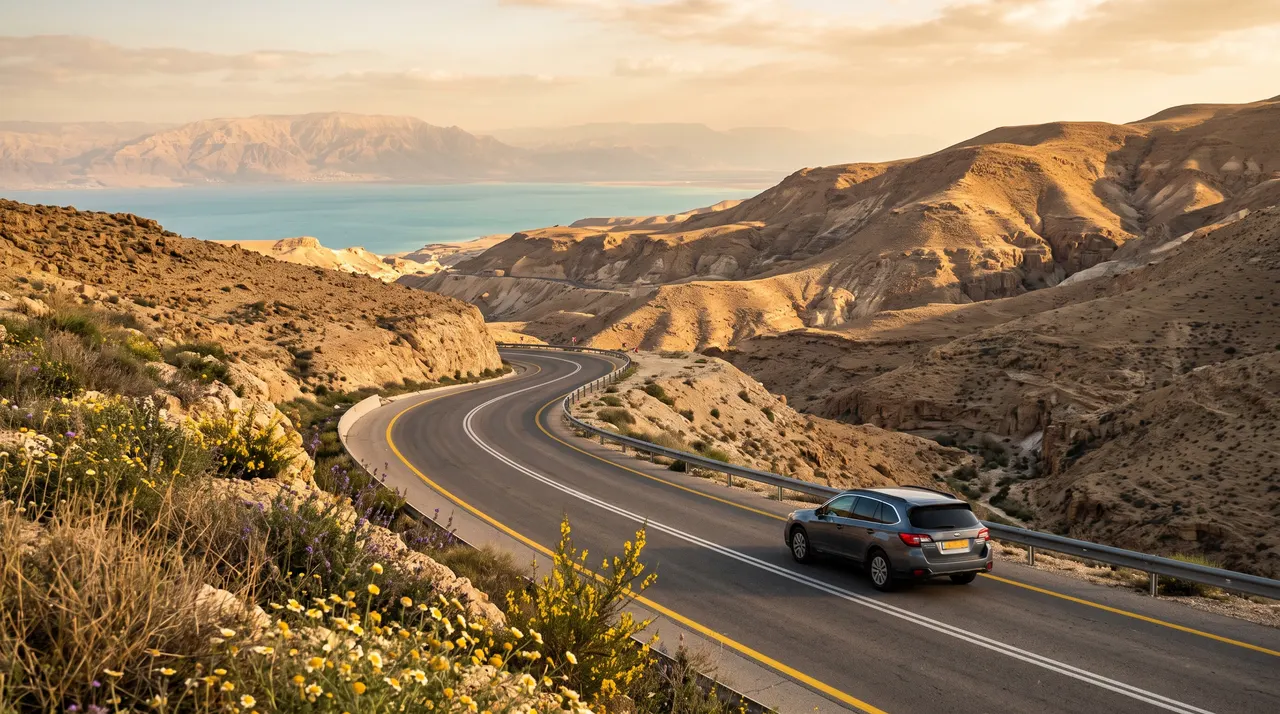
The descent through the Judean Desert from Jerusalem to the Dead Sea on Route 1/90, and the Galilee panorama roads, are the most sought-after Israeli drives. For most visitors the real draw is the freedom to reach places trains and tours don't, on your own schedule, with the open road generally capped around 110 km/h on Highway 6. Getting behind the wheel is the easy part: your International Driving Permit is a certified translation of your UK licence, carried alongside it, so rental staff and officials in Israel can read your credentials at a glance.
What applies to UK licence holders in Israel
| UK licence in Israel | |
|---|---|
| Do you need an IDP? | Recommended, not legally mandatory |
| IDP format required | 1949 Geneva |
| Your UK licence script | Roman (Latin) alphabet |
| United Kingdom is party to | 1949 Geneva and 1968 Vienna |
| Drives on the | Right-hand side |
| Minimum driving age | 17 |
| Emergency number | 100 (police), 101 (ambulance) |
| Top speed limit | 110 km/h on Highway 6 |
| Currency | ILS |
Driving rules in Israel you should know
- Headlights on inter-urban roads, Nov–Mar.
- 0.05% alcohol limit; 0.01% for new/young drivers.
- Highway 6 uses automatic plate tolling.
- Seatbelts mandatory.
Local driving facts in Israel
Emergency number: 100 (police), 101 (ambulance) (112 also connects from most mobiles). Typical maximum for cars on the fastest road class: 110 km/h on Highway 6. Posted limits always take precedence.
Tolls & road charges in Israel
Highway 6 (Kvish Shesh) is the main toll road and is fully electronic by plate with no booths; the charge plus a service fee is added to your rental bill. The fast-lane (Kvish Mahir) into Tel Aviv and the Carmel/Gilon tunnels are also electronically tolled.
Parking in Israel
Kerb markings set the rule: blue-and-white means paid parking (via app such as Pango/Cellopark or meter), red-and-white means no stopping, and grey/unmarked is free. Residential blue zones and unpaid bays are ticketed and cars can be towed.
Penalties & enforcement in Israel
Speeding, phone-use and seatbelt offences are largely camera- and patrol-enforced with fines from a few hundred shekels; there are no informal cash payments. Rental firms pass camera tickets to your card with a handling fee.
If you have an accident in Israel
Call police on 100 (ambulance 101); a police report is required for injuries or disputed fault. Photograph the scene, exchange details, and do not move vehicles on an injury accident - notify your rental company before leaving.
City driving in Israel
Tel Aviv parking is acutely scarce and tightly enforced: blue-and-white bays need the Pango app and many central streets are resident-only, so visitors typically use paid lots or park outside the centre.
Winter driving in Israel
No mandatory winter-tyre rules; snow is rare and confined to higher ground (Jerusalem hills, Golan, Mount Hermon), where roads may close briefly during winter storms.
Fuel in Israel
Stations offer self-service (lower price) or attendant service; petrol is 95 and 98 octane and diesel ('solar') is also sold, at a government-capped 95-octane price around ILS 7 per litre. Foreign cards sometimes fail at automated pumps, so pay the attendant.
Sources: tollguru.com, autoeurope.ie, tamir-rental.com