Do you need an International Driving Permit to drive in Armenia?
This is a private translation, not a government-issued permit. If Armenia requires the official document for your specific situation, confirm with its motor authority before you order.


Sourced from the 1949 Geneva & 1968 Vienna Conventions and rental-network policies
What the rules require
When do you need an IDP in Armenia?
Armenia drives on the right under the 1968 Vienna Convention and uses its own script, so an IDP is advised to translate your licence.
Does renting a car in Armenia require an IDP?
Yerevan desks ask for an IDP with non-Latin-script licences. Having your permit ready avoids losing your reservation at the counter.
Driving rules in Armenia you should know
- Drive on the right.
- Headlights on outside cities.
- Zero-tolerance alcohol policy.
- Mountain roads with steep grades.
How long is an IDP valid in Armenia?
Armenia uses the 1968 Vienna Convention format, under which an IDP can be valid for up to 3 years — or until your national licence expires, whichever comes first. If you travel regularly, the validity clock starts on the issue date, not on first use — so order close to your departure to maximise usable time.
Documents checklist for driving in Armenia
- Your original national driving licence — the IDP is a translation and is never valid on its own.
- Your International Driving Permit, prepared in the 1968 Vienna Convention format that Armenia recognises.
- Your passport or accepted national ID for police checks and rental pick-up.
- For rentals: the credit card used for the booking and your rental agreement (it covers the registration and insurance papers).
- Local currency or a card for road costs — Armenia uses the AMD.
Driving in Armenia: the practical detail
Sourced from national road authorities, motoring clubs and rental policies — the things that actually catch foreign drivers out.
Driving on a foreign licence
Since 2024 Armenia ended its grace period for foreign licences, so a visitor should carry a 1968 Vienna Convention-compliant licence or a national licence together with an International Driving Permit. The IDP/national licence combination is valid for the duration of a tourist stay (up to 180 days).
Tolls & road charges
Armenia has no toll roads, and the previous road-use charge for foreign-registered vehicles was abolished in 2018, so tourists pay nothing to use the highway network. No vignette is required.
Parking in the cities
Central Yerevan has paid parking marked by red lines, split into Zone A (around 300 AMD/hour) and Zone B (around 200 AMD/hour), with the first 15 minutes and 00:00-09:00 free. The system is fully cashless via app or terminal, and non-payment brings a 5,000 AMD fine.
Winter & seasonal rules
Winter tyres are not legally mandated by fixed dates, but mountain passes get heavy snow and ice from roughly November to March, so winter or all-season tyres and chains are strongly recommended for the highlands.
Fuel & filling up
Petrol (benzin) and diesel are widely available, and many cars run on cheaper compressed methane/LPG. Stations are attended, accept cards in cities, and prices are moderate by regional standards; keep fuel topped up before remote mountain routes.
If you have an accident
Call 102 for police (or 911 unified emergency); do not move the vehicles until police document the scene, as a police report is required for any insurance claim. Drivers must mark the scene and wait for the traffic police to attend.
Driving in the capital
In Yerevan, driving is assertive with frequent abrupt lane changes, and roundabouts such as those on the central ring demand caution; the red-line paid-parking zones in the downtown core are strictly enforced. Watch for cars stopping suddenly to pick up passengers.
Fines & enforcement
Speed and red-light cameras are widespread and rental firms pass camera fines to the renter's card; common fines include roughly 5,000 AMD for minor speeding and 10,000 AMD for phone use without a hands-free kit. Seatbelt non-use is also fined, and serious speeding escalates sharply.
A drive worth taking
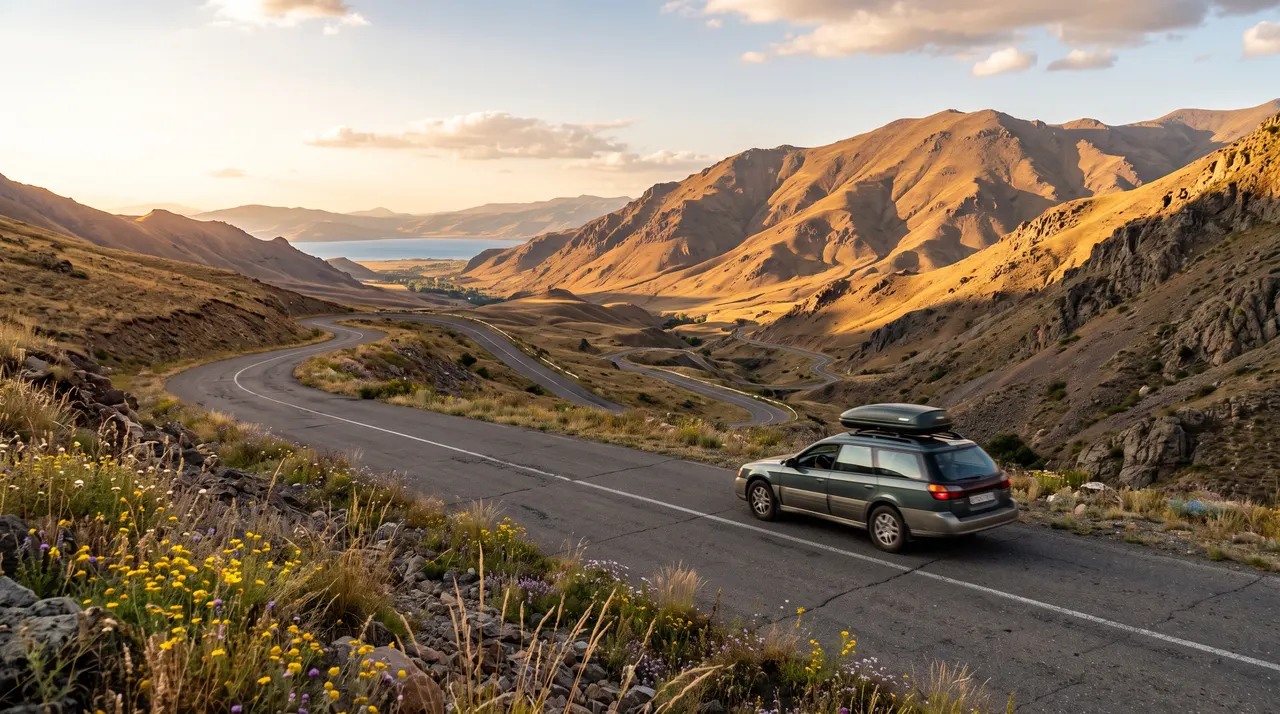
The mountain road to Lake Sevan and onward over the Selim (Vardenyats) Pass along the old Silk Road is a celebrated drive.
Sources: secrental.com · yerevan.am · rentacar-armenia.com
Armenia · common questions
What rental desks in Armenia ask foreign drivers for
| Rental company | Policy for foreign licences in Armenia |
|---|---|
| Hertz | Asks foreign drivers for a licence translation when the licence is not printed in the Roman alphabet, and often for non-EU renters in much of Europe. |
| Enterprise | Asks for a licence translation alongside your home licence in many countries across Europe, Asia and South America. |
| Alamo | Asks for a licence translation when the licence is in a non-Latin alphabet, and suggests one for all international renters. |
| Budget | Asks for a licence translation when your licence is not in the Roman alphabet. |
| National | Asks for a licence translation for non-Latin-alphabet licences and where local rules call for one. |
| Thrifty | Asks for a licence translation in select countries and for non-Roman-alphabet licences. |
| Sixt | Asks for a licence translation for licences issued outside the EU and not in the Roman alphabet. |
| Avis | Asks for a licence translation where the national licence is not in the Roman alphabet or where local rules call for one. |
Yerevan desks ask for an IDP with non-Latin-script licences. Minimum rental age in Armenia is typically 18+, with a young-driver surcharge usually applied under 25.