Do you need an International Driving Permit to drive in South Korea?


Sourced from the 1949 Geneva & 1968 Vienna Conventions and rental-network policies

What the rules require
When do you need an IDP in South Korea?
South Korea commonly asks foreign drivers for an IDP issued in their home country alongside their national licence.
Does renting a car in South Korea require an IDP?
1949 Geneva IDP requested at all rental desks. Having your permit ready avoids losing your reservation at the counter.
Driving rules in South Korea you should know
- Extensive speed and red-light camera network.
- 0.03% alcohol limit; licence revoked above 0.08%.
- Bus lanes restricted during set hours.
- Carry passport, IDP and home licence.
How long is an IDP valid in South Korea?
South Korea uses the 1949 Geneva Convention format, under which an IDP is valid for up to 1 year from its issue date. If you travel regularly, the validity clock starts on the issue date, not on first use — so order close to your departure to maximise usable time.
Documents checklist for driving in South Korea
- Your original national driving licence — the IDP is a translation and is never valid on its own.
- Your International Driving Permit, in the 1949 Geneva Convention format South Korea uses.
- Your passport or accepted national ID for police checks and rental pick-up.
- For rentals: the credit card used for the booking and your rental agreement (it covers the registration and insurance papers).
- Local currency or a card for road costs — South Korea uses the KRW.
Driving in South Korea: the practical detail
Sourced from national road authorities, motoring clubs and rental policies — the things that actually catch foreign drivers out.
Driving on a foreign licence
South Korea accepts a valid Geneva Convention IDP carried with the original home licence; you must hold both, and the IDP is valid for up to one year. Rental firms and police require the IDP, so a home licence alone is not sufficient to legally drive.
Tolls & road charges
Expressways use the Hi-Pass electronic system; if your rental has a Hi-Pass transponder use the blue Hi-Pass lanes, otherwise take the cash/card hybrid lanes and never enter a Hi-Pass-only lane. A Seoul-Busan trip costs roughly 20,000-25,000 KRW and tolls are payable by cash, card or T-money.
Parking in the cities
Street parking is scarce and metered; pay at the meter or machine and reverse-parking is the local norm in narrow bays. Cities use paid public lots and underground mall garages (often 1,000-3,000 KRW per 30 min), and illegally parked cars in central Seoul are ticketed or towed.
Winter & seasonal rules
Winter tyres or chains are recommended/required on snowbound mountain and expressway sections in deep winter (roughly December-February); rental cars in colder regions can be requested with winter tyres, and chains may be enforced during heavy snow on highland passes.
Fuel & filling up
Stations sell '가솔린/휘발유' (petrol, regular ~92 octane) and '경유' (diesel); both attended and self-service ('셀프') pumps are common and cards are accepted everywhere. Petrol typically runs around 1,600-1,750 KRW per litre.
If you have an accident
Call 112 for police and 119 for ambulance/fire; for any injury or insurance claim file a police report and do not leave the scene. Photograph vehicle positions before moving, and avoid privately settling with the other party as fault is determined for insurance.
Driving in the capital
Seoul is blanketed with fixed, mobile and average-speed ('section') cameras, and many tunnels and bus-only median lanes carry their own restrictions; the bus lanes (blue-marked, time-restricted) are heavily fined if entered by a rental car.
Fines & enforcement
Speeding fines commonly run 30,000-120,000+ KRW (school zones, 30 km/h, double fines from 2026), phone-without-handsfree and seatbelt are fined, and drink-driving at 0.03% BAC or above is severely punished. Camera fines are billed to the renter's card with an admin fee; some on-the-spot fines apply at stops.
A drive worth taking
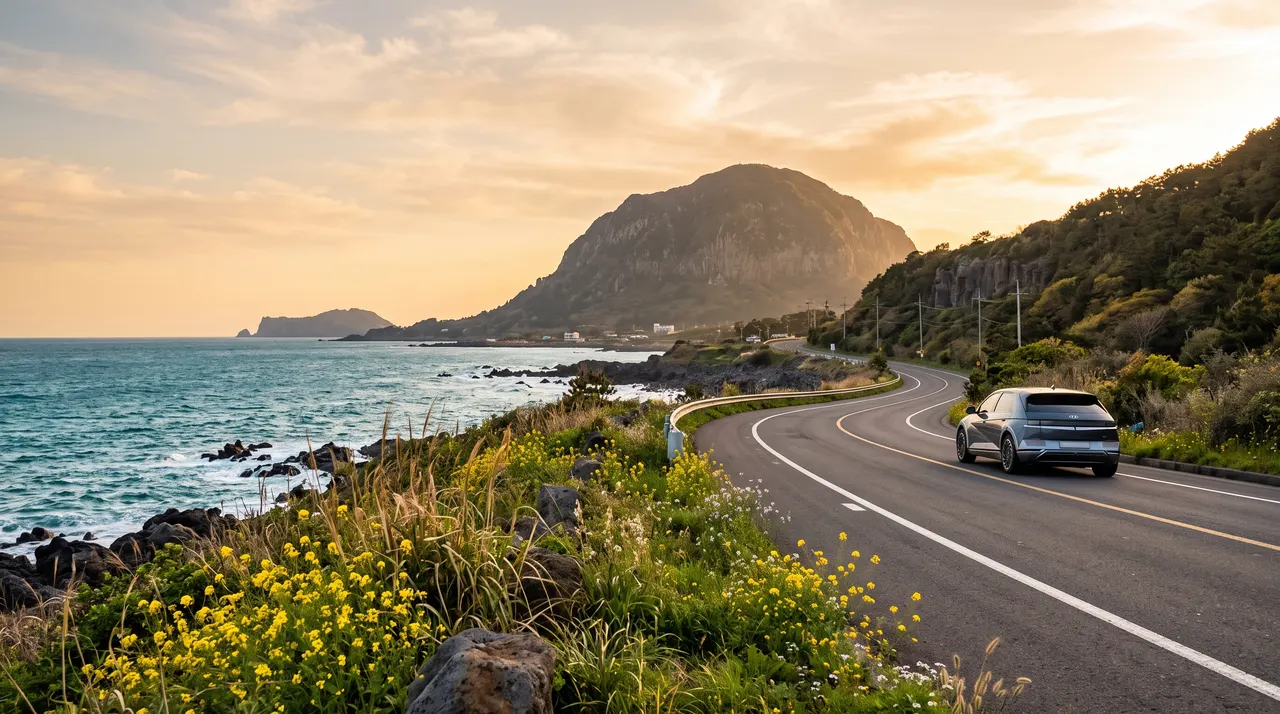
Jeju Island's coastal Route 1132 ring road circling the island past beaches and Hallasan is Korea's signature scenic drive.
Sources: inmykorea.com · haniseoul.com · english.visitkorea.or.kr · en.wikipedia.org
South Korea · common questions
What rental desks in South Korea ask foreign drivers for
| Rental company | Policy for foreign licences in South Korea |
|---|---|
| Hertz | Asks foreign drivers for a licence translation when the licence is not printed in the Roman alphabet, and often for non-EU renters in much of Europe. |
| Enterprise | Asks for a licence translation alongside your home licence in many countries across Europe, Asia and South America. |
| Alamo | Asks for a licence translation when the licence is in a non-Latin alphabet, and suggests one for all international renters. |
| Budget | Asks for a licence translation when your licence is not in the Roman alphabet. |
| National | Asks for a licence translation for non-Latin-alphabet licences and where local rules call for one. |
| Thrifty | Asks for a licence translation in select countries and for non-Roman-alphabet licences. |
| Sixt | Asks for a licence translation for licences issued outside the EU and not in the Roman alphabet. |
| Avis | Asks for a licence translation where the national licence is not in the Roman alphabet or where local rules call for one. |
1949 Geneva IDP requested at all rental desks. Minimum rental age in South Korea is typically 18+, with a young-driver surcharge usually applied under 25.