 US licence
  South Korea
Can you drive in South Korea with a US license?
Short answer: to drive in South Korea with a US license you need an International Driving Permit in the 1949 Geneva format, carried together with your US license.
Yes — to drive in South Korea on a US licence you should carry an International Driving Permit together with your US licence. South Korea expects foreign drivers to hold an IDP.
U.S. drivers should carry an International Driving Permit alongside their state licence when driving or renting a car abroad. Your International Driving Permit is a certified multilingual translation of your existing licence, prepared in the 1949 Geneva format and carried alongside your national licence.


What driving in South Korea is like
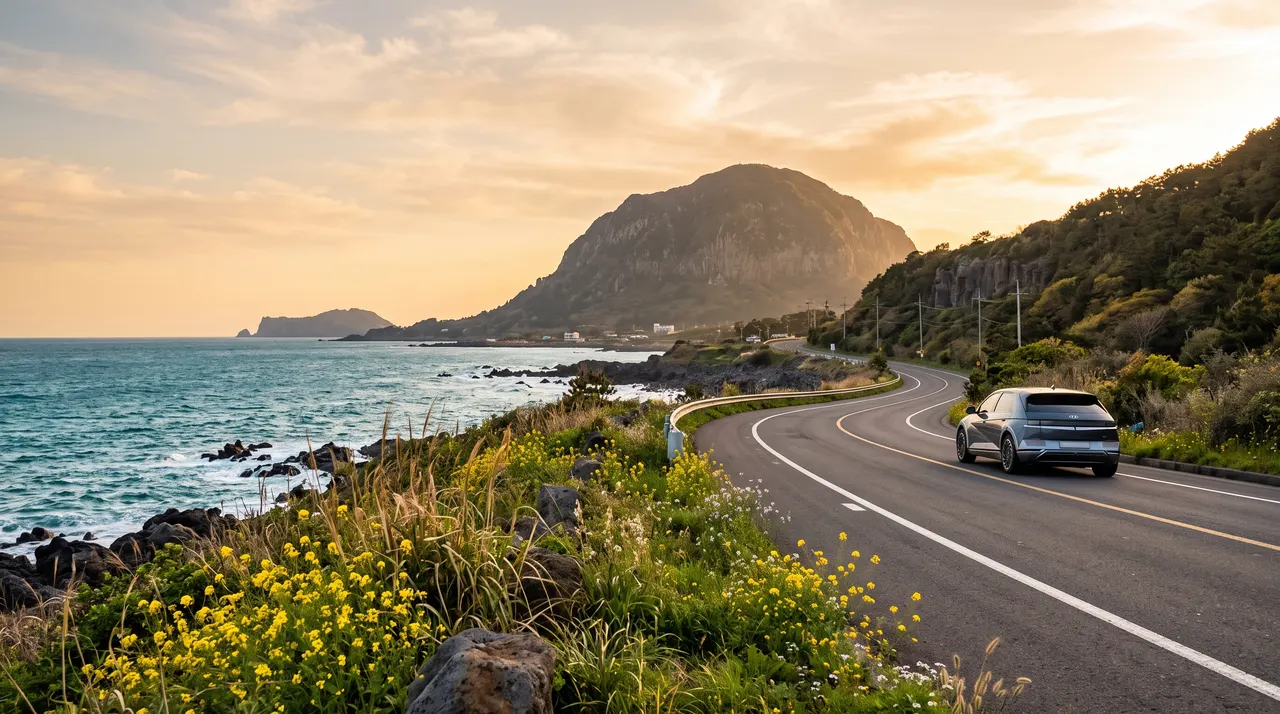
Jeju Island's coastal Route 1132 ring road circling the island past beaches and Hallasan is Korea's signature scenic drive. For most visitors the real draw is the freedom to reach places trains and tours don't, on your own schedule, with the open road generally capped around 100–120 km/h expressways. Getting behind the wheel is the easy part: your International Driving Permit is a certified translation of your US licence, carried alongside it, so rental staff and officials in South Korea can read your credentials at a glance.
What applies to US licence holders in South Korea
| US licence in South Korea | |
|---|---|
| Do you need an IDP? | Yes — carry one alongside your licence |
| IDP format required | 1949 Geneva |
| Your US licence script | Roman (Latin) alphabet |
| United States is party to | 1949 Geneva |
| Drives on the | Right-hand side |
| Minimum driving age | 18 |
| Emergency number | 112 (police), 119 (ambulance) |
| Top speed limit | 100–120 km/h expressways |
| Currency | KRW |
Driving rules in South Korea you should know
- Extensive speed and red-light camera network.
- 0.03% alcohol limit; licence revoked above 0.08%.
- Bus lanes restricted during set hours.
- Carry passport, IDP and home licence.
Local driving facts in South Korea
Emergency number: 112 (police), 119 (ambulance) (112 also connects from most mobiles). Typical maximum for cars on the fastest road class: 100–120 km/h expressways. Posted limits always take precedence.
Tolls & road charges in South Korea
Expressways use the Hi-Pass electronic system; if your rental has a Hi-Pass transponder use the blue Hi-Pass lanes, otherwise take the cash/card hybrid lanes and never enter a Hi-Pass-only lane. A Seoul-Busan trip costs roughly 20,000-25,000 KRW and tolls are payable by cash, card or T-money.
Parking in South Korea
Street parking is scarce and metered; pay at the meter or machine and reverse-parking is the local norm in narrow bays. Cities use paid public lots and underground mall garages (often 1,000-3,000 KRW per 30 min), and illegally parked cars in central Seoul are ticketed or towed.
Penalties & enforcement in South Korea
Speeding fines commonly run 30,000-120,000+ KRW (school zones, 30 km/h, double fines from 2026), phone-without-handsfree and seatbelt are fined, and drink-driving at 0.03% BAC or above is severely punished. Camera fines are billed to the renter's card with an admin fee; some on-the-spot fines apply at stops.
If you have an accident in South Korea
Call 112 for police and 119 for ambulance/fire; for any injury or insurance claim file a police report and do not leave the scene. Photograph vehicle positions before moving, and avoid privately settling with the other party as fault is determined for insurance.
City driving in South Korea
Seoul is blanketed with fixed, mobile and average-speed ('section') cameras, and many tunnels and bus-only median lanes carry their own restrictions; the bus lanes (blue-marked, time-restricted) are heavily fined if entered by a rental car.
Winter driving in South Korea
Winter tyres or chains are recommended/required on snowbound mountain and expressway sections in deep winter (roughly December-February); rental cars in colder regions can be requested with winter tyres, and chains may be enforced during heavy snow on highland passes.
Fuel in South Korea
Stations sell '가솔린/휘발유' (petrol, regular ~92 octane) and '경유' (diesel); both attended and self-service ('셀프') pumps are common and cards are accepted everywhere. Petrol typically runs around 1,600-1,750 KRW per litre.
Sources: inmykorea.com, haniseoul.com, english.visitkorea.or.kr, en.wikipedia.org