Do you need an International Driving Permit to drive in Japan?


Sourced from the 1949 Geneva & 1968 Vienna Conventions and rental-network policies
What the rules require
When do you need an IDP in Japan?
Japan accepts only the 1949 Geneva Convention IDP issued in your country of residence, and certain nationalities need an official JAF translation instead; our certified translation is not a substitute for the government-issued permit Japan requires.
Does renting a car in Japan require an IDP?
A 1949 Geneva IDP issued in your home country is expected; French, German, Swiss, Belgian, Taiwanese, Monégasque, Slovenian and Estonian licences need a JAF translation. Having your permit ready avoids losing your reservation at the counter.
Driving rules in Japan you should know
- Drive on the left.
- Zero-tolerance alcohol law — severe penalties.
- Stop fully at all railway crossings.
- Expressway tolls via ETC or cash.
How long is an IDP valid in Japan?
Japan uses the 1949 Geneva Convention format, under which an IDP is valid for up to 1 year from its issue date. If you travel regularly, the validity clock starts on the issue date, not on first use — so order close to your departure to maximise usable time.
Documents checklist for driving in Japan
- Your original national driving licence — the IDP is a translation and is never valid on its own.
- Your International Driving Permit, in the 1949 Geneva Convention format Japan uses.
- Your passport or accepted national ID for police checks and rental pick-up.
- For rentals: the credit card used for the booking and your rental agreement (it covers the registration and insurance papers).
- Local currency or a card for road costs — Japan uses the JPY.
Driving in Japan: the practical detail
Sourced from national road authorities, motoring clubs and rental policies — the things that actually catch foreign drivers out.
Driving on a foreign licence
Japan accepts only a 1949 Geneva Convention IDP (held with the original licence) for up to one year; drivers from France, Germany, Switzerland, Belgium, Monaco, Slovenia and Taiwan instead need an official Japanese translation of their licence (JAF or their embassy). Police do check at roadside stops, so the document is mandatory.
Tolls & road charges
Expressways (NEXCO) are extensively tolled and expensive (Tokyo-Osaka is well over 10,000 JPY); pay cash at booths or rent an ETC card from the rental firm (about 300-550 JPY) for the pre-installed ETC reader to use automatic green-lit gates and discounts.
Parking in the cities
On-street parking is largely banned; use coin/'times' lots that lock the tyre until you pay at the machine, with rates from a few hundred yen per 30-60 minutes. Residents need a proof-of-parking 'shako shomei' certificate, but tourists simply use paid garages and must never leave a car at the kerb.
Winter & seasonal rules
Winter tyres or chains are required in snowy regions such as Hokkaido and northern Honshu, roughly December-March; rental companies in those areas fit studless 'snow tyres' automatically, often at no extra charge.
Fuel & filling up
Pumps are colour-coded: red = regular petrol ('regular'), yellow = high-octane ('hi-oku'), green = diesel ('keiyu'/light oil). Both full-service and self-service ('serufu') stations exist, cards are accepted, and regular runs roughly 170-185 JPY per litre.
If you have an accident
Call 110 for police and 119 for ambulance/fire; reporting every accident to police is legally mandatory and you cannot get an insurance certificate without it. Do not leave the scene and do not privately settle injuries - move the car off the carriageway only if safe, then wait for police.
Driving in the capital
In central Tokyo the Shuto Expressway is a narrow, sharply curving elevated loop with very short merge lanes and confusing numbered junctions; surface streets are dense, left-hand-drive, and many have no shoulder, so a navigation unit set to English is essential.
Fines & enforcement
Speeding fines run from about 9,000-15,000+ JPY (and criminal charges for large excesses), mobile-phone use and no-seatbelt are fined, and the drink-drive limit is a very strict 0.03% with severe penalties for driver and even passengers. Camera/parking fines are billed to the renter; minor on-the-spot fines are paid at a bank, not in cash to police.
A drive worth taking
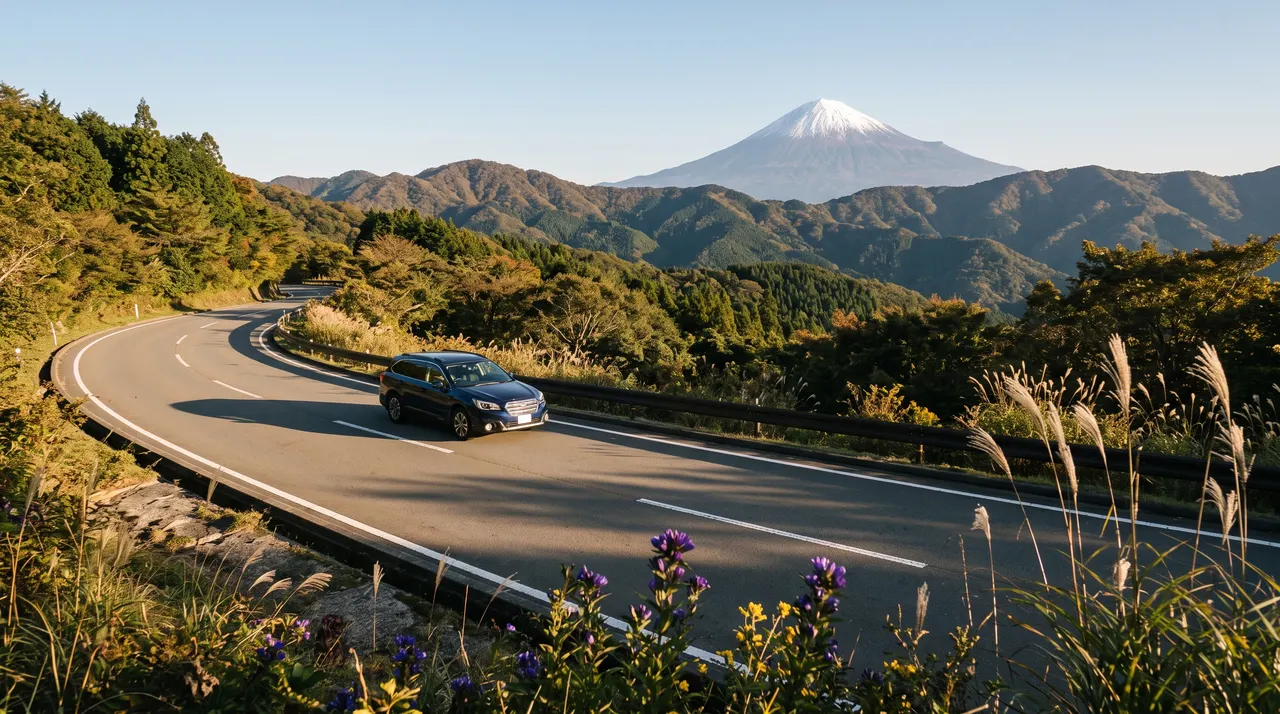
The Hakone area and the toll Hakone Turnpike/Ashinoko Skyline offer Japan's classic Mt. Fuji-view mountain driving route.
Sources: japan-guide.com · japanlivinglife.com · ready2drivejapan.com · driveinjapan.com
Japan · common questions
What rental desks in Japan ask foreign drivers for
| Rental company | Policy for foreign licences in Japan |
|---|---|
| Hertz | Asks foreign drivers for a licence translation when the licence is not printed in the Roman alphabet, and often for non-EU renters in much of Europe. |
| Enterprise | Asks for a licence translation alongside your home licence in many countries across Europe, Asia and South America. |
| Alamo | Asks for a licence translation when the licence is in a non-Latin alphabet, and suggests one for all international renters. |
| Budget | Asks for a licence translation when your licence is not in the Roman alphabet. |
| National | Asks for a licence translation for non-Latin-alphabet licences and where local rules call for one. |
| Thrifty | Asks for a licence translation in select countries and for non-Roman-alphabet licences. |
| Sixt | Asks for a licence translation for licences issued outside the EU and not in the Roman alphabet. |
| Avis | Asks for a licence translation where the national licence is not in the Roman alphabet or where local rules call for one. |
A 1949 Geneva IDP issued in your home country is expected; French, German, Swiss, Belgian, Taiwanese, Monégasque, Slovenian and Estonian licences need a JAF translation. Minimum rental age in Japan is typically 18+, with a young-driver surcharge usually applied under 25.