Do you need an International Driving Permit to drive in Botswana?


Sourced from the 1949 Geneva & 1968 Vienna Conventions and rental-network policies

What the rules require
When do you need an IDP in Botswana?
Botswana drives on the left; visitors can use an English licence, with an IDP advised for non-English licences and self-drive safaris.
Does renting a car in Botswana require an IDP?
An IDP is recommended for non-English licences; 4x4 essential for the Delta. Having your permit ready avoids losing your reservation at the counter.
Driving rules in Botswana you should know
- Drive on the left.
- Wildlife on roads, especially at night.
- 0.08% alcohol limit.
- Long distances between fuel stops.
How long is an IDP valid in Botswana?
Botswana uses the 1949 Geneva Convention format, under which an IDP is valid for up to 1 year from its issue date. If you travel regularly, the validity clock starts on the issue date, not on first use — so order close to your departure to maximise usable time.
Documents checklist for driving in Botswana
- Your original national driving licence — the IDP is a translation and is never valid on its own.
- Your International Driving Permit, in the 1949 Geneva Convention format Botswana uses.
- Your passport or accepted national ID for police checks and rental pick-up.
- For rentals: the credit card used for the booking and your rental agreement (it covers the registration and insurance papers).
- Local currency or a card for road costs — Botswana uses the BWP.
Driving in Botswana: the practical detail
Sourced from national road authorities, motoring clubs and rental policies — the things that actually catch foreign drivers out.
Driving on a foreign licence
Visitors may drive on a valid foreign licence (English, or with a certified English translation/IDP) for up to 90 days before conversion is required; SADC-issued licences are exempt. Always carry the national licence plus IDP together, as the IDP alone is not valid.
Tolls & road charges
Botswana currently has no national toll-road network or electronic toll tags; main highways such as the A1 (Gaborone–Francistown) are free to use. The main border-crossing cost travellers meet is the road-safety/permit levy paid on entering with a foreign-registered vehicle.
Parking in the cities
Gaborone uses paid, attended parking bays in the central business district and around malls, typically paid in cash pula to a marshal or meter, with marked disc/time limits. Illegally parked or abandoned vehicles can be clamped or towed by the city council.
Winter & seasonal rules
No winter-tyre rules - tropical/subtropical climate; the hazard is heat, dust and seasonal rain rather than snow.
Fuel & filling up
Petrol and diesel are widely sold at attended (full-service) stations; self-service is uncommon. Stations are far apart on remote routes such as the Trans-Kalahari, so keep the tank above half, carry pula cash, and don't assume cards work at rural pumps.
If you have an accident
By law you must stop, not move the vehicles, and report any accident to the police; the emergency number is 999 (or 997 for ambulance). A police report is required for insurance and rental claims, and you should exchange details and photograph the scene before moving anything.
Driving in the capital
Beyond Gaborone the country-defining driving quirk is straying cattle, donkeys and wildlife on open highways - hitting livestock can make you liable, and animal-related crashes are a leading cause of fatalities, so never drive these roads at night. Expect to stop at veterinary cordon fences where raw meat and sometimes dairy are confiscated.
Fines & enforcement
Speeding and other offences draw on-the-spot fines payable in pula, and allowing cattle to stray onto the road reserve carries fines of roughly P2,000–P5,000. Handheld phone use while driving is prohibited; rental firms recover camera and unpaid-fine charges from the card on file.
A drive worth taking
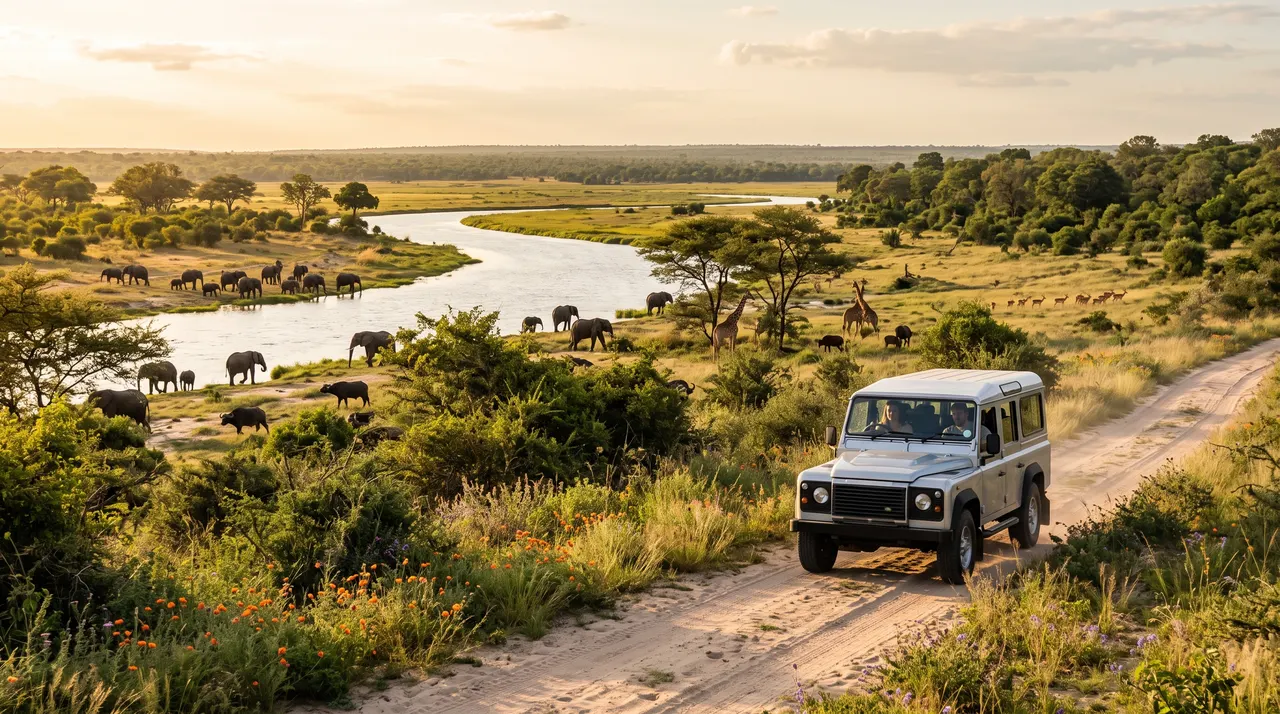
The drive through Chobe National Park toward Kasane, with riverfront elephant and big-game sightings, is Botswana's most sought-after self-drive route.
Sources: gov.bw · landrovingafrica.com · earthtrekkers.com · tyremap.com
Botswana · common questions
What rental desks in Botswana ask foreign drivers for
| Rental company | Policy for foreign licences in Botswana |
|---|---|
| Hertz | Asks foreign drivers for a licence translation when the licence is not printed in the Roman alphabet, and often for non-EU renters in much of Europe. |
| Enterprise | Asks for a licence translation alongside your home licence in many countries across Europe, Asia and South America. |
| Alamo | Asks for a licence translation when the licence is in a non-Latin alphabet, and suggests one for all international renters. |
| Budget | Asks for a licence translation when your licence is not in the Roman alphabet. |
| National | Asks for a licence translation for non-Latin-alphabet licences and where local rules call for one. |
| Thrifty | Asks for a licence translation in select countries and for non-Roman-alphabet licences. |
| Sixt | Asks for a licence translation for licences issued outside the EU and not in the Roman alphabet. |
| Avis | Asks for a licence translation where the national licence is not in the Roman alphabet or where local rules call for one. |
An IDP is recommended for non-English licences; 4x4 essential for the Delta. Minimum rental age in Botswana is typically 18+, with a young-driver surcharge usually applied under 25.