Do you need an International Driving Permit to drive in Oman?
This is a private translation, not a government-issued permit. If Oman requires the official document for your specific situation, confirm with its motor authority before you order.


Sourced from the 1949 Geneva & 1968 Vienna Conventions and rental-network policies

What the rules require
When do you need an IDP in Oman?
Oman drives on the right and accepts the 1949 Geneva IDP; tourists should carry it with their national licence to rent a car.
Does renting a car in Oman require an IDP?
Muscat desks request an IDP for most non-GCC licences. Having your permit ready avoids losing your reservation at the counter.
Driving rules in Oman you should know
- Drive on the right.
- Zero-tolerance alcohol law for driving.
- Speed cameras and radar widespread.
- 4x4 recommended for desert and wadi routes.
How long is an IDP valid in Oman?
Oman uses the 1949 Geneva Convention format, under which an IDP is valid for up to 1 year from its issue date. If you travel regularly, the validity clock starts on the issue date, not on first use — so order close to your departure to maximise usable time.
Documents checklist for driving in Oman
- Your original national driving licence — the IDP is a translation and is never valid on its own.
- Your International Driving Permit, prepared in the 1949 Geneva Convention format that Oman recognises.
- Your passport or accepted national ID for police checks and rental pick-up.
- For rentals: the credit card used for the booking and your rental agreement (it covers the registration and insurance papers).
- Local currency or a card for road costs — Oman uses the OMR.
Driving in Oman: the practical detail
Sourced from national road authorities, motoring clubs and rental policies — the things that actually catch foreign drivers out.
Driving on a foreign licence
Since late 2024 tourists and transit visitors may drive on a valid home-country licence for up to three months (90 days from entry); an IDP is mandatory if your licence is not in English or Arabic. In practice nearly all rental companies still ask for an IDP alongside the home licence for non-GCC drivers, so carry both.
Tolls & road charges
Oman has no highway toll roads or toll-tags; major routes including the Muscat Expressway and the Nizwa and Sur highways are free to use. The only motoring charges a tourist meets are fuel, parking and any fines.
Parking in the cities
Central Muscat (Ruwi, Muttrah, CBD) uses paid on-street parking via roadside machines and the mobile apps mwqf/Mawqif, roughly 100 baisa per 30 minutes during enforced hours, free on Fridays and evenings. Parking on yellow-hatched lines or blocking traffic risks fines and towing.
Winter & seasonal rules
No winter-tyre rules - tropical/desert climate, though sudden flash floods in wadis after rain are the real seasonal hazard. Never drive through flowing wadi water, which is a leading cause of fatalities.
Fuel & filling up
Stations sell M91 and M95 petrol plus diesel, are mostly attendant-served, and accept cards widely; fuel is cheap by global standards at roughly 230 baisa (about USD 0.60) per litre. Pumps are frequent on main roads but scarce in the desert interior, so refuel before remote stretches.
If you have an accident
Dial 9999 for police, ambulance or fire; for injury or disputed-fault crashes do not move the vehicles and wait for the Royal Oman Police, as moving can imply admission of guilt. For minor vehicle-only crashes where both agree on fault, you must move off the road and complete the ROP Simple/Minor Road Traffic Accident form (kept in the car) for insurance.
Driving in the capital
Muscat is spread along a coastal corridor of fast multi-lane highways where fixed and mobile speed cameras trigger at just 9 km/h over the limit, catching many tourists. Watch the Qurum and Expressway interchanges, and note speed limits drop sharply entering built-up districts.
Fines & enforcement
Fines start around RO 10 and rise in RO 5 steps; speeding bands run from RO 10 up to RO 50 with black points, and there is a strict 0.00% drink-drive limit with jail risk. Camera fines accrue to the plate and are billed to the renter through the rental firm, often with an admin fee, before you leave the country.
A drive worth taking
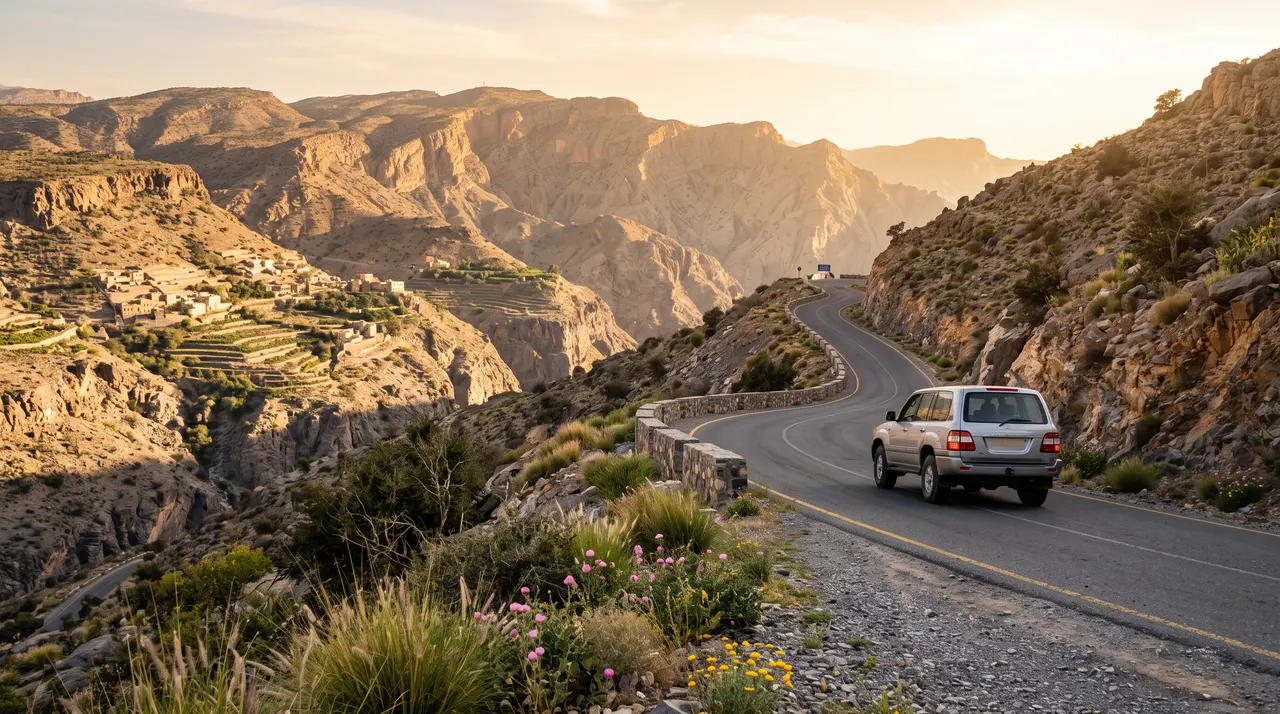
The 4x4-only climb from Birkat al Mouz up to Jebel Akhdar rewards with terraced rose villages and dramatic canyon viewpoints (a 4WD is mandatory at the police checkpoint).
Sources: gulfnews.com · omanobserver.om · askexplorer.com · omanwanderlust.com
Oman · common questions
What rental desks in Oman ask foreign drivers for
| Rental company | Policy for foreign licences in Oman |
|---|---|
| Hertz | Asks foreign drivers for a licence translation when the licence is not printed in the Roman alphabet, and often for non-EU renters in much of Europe. |
| Enterprise | Asks for a licence translation alongside your home licence in many countries across Europe, Asia and South America. |
| Alamo | Asks for a licence translation when the licence is in a non-Latin alphabet, and suggests one for all international renters. |
| Budget | Asks for a licence translation when your licence is not in the Roman alphabet. |
| National | Asks for a licence translation for non-Latin-alphabet licences and where local rules call for one. |
| Thrifty | Asks for a licence translation in select countries and for non-Roman-alphabet licences. |
| Sixt | Asks for a licence translation for licences issued outside the EU and not in the Roman alphabet. |
| Avis | Asks for a licence translation where the national licence is not in the Roman alphabet or where local rules call for one. |
Muscat desks request an IDP for most non-GCC licences. Minimum rental age in Oman is typically 18+, with a young-driver surcharge usually applied under 25.