 Canada licence
  Ghana
GhanaCan you drive in Ghana with a Canada license?
Short answer: to drive in Ghana with a Canada license you need an International Driving Permit in the 1968 Vienna format, carried together with your Canada license.
Yes — to drive in Ghana on a Canada licence you should carry an International Driving Permit together with your Canada licence. Ghana expects foreign drivers to hold an IDP.
Canadian drivers should carry an International Driving Permit alongside their provincial licence when driving abroad. Your International Driving Permit is a certified multilingual translation of your existing licence, prepared in the 1968 Vienna format and carried alongside your national licence.


What driving in Ghana is like
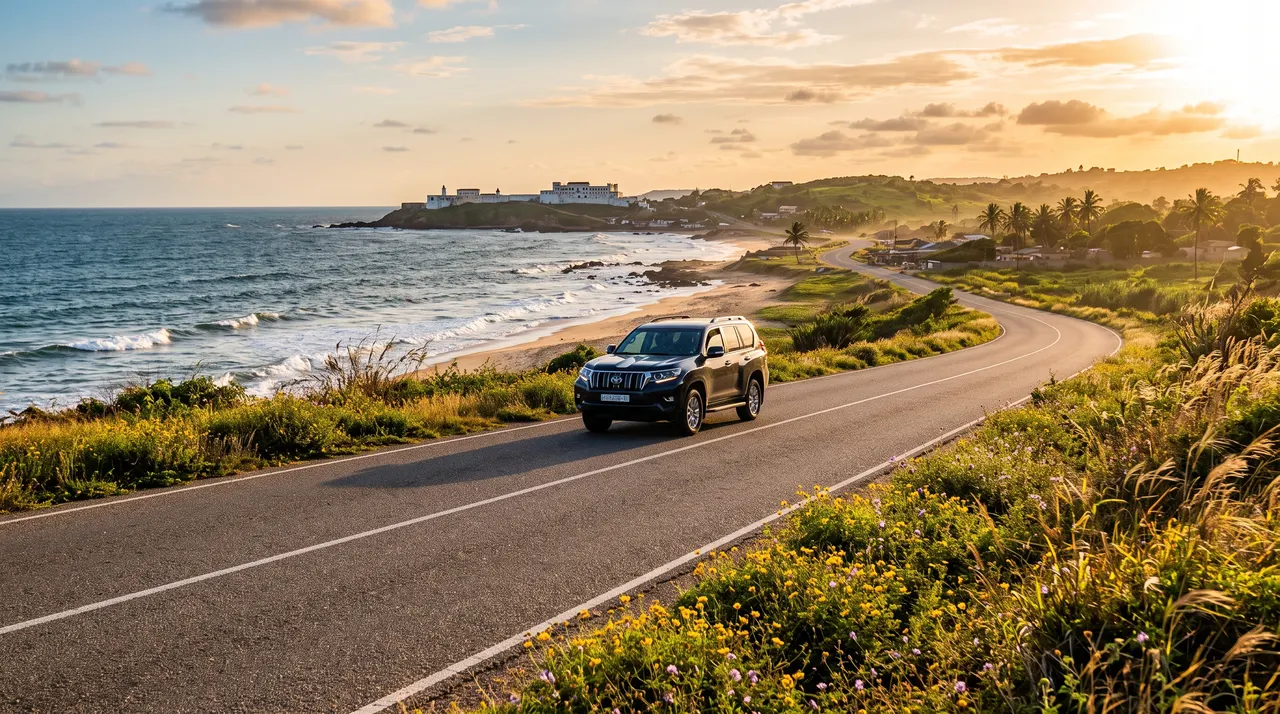
The coastal road west from Accra through Cape Coast and Elmina to their historic forts is the classic Ghana drive tourists search for. For most visitors the real draw is the freedom to reach places trains and tours don't, on your own schedule, with the open road generally capped around 100 km/h on the N1 motorway. Getting behind the wheel is the easy part: your International Driving Permit is a certified translation of your Canada licence, carried alongside it, so rental staff and officials in Ghana can read your credentials at a glance.
What applies to Canada licence holders in Ghana
| Canada licence in Ghana | |
|---|---|
| Do you need an IDP? | Yes — carry one alongside your licence |
| IDP format required | 1968 Vienna |
| Your Canada licence script | Roman (Latin) alphabet |
| Canada is party to | 1949 Geneva |
| Drives on the | Right-hand side |
| Minimum driving age | 18 |
| Emergency number | 191 (police), 193 (ambulance), 112 |
| Top speed limit | 100 km/h on the N1 motorway |
| Currency | GHS |
Driving rules in Ghana you should know
- Drive on the right.
- Heavy urban congestion in Accra.
- 0.08% alcohol limit.
- Carry passport, IDP and home licence.
Local driving facts in Ghana
Emergency number: 191 (police), 193 (ambulance), 112 (112 also connects from most mobiles). Typical maximum for cars on the fastest road class: 100 km/h on the N1 motorway. Posted limits always take precedence.
Tolls & road charges in Ghana
Ghana abolished all road and bridge tolls in the 2022 budget (effective late 2021), so there are currently no toll booths or passes to buy on public roads.
Parking in Ghana
Central Accra parking is largely on-street and informal, with car-park boys and private lots charging a few cedis; congestion, double-parking and obstruction around markets like Makola can lead to clamping or removal, so prefer guarded hotel or mall car parks.
Penalties & enforcement in Ghana
Police checkpoints are frequent and foreign drivers are stopped for document checks; on-the-spot fines (often cash) apply for speeding, no seatbelt and phone use, and rental companies pass any camera or unpaid fines on to the renter.
If you have an accident in Ghana
Drive on the right; call the Police on 191 or the national emergency line 112, do not move vehicles after an injury crash, and get a police report, which is mandatory for any insurance or rental claim.
City driving in Ghana
Accra's traffic is dominated by the heavily congested Ring Road, the N1 George Walker Bush Highway and the Tetteh Quarshie / Spintex interchange, where aggressive tro-tro minibuses stop without warning and gridlock is the daily norm.
Winter driving in Ghana
No winter-tyre rules - tropical climate; heavy rains (roughly April-July and September-November) cause flash flooding on Accra roads, the main seasonal driving hazard.
Fuel in Ghana
Fuel is sold by the litre as petrol and diesel (gasoil) at attended stations such as GOIL, Shell and Total; pumps are widely available in cities, prices are deregulated and move with the cedi, and cards are accepted at major-brand urban stations though cash is safer rurally.
Sources: graphic.com.gh, remitly.com, internationaldriversassociation.com, transparentrentals.com