 India licence
  Nepal
NepalCan you drive in Nepal with an India license?
Short answer: to drive in Nepal with an India license you need an International Driving Permit in the 1949 Geneva format, carried together with your India license.
Yes — to drive in Nepal on an India licence you should carry an International Driving Permit together with your India licence. Nepal expects foreign drivers to hold an IDP.
Indian drivers need an International Driving Permit to drive or rent a car in most countries abroad. Your International Driving Permit is a certified multilingual translation of your existing licence, prepared in the 1949 Geneva format and carried alongside your national licence.


What driving in Nepal is like
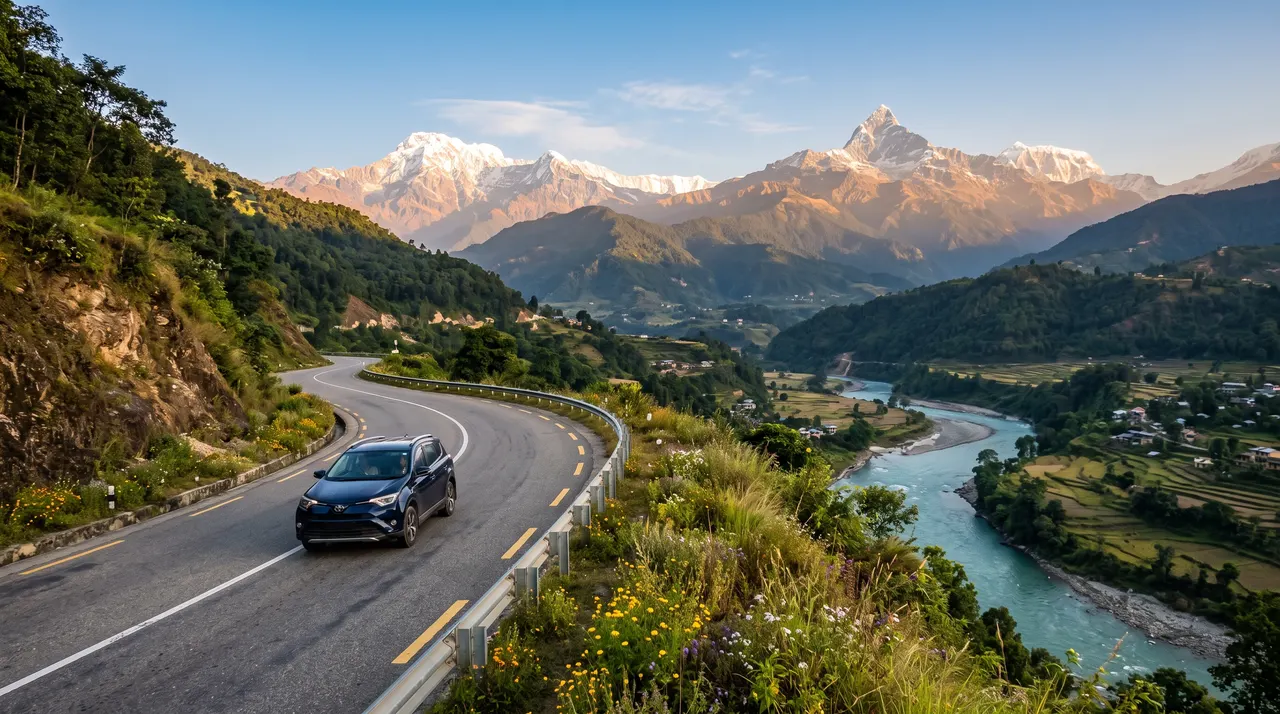
The 175 km Prithvi Highway from Kathmandu to Pokhara follows the Trisuli River through deep valleys with clear-day views of Machapuchare and the Annapurna massif. For most visitors the real draw is the freedom to reach places trains and tours don't, on your own schedule, with the open road generally capped around 80 km/h highways. Getting behind the wheel is the easy part: your International Driving Permit is a certified translation of your India licence, carried alongside it, so rental staff and officials in Nepal can read your credentials at a glance.
What applies to India licence holders in Nepal
| India licence in Nepal | |
|---|---|
| Do you need an IDP? | Yes — carry one alongside your licence |
| IDP format required | 1949 Geneva |
| Your India licence script | Roman (Latin) alphabet |
| India is party to | 1949 Geneva |
| Drives on the | Left-hand side |
| Minimum driving age | 18 |
| Emergency number | 100 (police), 102 (ambulance) |
| Top speed limit | 80 km/h highways |
| Currency | NPR |
Driving rules in Nepal you should know
- Drive on the left.
- Steep, narrow mountain roads.
- Zero-tolerance alcohol policy.
- Carry passport, IDP and home licence.
Local driving facts in Nepal
Emergency number: 100 (police), 102 (ambulance) (112 also connects from most mobiles). Typical maximum for cars on the fastest road class: 80 km/h highways. Posted limits always take precedence.
Tolls & road charges in Nepal
There are no electronic toll tags; tolls are minor cash booths on a few stretches such as the Nagdhunga and Kanti Lokpath sections and the Kathmandu-Tarai/Madhesh fast-track when fully open, typically a few hundred rupees per car. Most ordinary highways including the Prithvi Highway are toll-free.
Parking in Nepal
City parking in Kathmandu is largely informal paid lots and attended kerbside spaces where a collector issues a paper ticket for roughly NPR 20-50 per hour; there are very few meters or apps. Illegally parked vehicles in core areas of Kathmandu and Lalitpur can be clamped or towed by the metropolitan traffic police.
Penalties & enforcement in Nepal
Traffic police issue on-the-spot fines, often payable in cash, for speeding, no seatbelt and mobile-phone use, with drink-driving (zero-tolerance MaPaSe checks) drawing heavy fines and possible licence action. Rental firms pass any later-issued fines and damage to the renter, usually against the security deposit.
If you have an accident in Nepal
Dial 100 for police (or 102 for ambulance); in any injury or serious-damage crash do not move the vehicle and wait for traffic police, as crowds can gather quickly. Report immediately and exchange details, and notify the rental company at once since informal on-the-spot cash settlements are common but risky for foreigners.
City driving in Nepal
Kathmandu's Ring Road and core junctions are chronically congested with motorcycles weaving on all sides; authorities have repeatedly debated an odd-even number-plate rationing scheme during fuel crises, so check whether any plate restriction is active before driving in. The narrow lanes of Thamel and the old city are best avoided by car entirely.
Winter driving in Nepal
Winter tyres are not legally mandated, but high Himalayan passes and roads such as those toward Mustang, Jomsom or the Tibet border can see snow and ice from roughly December to February, where chains or a 4x4 are practically necessary. Lowland and Kathmandu Valley driving has no winter-equipment rules.
Fuel in Nepal
Stations sell petrol and diesel only (no widespread LPG/CNG for cars), are attendant-served, and as of mid-2026 prices are among South Asia's highest at about NPR 219/litre petrol and NPR 207/litre diesel. Outside cities pumps are sparse and often cash-only, so fill up before long mountain stretches.
Sources: internationaldrivingpermit.org, kathmandupost.com, english.ratopati.com, en.wikipedia.org