Do you need an International Driving Permit to drive in Nepal?


Sourced from the 1949 Geneva & 1968 Vienna Conventions and rental-network policies

What the rules require
When do you need an IDP in Nepal?
Nepal drives on the left through Himalayan terrain; an IDP is commonly requested for foreign drivers, and mountain roads demand caution.
Does renting a car in Nepal require an IDP?
Kathmandu desks request an IDP; many travellers hire a car with a driver. Having your permit ready avoids losing your reservation at the counter.
Driving rules in Nepal you should know
- Drive on the left.
- Steep, narrow mountain roads.
- Zero-tolerance alcohol policy.
- Carry passport, IDP and home licence.
How long is an IDP valid in Nepal?
Nepal uses the 1949 Geneva Convention format, under which an IDP is valid for up to 1 year from its issue date. If you travel regularly, the validity clock starts on the issue date, not on first use — so order close to your departure to maximise usable time.
Documents checklist for driving in Nepal
- Your original national driving licence — the IDP is a translation and is never valid on its own.
- Your International Driving Permit, in the 1949 Geneva Convention format Nepal uses.
- Your passport or accepted national ID for police checks and rental pick-up.
- For rentals: the credit card used for the booking and your rental agreement (it covers the registration and insurance papers).
- Local currency or a card for road costs — Nepal uses the NPR.
Driving in Nepal: the practical detail
Sourced from national road authorities, motoring clubs and rental policies — the things that actually catch foreign drivers out.
Driving on a foreign licence
Nepal is not a party to the 1949 Geneva or 1968 Vienna conventions, so it has no treaty obligation to accept foreign licences; in practice the Department of Transport Management expects foreigners to carry their home licence plus an International Driving Permit, and an IDP is effectively required from arrival. Acceptance is discretionary by police and rental firms, so an IDP (obtained in your home country before travel) is strongly advised, especially if your licence is not in English.
Tolls & road charges
There are no electronic toll tags; tolls are minor cash booths on a few stretches such as the Nagdhunga and Kanti Lokpath sections and the Kathmandu-Tarai/Madhesh fast-track when fully open, typically a few hundred rupees per car. Most ordinary highways including the Prithvi Highway are toll-free.
Parking in the cities
City parking in Kathmandu is largely informal paid lots and attended kerbside spaces where a collector issues a paper ticket for roughly NPR 20-50 per hour; there are very few meters or apps. Illegally parked vehicles in core areas of Kathmandu and Lalitpur can be clamped or towed by the metropolitan traffic police.
Winter & seasonal rules
Winter tyres are not legally mandated, but high Himalayan passes and roads such as those toward Mustang, Jomsom or the Tibet border can see snow and ice from roughly December to February, where chains or a 4x4 are practically necessary. Lowland and Kathmandu Valley driving has no winter-equipment rules.
Fuel & filling up
Stations sell petrol and diesel only (no widespread LPG/CNG for cars), are attendant-served, and as of mid-2026 prices are among South Asia's highest at about NPR 219/litre petrol and NPR 207/litre diesel. Outside cities pumps are sparse and often cash-only, so fill up before long mountain stretches.
If you have an accident
Dial 100 for police (or 102 for ambulance); in any injury or serious-damage crash do not move the vehicle and wait for traffic police, as crowds can gather quickly. Report immediately and exchange details, and notify the rental company at once since informal on-the-spot cash settlements are common but risky for foreigners.
Driving in the capital
Kathmandu's Ring Road and core junctions are chronically congested with motorcycles weaving on all sides; authorities have repeatedly debated an odd-even number-plate rationing scheme during fuel crises, so check whether any plate restriction is active before driving in. The narrow lanes of Thamel and the old city are best avoided by car entirely.
Fines & enforcement
Traffic police issue on-the-spot fines, often payable in cash, for speeding, no seatbelt and mobile-phone use, with drink-driving (zero-tolerance MaPaSe checks) drawing heavy fines and possible licence action. Rental firms pass any later-issued fines and damage to the renter, usually against the security deposit.
A drive worth taking
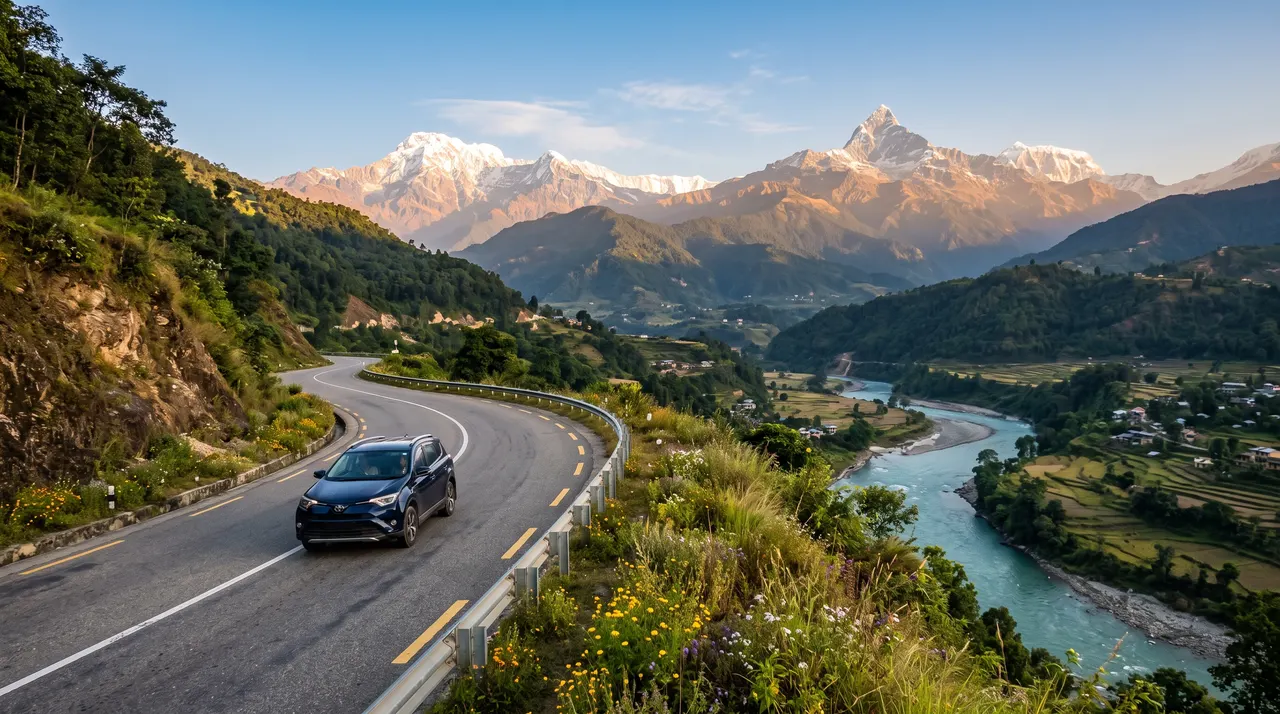
The 175 km Prithvi Highway from Kathmandu to Pokhara follows the Trisuli River through deep valleys with clear-day views of Machapuchare and the Annapurna massif.
Sources: internationaldrivingpermit.org · kathmandupost.com · english.ratopati.com · en.wikipedia.org
Nepal · common questions
What rental desks in Nepal ask foreign drivers for
| Rental company | Policy for foreign licences in Nepal |
|---|---|
| Hertz | Asks foreign drivers for a licence translation when the licence is not printed in the Roman alphabet, and often for non-EU renters in much of Europe. |
| Enterprise | Asks for a licence translation alongside your home licence in many countries across Europe, Asia and South America. |
| Alamo | Asks for a licence translation when the licence is in a non-Latin alphabet, and suggests one for all international renters. |
| Budget | Asks for a licence translation when your licence is not in the Roman alphabet. |
| National | Asks for a licence translation for non-Latin-alphabet licences and where local rules call for one. |
| Thrifty | Asks for a licence translation in select countries and for non-Roman-alphabet licences. |
| Sixt | Asks for a licence translation for licences issued outside the EU and not in the Roman alphabet. |
| Avis | Asks for a licence translation where the national licence is not in the Roman alphabet or where local rules call for one. |
Kathmandu desks request an IDP; many travellers hire a car with a driver. Minimum rental age in Nepal is typically 18+, with a young-driver surcharge usually applied under 25.