Do you need an International Driving Permit to drive in Cameroon?
This is a private translation, not a government-issued permit. If Cameroon requires the official document for your specific situation, confirm with its motor authority before you order.


Sourced from the 1949 Geneva & 1968 Vienna Conventions and rental-network policies

What the rules require
When do you need an IDP in Cameroon?
Cameroon drives on the right; an IDP is recommended with your national licence, and road conditions vary widely between regions.
Does renting a car in Cameroon require an IDP?
Douala and Yaoundé desks request an IDP for non-French licences. Having your permit ready avoids losing your reservation at the counter.
Driving rules in Cameroon you should know
- Drive on the right.
- Frequent police checkpoints.
- 0.08% alcohol limit.
- Carry passport, IDP and home licence.
How long is an IDP valid in Cameroon?
Cameroon uses the 1949 Geneva Convention format, under which an IDP is valid for up to 1 year from its issue date. If you travel regularly, the validity clock starts on the issue date, not on first use — so order close to your departure to maximise usable time.
Documents checklist for driving in Cameroon
- Your original national driving licence — the IDP is a translation and is never valid on its own.
- Your International Driving Permit, prepared in the 1949 Geneva Convention format that Cameroon recognises.
- Your passport or accepted national ID for police checks and rental pick-up.
- For rentals: the credit card used for the booking and your rental agreement (it covers the registration and insurance papers).
- Local currency or a card for road costs — Cameroon uses the XAF.
Driving in Cameroon: the practical detail
Sourced from national road authorities, motoring clubs and rental policies — the things that actually catch foreign drivers out.
Driving on a foreign licence
Visitors may drive on a valid foreign licence for short stays, but it must be accompanied by an International Driving Permit (1968 Convention) since it is in a non-French language; rental firms and gendarmes at checkpoints routinely demand the IDP. For stays beyond about three months a Cameroonian licence is expected.
Tolls & road charges
Cameroon has no vignette but operates physical toll gates (postes de péage) on major axes including the Douala-Yaounde corridor and the newer expressway; cars pay a small flat fee in CFA francs (XAF), typically a few hundred francs, in cash at the booth.
Parking in the cities
Street parking in Douala and Yaounde is largely informal and chaotic; self-appointed 'gardiens' will watch your car for a tip of a few hundred XAF, and there are few marked or metered bays. Park in guarded hotel or mall lots where possible to reduce theft risk.
Winter & seasonal rules
No winter-tyre rules - tropical climate
Fuel & filling up
Petrol (essence/super) runs around XAF 840 per litre and diesel (gasoil) around XAF 828 per litre (2026) at government-fixed prices. Stations are attended (no self-serve); cash in CFA francs is expected, with cards rarely accepted outside major-city branded stations, so carry fuel for long rural legs.
If you have an accident
Stop, do not leave the scene, and call the police on 117 (general emergencies 112); a police report is required for insurance and rental claims. Move vehicles only if they block traffic and it is safe, and avoid disputes as crowds can gather quickly.
Driving in the capital
Douala's Carrefour Ndokoti and the bridges over the Wouri are notorious chokepoints with relentless congestion, motorbike taxis (bendskins) weaving everywhere, and frequent gendarmerie stops; allow far more time than distances suggest.
Fines & enforcement
Police and gendarmes issue on-the-spot fines for speeding, no seatbelt, or phone use, and unofficial 'fees' are often solicited at checkpoints; insist on an official receipt. Rental companies pass camera or unpaid fines to your card, so settle any ticket before returning the car.
A drive worth taking
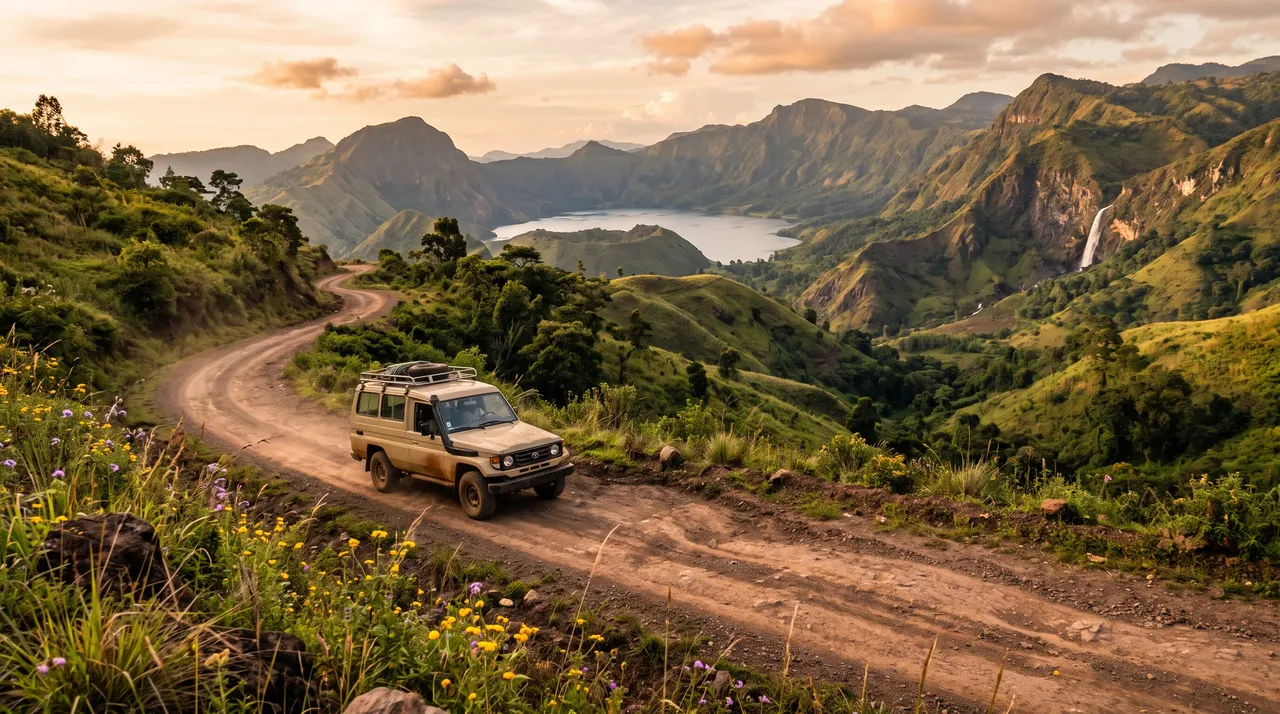
The Ring Road around the Bamenda highlands in the North-West offers dramatic volcanic crater lakes and waterfalls, though large sections are unpaved and need a 4x4.
Sources: tyremap.com · globalpetrolprices.com · whitepages.com.cm · internationaldriversassociation.com
Cameroon · common questions
What rental desks in Cameroon ask foreign drivers for
| Rental company | Policy for foreign licences in Cameroon |
|---|---|
| Hertz | Asks foreign drivers for a licence translation when the licence is not printed in the Roman alphabet, and often for non-EU renters in much of Europe. |
| Enterprise | Asks for a licence translation alongside your home licence in many countries across Europe, Asia and South America. |
| Alamo | Asks for a licence translation when the licence is in a non-Latin alphabet, and suggests one for all international renters. |
| Budget | Asks for a licence translation when your licence is not in the Roman alphabet. |
| National | Asks for a licence translation for non-Latin-alphabet licences and where local rules call for one. |
| Thrifty | Asks for a licence translation in select countries and for non-Roman-alphabet licences. |
| Sixt | Asks for a licence translation for licences issued outside the EU and not in the Roman alphabet. |
| Avis | Asks for a licence translation where the national licence is not in the Roman alphabet or where local rules call for one. |
Douala and Yaoundé desks request an IDP for non-French licences. Minimum rental age in Cameroon is typically 18+, with a young-driver surcharge usually applied under 25.