Do you need an International Driving Permit to drive in Colombia?


Sourced from the 1949 Geneva & 1968 Vienna Conventions and rental-network policies

What the rules require
When do you need an IDP in Colombia?
Carry an IDP with your licence to drive and rent in Colombia.
Does renting a car in Colombia require an IDP?
Requested by major desks; pico y placa plate restrictions apply in cities. Having your permit ready avoids losing your reservation at the counter.
Driving rules in Colombia you should know
- Pico y placa restricts driving by plate number on set days.
- 0.02% alcohol limit, strictly enforced.
- Headlights on outside urban areas.
- Toll roads (peajes) are common.
How long is an IDP valid in Colombia?
Colombia uses the 1968 Vienna Convention format, under which an IDP can be valid for up to 3 years — or until your national licence expires, whichever comes first. If you travel regularly, the validity clock starts on the issue date, not on first use — so order close to your departure to maximise usable time.
Documents checklist for driving in Colombia
- Your original national driving licence — the IDP is a translation and is never valid on its own.
- Your International Driving Permit, in the 1968 Vienna Convention format Colombia uses.
- Your passport or accepted national ID for police checks and rental pick-up.
- For rentals: the credit card used for the booking and your rental agreement (it covers the registration and insurance papers).
- Local currency or a card for road costs — Colombia uses the COP.
Driving in Colombia: the practical detail
Sourced from national road authorities, motoring clubs and rental policies — the things that actually catch foreign drivers out.
Driving on a foreign licence
Tourists may drive on a valid home licence for the duration of their stay (up to 90 days, extendable). An IDP is not strictly required if your licence has a photo and is in Spanish or English, but it is recommended to ease police checkpoint interactions.
Tolls & road charges
Colombia has roughly 180+ toll booths (peajes), regulated by ANI/Invías, costing about COP 10,000-17,000 (~USD 2.70-4.60) per booth for a car; carry small-denomination cash as card acceptance is not universal.
Parking in the cities
Use guarded paid lots (parqueaderos) rather than the street in Bogotá, Medellín and Cartagena; heed signed restrictions and 'no parquear' zones, as towing (grúa) and immobilization are enforced in central districts.
Winter & seasonal rules
No winter-tyre rules - tropical climate; mountain roads bring fog, heavy rain and landslides, so the real hazards are wet/foggy Andean passes rather than snow.
Fuel & filling up
Stations (Terpel, Biomax, Primax) are attended; petrol is 'corriente' (regular) and 'extra' (premium) plus diesel ('ACPM'), around USD 0.65-0.80 per litre, with cards generally accepted in cities.
If you have an accident
Call 123 (national emergency line) for police and ambulance; do not move vehicles if there are injuries. SOAT covers bodily injury only; exchange details and get a police report for the rental insurer.
Driving in the capital
Bogotá, Medellín and Cali enforce 'pico y placa', barring cars on set weekdays by the last plate digit during peak hours - it applies to rental cars too, so check the city's Secretaría de Movilidad schedule before driving.
Fines & enforcement
Speed cameras (fotomultas) are widespread; speeding, no seatbelt and phone use draw fines set in daily minimum wages (often hundreds of thousands of pesos). Officers should not collect cash on the road; camera and towing fines are passed to the renter via the rental company.
A drive worth taking
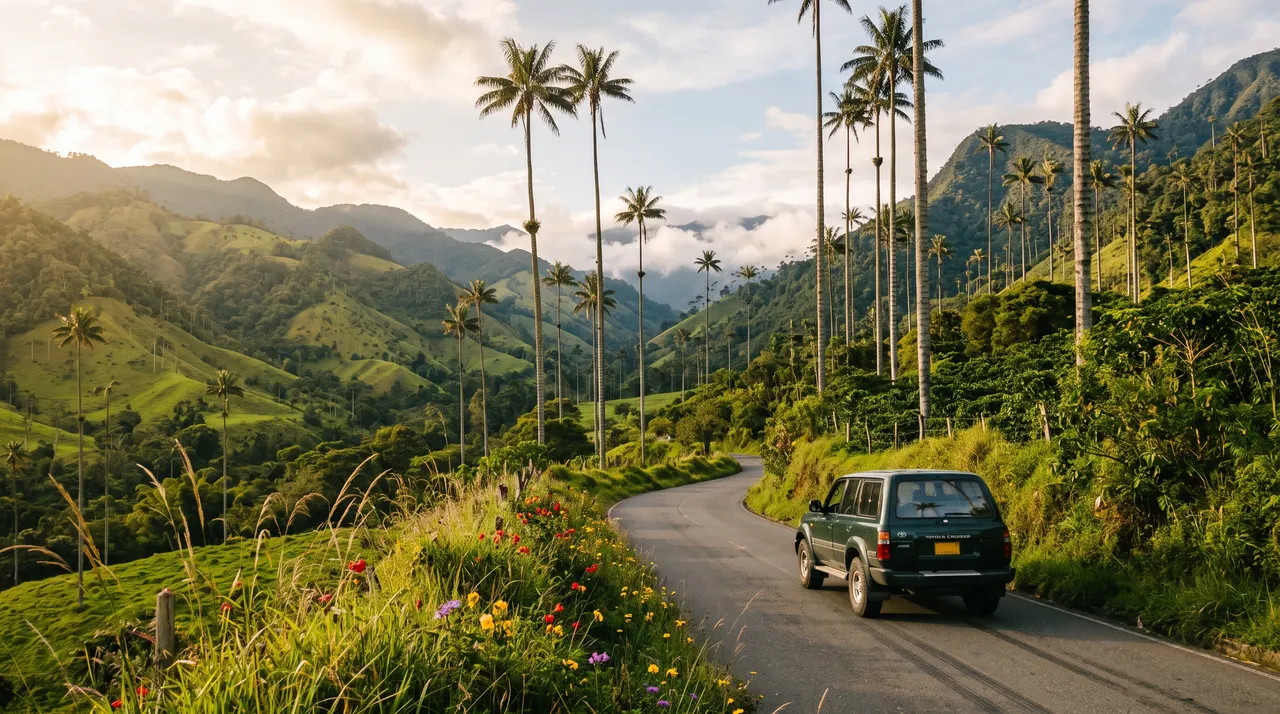
The coffee-region drive through the Cocora Valley near Salento, lined with the world's tallest wax palms.
Sources: expat.com · tyremap.com · en.wikipedia.org · internationaltravelpermits.com
Colombia · common questions
What rental desks in Colombia ask foreign drivers for
| Rental company | Policy for foreign licences in Colombia |
|---|---|
| Hertz | Asks foreign drivers for a licence translation when the licence is not printed in the Roman alphabet, and often for non-EU renters in much of Europe. |
| Enterprise | Asks for a licence translation alongside your home licence in many countries across Europe, Asia and South America. |
| Alamo | Asks for a licence translation when the licence is in a non-Latin alphabet, and suggests one for all international renters. |
| Budget | Asks for a licence translation when your licence is not in the Roman alphabet. |
| National | Asks for a licence translation for non-Latin-alphabet licences and where local rules call for one. |
| Thrifty | Asks for a licence translation in select countries and for non-Roman-alphabet licences. |
| Sixt | Asks for a licence translation for licences issued outside the EU and not in the Roman alphabet. |
| Avis | Asks for a licence translation where the national licence is not in the Roman alphabet or where local rules call for one. |
Requested by major desks; pico y placa plate restrictions apply in cities. Minimum rental age in Colombia is typically 18+, with a young-driver surcharge usually applied under 25.