Do you need an International Driving Permit to drive in Chile?


Sourced from the 1949 Geneva & 1968 Vienna Conventions and rental-network policies

What the rules require
When do you need an IDP in Chile?
Carry an IDP with your national licence to drive and rent in Chile.
Does renting a car in Chile require an IDP?
Electronic toll (TAG) devices fitted to rental cars on Santiago motorways. Having your permit ready avoids losing your reservation at the counter.
Driving rules in Chile you should know
- Seatbelts mandatory for all occupants.
- 0.03% alcohol limit; criminal above 0.08%.
- Headlights on in tunnels.
- Andean mountain passes may require chains in winter.
How long is an IDP valid in Chile?
Chile uses the 1968 Vienna Convention format, under which an IDP can be valid for up to 3 years — or until your national licence expires, whichever comes first. If you travel regularly, the validity clock starts on the issue date, not on first use — so order close to your departure to maximise usable time.
Documents checklist for driving in Chile
- Your original national driving licence — the IDP is a translation and is never valid on its own.
- Your International Driving Permit, in the 1968 Vienna Convention format Chile uses.
- Your passport or accepted national ID for police checks and rental pick-up.
- For rentals: the credit card used for the booking and your rental agreement (it covers the registration and insurance papers).
- Local currency or a card for road costs — Chile uses the CLP.
Driving in Chile: the practical detail
Sourced from national road authorities, motoring clubs and rental policies — the things that actually catch foreign drivers out.
Driving on a foreign licence
Visitors may drive on a valid foreign licence for the length of their tourist stay (up to 90 days). An IDP is recommended and is required if your licence is not in Spanish or uses non-Roman characters; carry licence, IDP and passport together.
Tolls & road charges
Santiago's urban autopistas (Costanera Norte, Vespucio, etc.) are free-flow and require a TAG transponder, which by law all Santiago rental cars now carry; intercity highways (Ruta 5) use manned plazas where many lanes take only Chilean peso cash.
Parking in the cities
In cities use signed paid street zones (parquímetro, often via attendants/apps) or guarded lots; informal 'cuidadores' watch parked cars for a tip. Heed no-parking signs as towing and clamping occur in central Santiago.
Winter & seasonal rules
Snow chains are mandatory when Carabineros require them on snow-affected Andean routes (e.g. Portillo, the pass to Mendoza, and southern Lake District/Patagonia roads) in winter (roughly May-September); rentals to ski areas should carry chains.
Fuel & filling up
Stations (Copec, Shell, Petrobras/Aramco) are full-service; petrol is sold as 93/95/97 octane and diesel as 'petróleo diésel', roughly USD 1.20-1.40 per litre, with cards widely accepted. Rentals usually run full-to-full.
If you have an accident
Call Carabineros on 133 (ambulance 131); do not move vehicles if anyone is injured. Report the crash, give names, plate numbers and time/place, and obtain the constancia for insurance and the rental company.
Driving in the capital
Santiago runs 'restricción vehicular' May 1-Aug 31, weekdays 07:30-21:00 inside the Américo Vespucio ring, enforced by plate-reading cameras; vehicles without a green seal (sello verde) are restricted by last plate digit, though most modern rentals are exempt.
Fines & enforcement
Speed and red-light cameras are common; serious speeding and drink-driving are court matters with heavy fines. Carabineros do roadside checks; fines are not paid in cash to officers, and camera/photo infractions are billed to the renter via the rental agency.
A drive worth taking
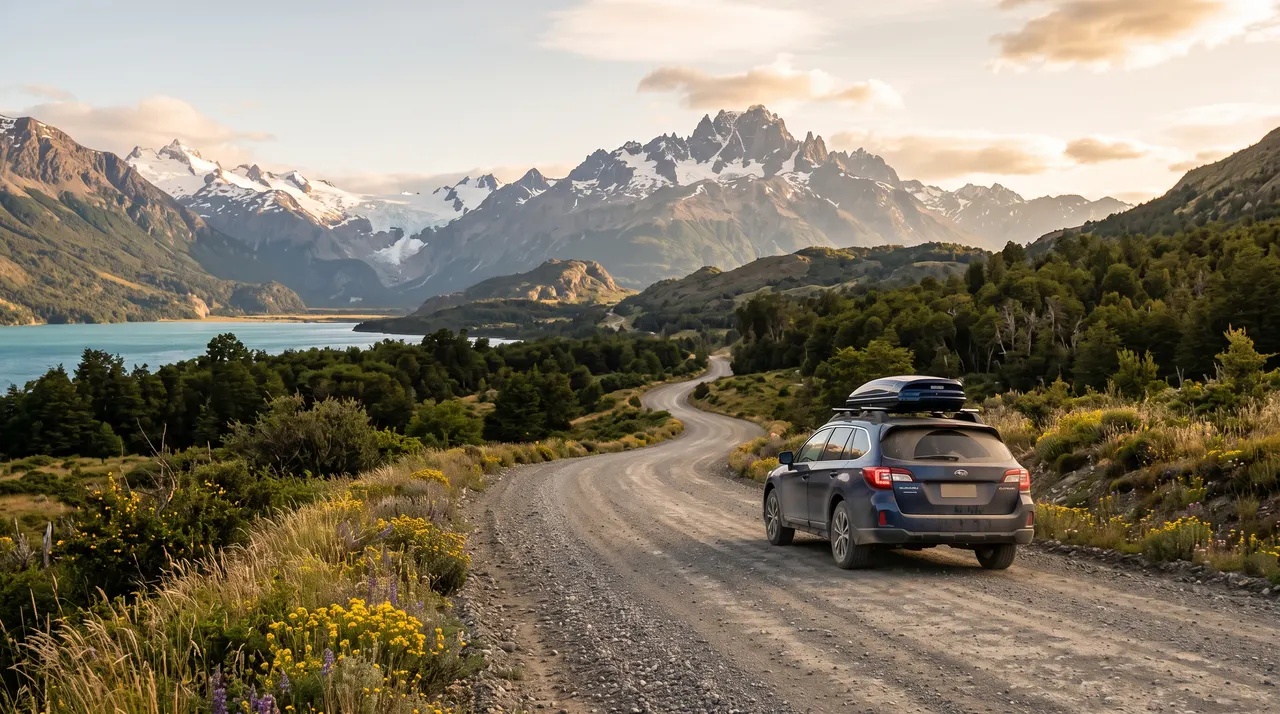
The Carretera Austral (Ruta 7) through Patagonia from Puerto Montt toward Villa O'Higgins.
Sources: internationaltravelpermits.com · mtt.gob.cl · en.wikivoyage.org · sixt.com
Chile · common questions
What rental desks in Chile ask foreign drivers for
| Rental company | Policy for foreign licences in Chile |
|---|---|
| Hertz | Asks foreign drivers for a licence translation when the licence is not printed in the Roman alphabet, and often for non-EU renters in much of Europe. |
| Enterprise | Asks for a licence translation alongside your home licence in many countries across Europe, Asia and South America. |
| Alamo | Asks for a licence translation when the licence is in a non-Latin alphabet, and suggests one for all international renters. |
| Budget | Asks for a licence translation when your licence is not in the Roman alphabet. |
| National | Asks for a licence translation for non-Latin-alphabet licences and where local rules call for one. |
| Thrifty | Asks for a licence translation in select countries and for non-Roman-alphabet licences. |
| Sixt | Asks for a licence translation for licences issued outside the EU and not in the Roman alphabet. |
| Avis | Asks for a licence translation where the national licence is not in the Roman alphabet or where local rules call for one. |
Electronic toll (TAG) devices fitted to rental cars on Santiago motorways. Minimum rental age in Chile is typically 18+, with a young-driver surcharge usually applied under 25.