Do you need an International Driving Permit to drive in Brazil?


Sourced from the 1949 Geneva & 1968 Vienna Conventions and rental-network policies

What the rules require
When do you need an IDP in Brazil?
Rental companies and local authorities in Brazil commonly ask foreign drivers to carry an IDP with their national licence; Localiza and other desks ask for the original document.
Does renting a car in Brazil require an IDP?
Localiza and Movida ask for the physical IDP plus your home licence at the counter. Having your permit ready avoids losing your reservation at the counter.
Driving rules in Brazil you should know
- Headlights on during the day on highways.
- Zero-tolerance alcohol law (Lei Seca).
- Carry original licence + IDP — photocopies not accepted.
- Radar speed enforcement is widespread.
How long is an IDP valid in Brazil?
Brazil uses the 1968 Vienna Convention format, under which an IDP can be valid for up to 3 years — or until your national licence expires, whichever comes first. If you travel regularly, the validity clock starts on the issue date, not on first use — so order close to your departure to maximise usable time.
Documents checklist for driving in Brazil
- Your original national driving licence — the IDP is a translation and is never valid on its own.
- Your International Driving Permit, in the 1968 Vienna Convention format Brazil uses.
- Your passport or accepted national ID for police checks and rental pick-up.
- For rentals: the credit card used for the booking and your rental agreement (it covers the registration and insurance papers).
- Local currency or a card for road costs — Brazil uses the BRL.
Driving in Brazil: the practical detail
Sourced from national road authorities, motoring clubs and rental policies — the things that actually catch foreign drivers out.
Driving on a foreign licence
Visitors may drive on a valid foreign licence for up to 180 days from entry, but it must be accompanied by an International Driving Permit (PID) or an official Portuguese translation if not in Portuguese. Carry both your home licence and the IDP, as police and rental firms commonly ask for them.
Tolls & road charges
Intercity highways charge tolls ('pedagio') payable in cash (reais) or card at booths, or automatically via windshield tags such as Sem Parar, ConectCar and Veloe used in 1,000+ lanes; some corridors are now free-flow plate-read. Ask the rental firm whether the car includes a tag.
Parking in the cities
Cities use paid 'Zona Azul' street parking bought via app or rotativo ticket displayed in the windscreen; informal 'flanelinhas' may ask to watch your car. Guarded lots ('estacionamento') are safest, and tow-away/clamping enforcement is active in central zones.
Winter & seasonal rules
No winter-tyre rules - tropical climate (occasional frost only in far-southern highlands, with no chain mandate).
Fuel & filling up
Stations sell gasolina comum (already ~27% ethanol), gasolina aditivada, pure etanol (hydrous ethanol) and diesel; most rental cars are flex-fuel and run on either petrol or ethanol. Attendants pump the fuel; ethanol is cheaper but only worth it below ~70% of the petrol price.
If you have an accident
Call 190 (Military Police) or 193 (fire/rescue) for injuries. Do not move the vehicles unless they block traffic or are unsafe, notify the rental company immediately, and obtain a police occurrence report (Boletim de Ocorrencia) for insurance.
Driving in the capital
Sao Paulo's 'rodizio' bars cars by last plate digit during peaks (07:00-10:00 and 17:00-20:00, Mon-Fri) within the expanded centre - plates ending 1-2 on Monday through 9-0 on Friday - and the rule applies to foreign/rental cars too.
Fines & enforcement
Fines for speeding, no seatbelt or handheld phone are camera-enforced and tiered (a 'gravissima' offence is around R$293, with heavier multipliers for extreme speed), adding points to the licence. Rental companies identify the driver and pass camera fines plus an admin fee to your card.
A drive worth taking
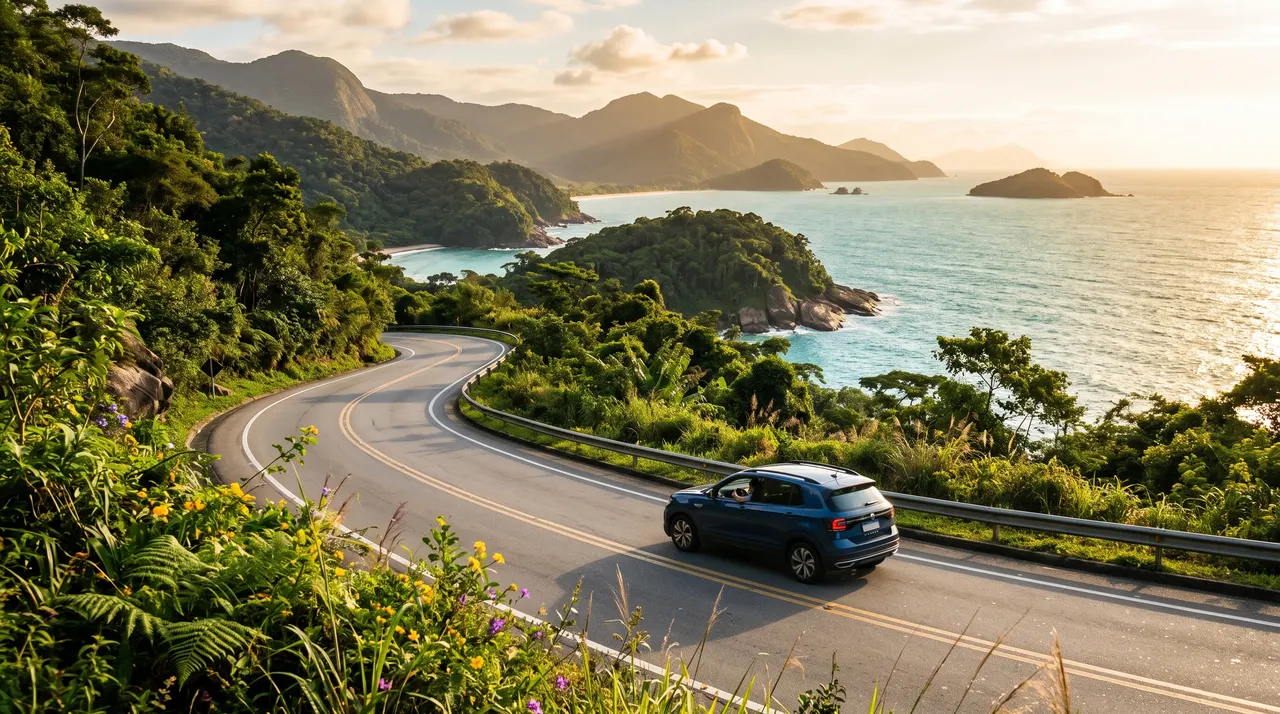
The coastal Rio-Santos highway (BR-101/SP-055) between Rio de Janeiro and Santos, winding past Paraty and Ubatuba, is a renowned Brazilian drive.
Sources: tollguru.com · internationaldriversassociation.com · en.wikipedia.org · zestcarrental.com
Brazil · common questions
What rental desks in Brazil ask foreign drivers for
| Rental company | Policy for foreign licences in Brazil |
|---|---|
| Hertz | Asks foreign drivers for a licence translation when the licence is not printed in the Roman alphabet, and often for non-EU renters in much of Europe. |
| Enterprise | Asks for a licence translation alongside your home licence in many countries across Europe, Asia and South America. |
| Alamo | Asks for a licence translation when the licence is in a non-Latin alphabet, and suggests one for all international renters. |
| Budget | Asks for a licence translation when your licence is not in the Roman alphabet. |
| National | Asks for a licence translation for non-Latin-alphabet licences and where local rules call for one. |
| Thrifty | Asks for a licence translation in select countries and for non-Roman-alphabet licences. |
| Sixt | Asks for a licence translation for licences issued outside the EU and not in the Roman alphabet. |
| Avis | Asks for a licence translation where the national licence is not in the Roman alphabet or where local rules call for one. |
Localiza and Movida ask for the physical IDP plus your home licence at the counter. Minimum rental age in Brazil is typically 18+, with a young-driver surcharge usually applied under 25.