Do you need an International Driving Permit to drive in Lebanon?


Sourced from the 1949 Geneva & 1968 Vienna Conventions and rental-network policies

What the rules require
When do you need an IDP in Lebanon?
Lebanon drives on the right with assertive Beirut traffic; tourists should carry an IDP with their national licence.
Does renting a car in Lebanon require an IDP?
Beirut desks request an IDP for non-Latin-script licences. Having your permit ready avoids losing your reservation at the counter.
Driving rules in Lebanon you should know
- Drive on the right.
- Seatbelts mandatory.
- 0.05% alcohol limit.
- Drive defensively in dense city traffic.
How long is an IDP valid in Lebanon?
Lebanon uses the 1949 Geneva Convention format, under which an IDP is valid for up to 1 year from its issue date. If you travel regularly, the validity clock starts on the issue date, not on first use — so order close to your departure to maximise usable time.
Documents checklist for driving in Lebanon
- Your original national driving licence — the IDP is a translation and is never valid on its own.
- Your International Driving Permit, in the 1949 Geneva Convention format Lebanon uses.
- Your passport or accepted national ID for police checks and rental pick-up.
- For rentals: the credit card used for the booking and your rental agreement (it covers the registration and insurance papers).
- Local currency or a card for road costs — Lebanon uses the LBP.
Driving in Lebanon: the practical detail
Sourced from national road authorities, motoring clubs and rental policies — the things that actually catch foreign drivers out.
Driving on a foreign licence
Lebanon follows the 1949 Geneva Convention and requires foreign visitors to carry an International Driving Permit alongside their national licence; without the IDP your rental insurance can be voided after a crash, leaving you personally liable, so it is effectively mandatory from day one.
Tolls & road charges
Lebanon has no functioning highway toll or vignette system, so tourists pay nothing for road use beyond fuel.
Parking in the cities
Beirut has paid metered and zoned street parking plus many attended private lots; illegal parking, even where locals do it, risks fines and towing, and valet parking is widespread at restaurants and hotels.
Winter & seasonal rules
No nationwide winter-tyre law, but snow chains or winter tyres are strongly advised roughly December-March on the high mountain roads to ski resorts such as Faraya-Mzaar and the Cedars, where snow regularly closes passes.
Fuel & filling up
Stations sell 95 and 98 octane petrol plus diesel (mazout) and are attendant-served; they are plentiful on main routes but sparse in remote mountains, and after years of shortages it is wise to keep the tank full and carry cash as prices fluctuate.
If you have an accident
Dial 112 for police and 140 for the Lebanese Red Cross ambulance; stop at the scene, do not leave, and wait for the Internal Security Forces to file a report, which insurers and the rental company will require for any claim.
Driving in the capital
In Beirut expect heavy, aggressive traffic with weak signage, frequent ignoring of lanes and red lights, and chaotic informal roundabouts such as Dora and the Cola junction, where right-of-way is negotiated rather than signed.
Fines & enforcement
Under the current traffic law, driving ~20 km/h over the limit costs around 200,000 LL and no seatbelt around 350,000 LL, with phone use and red-light running similarly fined; tickets may be handled on the spot, and rental firms pass camera/parking fines to the card on file.
A drive worth taking
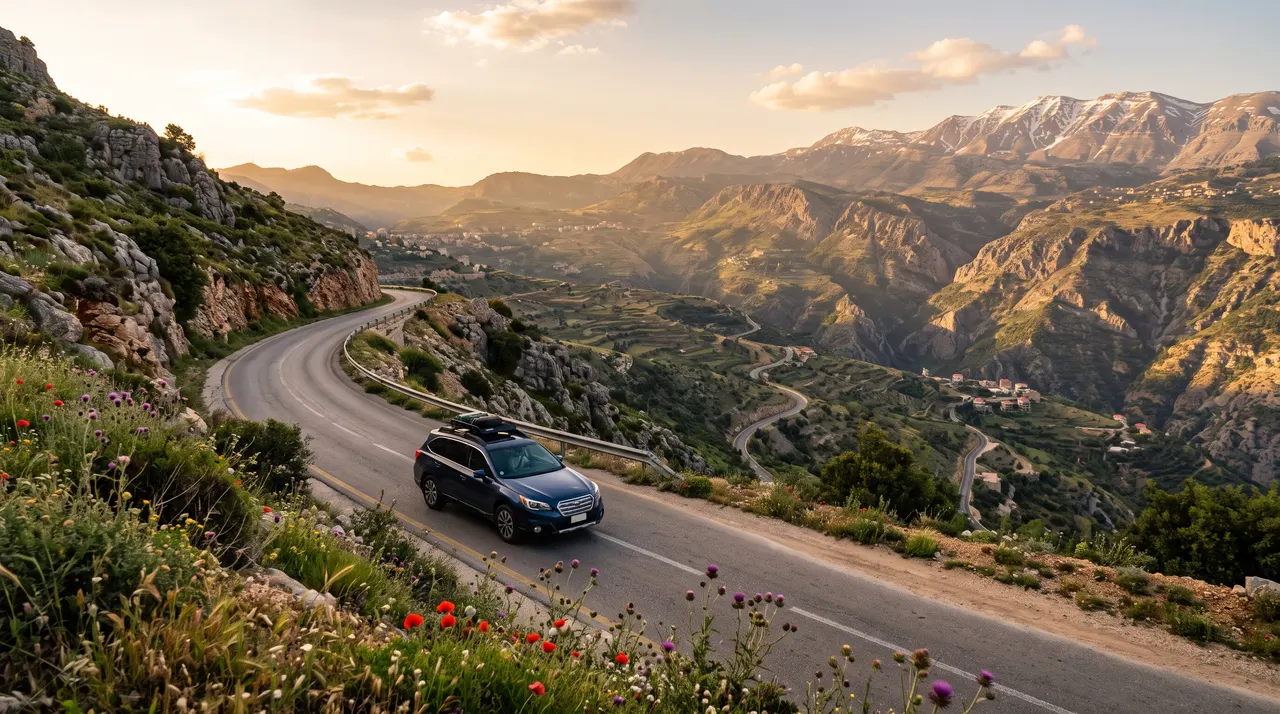
The mountain drive from Beirut up to Faraya-Mzaar climbs to about 1,650 m with sweeping panoramic views and is a route visitors specifically seek out.
Sources: internationaldriversassociation.com · stateofmind13.com · tyremap.com · lebanoninfocenter.eu.org
Lebanon · common questions
What rental desks in Lebanon ask foreign drivers for
| Rental company | Policy for foreign licences in Lebanon |
|---|---|
| Hertz | Asks foreign drivers for a licence translation when the licence is not printed in the Roman alphabet, and often for non-EU renters in much of Europe. |
| Enterprise | Asks for a licence translation alongside your home licence in many countries across Europe, Asia and South America. |
| Alamo | Asks for a licence translation when the licence is in a non-Latin alphabet, and suggests one for all international renters. |
| Budget | Asks for a licence translation when your licence is not in the Roman alphabet. |
| National | Asks for a licence translation for non-Latin-alphabet licences and where local rules call for one. |
| Thrifty | Asks for a licence translation in select countries and for non-Roman-alphabet licences. |
| Sixt | Asks for a licence translation for licences issued outside the EU and not in the Roman alphabet. |
| Avis | Asks for a licence translation where the national licence is not in the Roman alphabet or where local rules call for one. |
Beirut desks request an IDP for non-Latin-script licences. Minimum rental age in Lebanon is typically 18+, with a young-driver surcharge usually applied under 25.